WORK AS A HOBBY (Agenda, 2008 Issue 02, p.18,19)
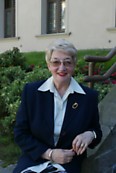
WORK AS A HOBBYHE Dr. Halina Kobeckaite, Ambassador of Lithuania to Finland Recently posted to Finland, HE Mrs Halina Kobeckaite was Ambassador to Estonia, Turkey, Azerbaijan and Uzbekistan and also Advisor to the President of Lithuania. She advocates for human rights of minorities and women. A member of both the Writers and Journalists Guilds, she has been prestigiously awarded for diplomatic services and translations, both for Lithuanian and foreign institutions.
 You are the translator of over 20 books, academician for 20 years, and a diplomat since 1994. What part of your work do you like most?
What I like most about my work is the work itself. I like everything I do. I kept up my translation work all through my studies and my ambassadorial postings. When I studied in Uzbekistan, I tried to meet as many authors as possible, so I could get to know their style and their way of speaking and thinking, in order to “get inside their head” and translate them as accurately as possible. I translate mostly fiction. At the beginning of March Calykusu, my latest translation work from Turkish, was published. The book is a beautiful and popular novel about a little girl with the same name and was written in 1922 by R. Guntekin. It has been widely translated and also been brought to screen as a movie. The other book I recently translated is from Polish, written by psychotherapist Maria Molicka, Therapy Tales. It contains short tales telling parents what to say in order to help their children in different situations, such as when they are ill, when they need to go to hospital, when they have to grieve somebody’s departure. It is a currently a bestseller in Lithuania and first in the top ten.
How many languages do you speak?
Lithuanian, Polish, Russian, Karaim, English, Turkish, Uzbek and Azerbaijani - Karaim is a Turkish language and, being my mother tongue, it was easy for me to expand to learning other related languages. I studied Uzbek in Tashkent and went for post doctoral studies in Moscow. Thirty years later I was appointed Ambassador to Uzbekistan, and I met again my authors; I can’t tell you the joy we shared.
Several countries celebrate Mother’s Day and Women’s Day in March and since 1991 you have been vice-chairman of the Lithuanian National Commission of UNESCO, which is responsible for women’s issues. Has being a woman affected your professional life?
In Lithuania, being a woman or a man in professional career sense does not matter. What counts is the level of professionalism. We have many women in high positions, and we do not have any need to promote women or to establish a quota of women in different areas. In Lithuania, over 20% of Parliament is women, three are members of the government, and one lady is an EU commissioner. 55% of Foreign Affairs Ministry employees are women and, from a total of 40, we also count seven ambassadors - I’m the first woman ambassador in Lithuania, by the way. In business, at an economical forum, we realised that 60% of small- and medium-sized enterprises in Lithuania are led by women. In my postings I was always taken seriously, regardless if I was in Turkey, Estonia, Azerbaijan or Uzbekistan.
You also belong to the ethnic minority of Karaims, a Turkish related minority in Lithuania. In a number of countries belonging to an ethnic minority is an impediment to one’s career. Did it play any role in yours?
Lithuania has a long history of different ethnic groups sharing the same territory, from 600 years back when the Grand Duchy of Lithuania was the largest country in Europe, including today’s Belarus, Ukraine, and parts of Poland and Russia. As far as one is a citizen of Lithuania and can speak the official language, Lithuanian, the doors are wide open, regardless of its ethnic group. I am glad to say that nowadays Russians have no problem in speaking Lithuanian, although this used to be a problem in the past. Concerning Karaims, there are about 250 people from this minority in Lithuania, brought from Crimea in 1397 and settled mainly in Trakai, later in Panevėžys. Because of our own history there is a large tolerance towards minorities. When I started my political career in 1989, I was named the Director of the Department of National Minorities, at a time when there was absolutely no law for minorities. So we made the law, presented it to the parliament and it is still functioning without major changes or complaints.
Lithuania celebrated 90 years of independence on February 16th. What are your thoughts related to independence?
In 1253, the first state of Lithuania was founded, in 1256 we had our first king. After our glorious history, in the 19th century we were under the rule of the Russian empire for 120 years, but we kept our feelings of national dignity and dreams of independence alive. In 1918, we restored our freedom, our statehood and economy, and we became members of the League of Nations, until 1939 when we were once again occupied. In March 1990, we regained our independence. It is very important for us that we restored it twice in one century.
The priority of the second term of your president is “bringing European welfare to each and every home in Lithuania and building a Lithuania where nobody is forgotten.” How can this be achieved and how do you cope with young labour moving abroad in search of better wages?
The restoration of independence had for us a European meaning – we have always been in Europe geographically, but since 1990 we are in Europe politically again. First of all I should say we are very happy to enjoy the mobility that accession to the EU and Schengen space brought us, but this aspect has two sides. On the minus side is the fact that we lost about 10% of our population in the last few years, mainly young people who went to work abroad.
On the positive side, the fact that they work abroad brings them a solid professional and life experience. Our government prepares a strategy to attract this labour force back into Lithuania. In Finland, we have about 500 people, usually well-educated, and they work in banks, as engineers or in high technology. Indeed, our priority is to raise the level of life of our citizens, and I am glad to say that poverty is not our main issue anymore. Our main topics of discussion in Lithuania at the moment are elections; investments - of which we would need more -; energy because we rely too heavily upon imports of oil and gas from Russia, and we need to find our way to energy independence; and education reforms and teacher salaries. Of course, one of the hottest issues is Vilnius as a Capital of Culture in 2009, the year we also celebrate 1,000 years since the name of Lithuania was first mentioned.
Interview by Denisa Udroiu, published in Agenda, magazine for the diplomatic community in Finland, www.agendafin.com

Social media