WEIRD AND WONDERFUL VILNIUS (City Paper, No 108, May 2008, p.14-15)
Vilnius is a city saturated in folklore, culture and in a word, wackiness. This vibrant capital boasts an excitement and mystery within it's streets that captivates an increasing number of tourists every year. What other city can include: a monument to Frank Zappa, a break-away republic, a giant egg and a wishing square amongst its attractions? To add some more amazement upon the traveler, all this wackiness is created within an UNESCO site chosen mainly because of its splendid Baroque architecture.
Walking down Pilies gatve one cannot help but gasp in awe at the site of Gedimino's castle towering above the town. The castle itself has a unique story behind its conception and is considered to be the first building in Vilnius. Legend tells us of a time Grand Duke Gedimino was hunting near Sventaragus valley. As night approached the Duke decided that it was too late to return to his home in Trakai and he set up camp in the forest. That night he dreamed of an iron wolf standing on top of a hill howling. In fear the Duke tried to shoot the wolf with some arrows but they just bounced off his iron sides. The wolf howled so loudly its echo sounded as if hundreds of wolves were howling from the forests. Upon wakening Gedimino asked the pagan priest Lizdeika to interpret the meaning  of his peculiar dream. Lizdeika told him "What is desired for the ruler and the state of Lithuania is thus: the iron wolf represents a castle and a city which will be established by you on this site. This city will be the capital of the Lithuanian lands and the dwelling of their rulers, and the glory of their deeds shall echo throughout the world".
Below this castle sits a breath-taking cathedral, a fine example of the classical architecture that can be found in Vilnius. However, even this seemingly innocent building has a quirky little secret just outside its doors! Tucked in amongst the ordinary paving stones between the cathedral and the bell tower you will find a not-so-ordinary stone. The stone marks the spot where a human chain of two million Balts joined Tallinn with Vilnius ended, and it has become a symbol of freedom and hope. Embedded into the tile is the word "Stebuklas" which means miracle in Lithuanian. A common sight in the Cathedral Square is tourists spinning clockwise on random tiles. It is said that if you stand on the tile and turn a full 360 degrees your wish will come true however, you cannot be told where to find the tile, or it won't work!
This quirky sense of humor is evident throughout the city. Take Uzupis as an example. Uzupis is often described as the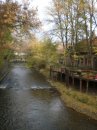 Montmartre of Vilnius and its name means "on the other side of a river". Uzupis was traditionally a Jewish area of the city but was left abandoned after the Jewish population were killed or expelled from the city. It became a haven for artists and squatters and in 1997 declared itself a republic complete with a president, flag, currency, constitution, an embassy in Moscow and an army (with approximately 12 members). This tongue-in-cheek Republic chose April 1st as their Day of Independence, choosing to share the celebration with the traditional fool's day. Film director and musician Romas Lileikis is the President of Uzupio Respublika keeping with the creative undertone of the area. Interestingly, three of the four honorary citizens of Uzupis are also artists.
The three artists are Jonas Mekas, known as the godfather of "avant-garde cinema", Ugne Karvelis a well known writer as well as the Lithuanian ambassador to UNESCO, and Zeonas Steinys a much loved local painter who died in 1998. So loved was Steinys that on April 4th 2001, a statue of an angel blowing a trumpet was unveiled in the town square in his honor. The angel symbolizes the revival and artistic freedom of the district, and it was wished by the Dalai Lama (the fourth honorary member of Uzupis) during his visit in 2001, that the Angel's horn would sound throughout the world.
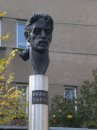 Uzupis' amazing dedication to artists is probably most evident in the bronze cast of Frank Zappa. The concept was created by a Zappa fan Saulius Paukstus and created by Konstantinas Bogdnas, a sculptor who was frequently employed by the soviet bureaucrats in Moscow to create Lenin and Stalin casts. After the death of Zappa, Paukstus felt that his idol should be remembered in an iconic fashion and hence the idea of the cast was created. He founded the Frank Zappa fan club and used it to raise money to create the sculpture. He then convinced the town council to allow the sculpture, supposedly using Zappa's Jewish features and connecting them with the history of Jewish people who died in Vilnius in his argument for the project. His argument was successful and the council agreed to allow the statue.
The first Zappa statue in the world was opened in a lavish ceremony. The bohemian Czech President Vaclav Havel was invited to the opening, a military brass band churned out Zappa hits and one of the radio stations began a weekly Zappa broadcast which included extracts of wacky Zappa philosophy. The fan club membership ballooned and the Zappa love letter club was set up for lonely hearts. Perhaps the wackiest part of the whole ceremony was that it took place in a car park, a car park which hundreds of confused tourists visit each year searching for the statue of the man, who is possibly best known by the world for naming his children Moon Unit, Dweezil and Diva Muffin!
This wonderful flair for fun is visible all over Vilnius. Festivals are community events full of color, costume, music and dance. Pilies street is a haven for young buskers trying to earn their way and improve their art sitting amongst the classical architecture and blending perfectly. It is an example of how well Vilnius old integrates with its new.
Stalls full of local goods and amber are dotted throughout the city generally accompanied by a local person willing to tell you the legend of an unhappy love between the goddess Jurate and a local fisherman Kastytis. The god Perkunas discovered the affair between the goddess and the mortal and in a fit of fury struck a bolt of lightening into the sea shattering the amber palace that they shared. Kastytis drowned. Ever since the sea has been washing up fragments of the palace, and when smaller pieces come ashore they are believed to be Jurate's tears after her beloved fisherman.
A city of legends and legacy Vilnius is unique. It boasts sights and scenery to rival any of the great European capitals. It has a history full of struggles and perseverance and success. Most impressively, it has a wonderful and weird personality that is the envy of other capitals but is only to be found in Gedimino's city.
By Louise O'Dwyer

Social media