VILNIUS: THE CITY OF FREEDOM (Meridian, No 34, April/May, 2007 )
My first visit to Vilnius was truly unforgettable. It was at the end of 1990, and an acquaintance from Kyiv University said something intriguing: “You have to visit Vilnius in the spring. If you don’t, you’ll regret it the rest of your life.” Fortunately, in those days a Student ID card was the only visa you needed for the journey to Lithuania, and a train ticket cost considerably less. So a group of seven Ukrainians dressed in jerseys and old military overcoats set out from the Kyiv station to discover Lithuania.
Carnival Lithuanian style 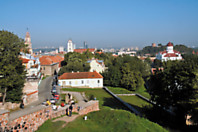
Our train arrived in Vilnius, the capitol of Lithuania, at about three in the morning, making our first impression of the city as some kind of parallel reality even more intense. Stotis (“stand up”) was the first Lithuanian word that our company learned, and it certainly described the station. The plank floor of the second story of the Vilnius station was extremely slippery. Besides, it was crowded with almost fabulous creatures with long hair wearing all kinds of necklaces, ribbons, and bellbottoms. Some of these hippies were sleeping. Others were strumming guitars quietly. This motley crowd had arrived from different corners of the Soviet Union to see Kaziukas, the holiday of spring and music. For them — and for us as well — it became a real holiday of freedom.
Officially, this holiday is called the “Day of Saint Kazimir,” the city’s patron saint, whom Vilnius’ inhabitants lovingly refer to as Kaziukas, a nickname for Kazimir. During similar holidays—and there are many of them in Vilnius—the old city becomes a sea of pedestrians, transformed into a medieval fair of folk wares for several days. Here you can taste national food and earn some money singing Ukrainian folk songs on a self-made stage. When our company found itself in the old city, we were overwhelmed with emotions. It reminded us of Andriyivskiy Uzviz, one of the oldest streets in Kyiv... only one hundred times as big and full of friendly and hospitable people. As we traveled down cozy backstreets, happy people—many of whom were dressed in a sort of Lithuanian embroidered shirt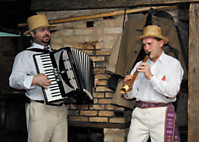 — smiled at us from every corner.
What impressed us next were Vilnius’ cafes. The sheer number of cafes per square meter rivals only Lviv in the Ukraine. Each cafe has its own distinctive charm and atmosphere. In some of them, come prepared to watch soccer over a mug of beer. Others have romantic semi-darkened interiors with quiet music, clearly designed for people in love. I immensely enjoyed a small urban delicatessen that I came across during this unforgettable visit. For years, from morning till night, its owner played nothing but songs by Tom Waits, an American singer whose music appeals to b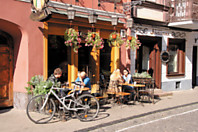 rave, quiet, sensitive souls.
It was also in Vilnius that my friends and I discovered an enigmatic drink that instantly warms you and makes you both cheerful and mentally alert — Lithuanian mulled wine. It’s a mixture of several different red wines brought to a boil, generously flavored with nutmeg, cinnamon, and pepper, and served in high glasses with a straw. You can be sure that patrons often order a second round.
Dreams of a Howling Wolf
Every time I visit the Lithuanian capital, I admire its tidiness and the cultural level of the local population. During our first visit to Vilnius, these traits even caused a slight culture shock. For example, before pouring something into our cups — which in our view were already snow-white and clean — our Lithuanian colleagues went to the dormitory kitchen to wash them with soda water. And after dinner, Vilnius’ students suggested playing some of their favorite games. They were so innocent! Here we were, students who, back in Kyiv, were in the habit of finishing off the third box of beer at three in the morning and testing the strength of the dormitory walls by battering them with musical decibels, yet somehow we became quickly fascinated by their cultural pastimes. It must have been a miracle! It did prove how quick-witted we were, at least. Female Lithuania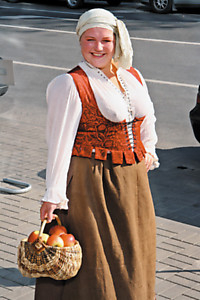 n students just about fell over laughing watching us Ukrainians try to do charades of a boiling kettle or a ship’s anchor.
Lithuanians simply adore their capital and treat their history with special reverence. Local students, with whom we stayed the night, told us about the real and legendary past of Vilnius with the finesse of professional guides. As it turned out, a great Lithuanian prince, Gediminas, founded Vilnius in 1323. According to an old legend, he had been enjoying a hunt along the banks of the Neris and Vilniale rivers. Becoming tired, the prince lay down to have a rest and dreamed about an enormous iron wolf, howling loudly on the mountain. In the morning, the prince called for a priest and asked him to interpret the strange dream. The priest gave the following interpretation: the wolf symbolized a city and a castle that the prince would found there, and the city would become the capital of all Lithuania. The wolf’s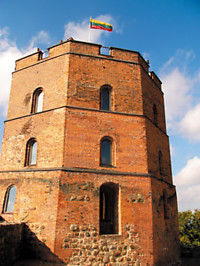 howl was the glory that would spread all over the world thanks to the many virtues of the city’s population.
Gediminas was a wise prince, and he immediately sent numerous letters to Europe inviting artisans, merchants, and monks to move to the new capital, offering them many benefits. The idea worked: the stream of immigrants was as strong as it would be to America in the future. In 1387, Lithuania adopted Christianity, and Vilnius was granted the right to self-government — the Magdeburg Right.
As far as Vilnius’ population is concerned, the wolf didn’t howl in vain—and quite probably, sang in his own unique way — in Gediminas’s subconscious. Vilnius’ inhabitants, like all Lithuanians, are a very kind, tolerant, but at the same time, proud, people. The city has always been a hospitable refuge for many peoples. For example, the Jews were never persecuted there, and at the end of the 19th century, they made up 40% of the city’s population. By the way, the time when most of Ukraine’s lands were part of the Grand Duchy of Lithuania (the 14th and the 16th centuries) is considered the quietest and happiest period in the history of Ukraine. Even today in Vilnius, with a population of half a million, only slightly more than half are Lithuanians. The rest are Poles, Russians, Belorusians, and Jews. The citizens of Vilnius never scowl when people speak to them in Russian. And if you say that you come from Ukraine or start speaking Ukrainian, you’ll be invited for coffee. But if you say a few words in Lithuanian, you’ll definitely be treated to something stronger!
Lithuanian women deserve a special mention. They are beautiful, generous and patient as well as refined. A Lithuanian woman, for instance, might cry half the night, hurt that her boyfriend doesn’t care for the classical music they heard that evening in the Philharmonic Society. A Lithuanian woman, like Decembrist’s wife, will follow her husband anywhere, oblivious to comfort, taking care of the house and raising the children. She considers that her husband is a great poet who will one day be appreciated and for that she is ready to endure everything. No surprise that one fellow from our company married a Lithuanian woman a year after our first visit, and another did so three years later. To this day, they have no regrets.
From Gediminas’ Towe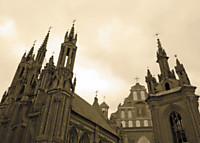 r to Frank Zappa
In the spring of 1991, Vilnius became not only a refreshing taste of authentic Europe inside the suffocating USSR, but also a real textbook illustration on architecture for our company of students. As we came across a mixture of Gothic, Renaissance, Baroque, Modern, and Classical architecture, we felt as if we were traveling in time. We started our excursion around Vilnius at the traditional spot, Gediminas’ Tower, an interesting example of Gothic architecture and the emblem and symbol of not only Vilnius but also of all Lithuania.
Previously, you could get to Castle Mount where the tower stands, only along a spiraling stone path, constructed almost 100 years ago. However, for four years now, there has been a cable car. (This will surely remind you of Kyiv.) When going up to the observation area, we ascended some fascinating, very narrow stairs that circled from left to right, unlike the Kyiv Great Lavra belfry or stairs in high rises. It turns out that the ancient architects deliberately made the climb difficult to discourage invaders. On such stairs it is difficult for enemy soldiers, brandishing swords in their right hands, to attack, but very easy for defen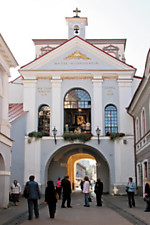 ders to fight.
Later there was another masterpiece of Gothic architecture — Saint Anna’s Roman Catholic Church, built in the 16th century. It was during one of our next visits to Vilnius that I heard a story about Napoleon Bonaparte. In 1812, the remainder of the once-invincible French army was retreating home through Vilnius. When the emperor saw Saint Anna’s Church, he liked it so much that he wanted to bring it back to France. Fortunately, more pressing problems prevented him from doing that.
Then hospitable Lithuanians directed us to the Renaissance Saint Gate (“Ausros Vartai” in Lithuanian) that is in the protective wall of the old city. As was explained to us, when you go through the gate, if you make a wish — a good one — it will definitely come true. Mine, for example, came 100% true!
Amazingly, our entire company of Ukrainian students somehow unanimously fell in love with the Lithuanian language. At night we often stopped in some old district under a lit window and listened to the sound of pleasant Lithuanian — incidentally, one of the oldest languages in the world. And it didn’t matter who was talking or in what tone — whether it was the soft chatter of youths or the cursing of a pensioner with her tipsy husband. We just enjoyed the rich phonetics and magic Lithuanian intonations!
After this first and particularly memorable visit to Vilnius, I returned many times, and each time I would admire or discover something new there, hitherto unseen or unnoticed. For example, I was just flabbergasted when once in Kalinausko Street I saw a monument to American sin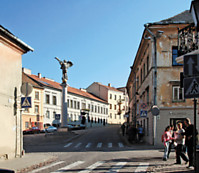 ger, guitarist, and composer Frank Zappa. It must be the only one in the world!
Vilnius seems not to have grown old during the last fifteen years but, on the contrary, has even gotten younger, since the city keeps growing. By the way, the modern high-rise districts of the Lithuanian capital that have emerged recently like mushrooms after the rain don’t spoil the impression of old Vilnius by any means but complement them. When seeing Vilnius’ new buildings you have a feeling of tidiness, comfort and excellent taste.
In 2009, Vilnius will be the first city of the new countries joining the EU to become the cultural capital of Europe. It’s quite an appropriate decision! But in my own view, Vilnius has been the capital of Europe for fifteen years already, ever since my first visit to the Lithuanian capital as a student. Of course, there are a lot of wonderful and glorious cities on the continent, but for me, as well as for all my colleagues on this unforgettable trip; it is Vilnius that still personifies all European refinement, allure and mystery. For me, Vilnius will always remain the symbol of Europe and real freedom.
By VIKTOR YAKYMENKO

Social media