


TRANSPORT SPEED IN CENTRAL AND EASTERN EUROPE DOES NOT MEET THE NEEDS OF THE 21ST CENTURY, LITHUANIAN FOREIGN VICE-MINISTER SAYS
Transport speed in Central and Eastern Europe is too slow. Therefore, there is a need to take more active action in order to solve this long-standing challenge, Lithuanian Vice-Minister of Foreign Affairs Egidijus Meilūnas said on 18 May in Vilnius at the conference “The EU Transport Policy White Paper: Challenges and Opportunities for Europe and Lithuania”, which was co-organized by the MFA and Ministry of Transport and Communications. According to the Vice-Minister, differences in transport infrastructure development throughout the EU and associated consequences present one of the greatest challenges for the region.
“We have half as many train runs than the EU average. We are also 2.5 times behind the EU according to trunk road density. This is a problem of the entire region. It takes more than ten hours to get from Vilnius to Warsaw, and about seven hours by car to cover a distance of 450 km. Do you agree that the speed of 50-60 km/hr is not the 21st century speed? Imagine that by train it takes three hours to get from Vilnius to Warsaw, and another three hours to get from Warsaw to Berlin. We could have such a vision and pursue it,” Vice-Minister E.Meilūnas said.According to the Vice-Minister, we must take concrete steps to ensure better transport links across all European regions.
 “In this context, it is especially important to continue to successfully develop a cooperative pan-European transport network, and it will be possible if the continuity of the cohesion policy will be ensured in the new EU Financial Perspectives (2014-2020),” Vice-Minister E.Meilūnas said.
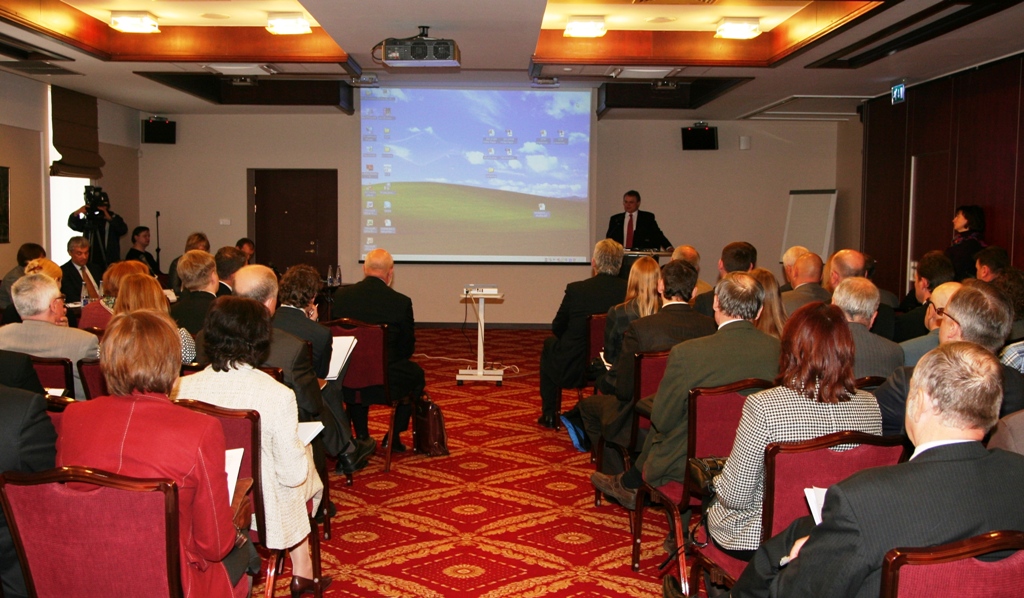
Participants of the conference “The EU Transport Policy White Paper: Challenges and Opportunities for Europe and Lithuania” discuss the plan that was outlined by the European Commission - “Roadmap to a Single European Transport Area – Towards a competitive and resource efficient transport system” – the initiatives that it foresees and their impact on Lithuania’s transport, environmental and economic sectors.
At the conference, results of the study by company Jaržemskis ir ekspertai of Lithuania’s interests in the context of the review of the guidelines for the development of the trans-European transport network (TEN-T) were presented to the participants.
The event is attended by representatives from the Ministry of Foreign Affairs, guests from the European Commission, authors of the study, transport specialists and experts.
Social media


