TOGETHER WE ARE STRONGER (Balticness, autumn 2009, p.1-4)
Interview with the Lithuanian Minister for Foreign Affairs Mr Vygaudas Ušackas
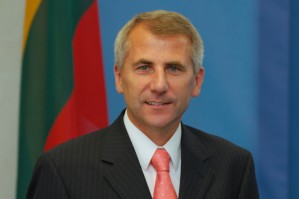 Lithuania takes over the CBSS Presidency in the most challenging of times, economically and financially. The ongoing crisis has hit the region fairly hard. Challenges like climate change, sustainable energy production and cross-border crime are all difficult, complex and potentially expensive to address; tackling these challenges with efficient and shared political actions will require strong resolve. The CBSS, naturally, is not an instrument to solve the financial crisis, but how do you see the potential for CBSS input on some of these other challenges that the region is facing during your presidency?
The current economic situation presents the Lithuanian Presidency of the CBSS, as well as all the CBSS Member States, with an additional challenge of how to keep the organization up and running. In addition the CBSS is currently undergoing a transformation from being a forum for political dialogue to rallying the countries to initiate and implement strategic projects of regional importance in the priority areas agreed upon by its members. It is for the Lithuanian Presidency to seek to finalize this reform despite the financial crisis.
In this respect it is a well known truth that challenge is a unifying force which, if handled well, opens new windows of opportunity.
The underlying principle has to be connectivity. Creating transport links, integrating energy networks, using renewable energy sources, liberalising visa regime for all countries in the region – these are just a few specific tasks, on completion of which the Baltic Sea Region would also become more competitive and unified.
Challenges in our region are many indeed: dealing with the negative effects of the current financial and economic crisis, a lack of energy security, the ecological vulnerability of the Baltic Sea Region due to environmental deterioration, climate change, and the threats posed by large scale infrastructure projects, dumped chemical weapons, and rapidly increasing oil tanker traffic, as well as threats to civil security, such as deterioration of living conditions, the spread of new pandemic diseases, drug and human trafficking, and child abuse. None of these issues can be solved by individual countries alone. Together we are stronger. The Baltic Sea Region is often called one of the most dynamic and innovative European regions. Today, while confronted with economic and financial challenges, we continue to look forward. As national economies begin to recover, competition between states and whole regions will grow, as each of them will strive to occupy a better starting position. We should identify priority fields that would require our increased attention and resources, because they will determine the dynamism of development both in the region and the whole of Europe. The CBSS together with its partners could develop a vision of the future of the region where the responses to key challenges as well as potential areas of future cooperation are defined.
In the opinion of the Lithuanian Presidency, among the tasks to be included in such an overview, energy and the environment should be singled out. We need to find ways to use alternative “green” resources which would both help to secure energy supplies in a region poor of natural resources and deal with the problems relating to climate change.
The improvement of transport infrastructure should also be high on this list of priorities. Our aim is full integration of the transport infrastructure of the Baltic Sea Region into the Trans-European network. Travel by rail from Vilnius to Warsaw, Berlin, or Kaliningrad, Russia should be a matter of two to three hours, and not eight or twelve hours as it is today.
Then, there is the problem of how to increase people-to-people contacts as this gives knowledge by experience, enhances creative powers, helps foster the growth of our civil societies, gives more self-reliance and unites efforts in striving for higher living standards. For this, we need to facilitate communication across borders. We need to continue visa facilitation for Kaliningrad Region of the Russian Federation and Belarus, and gradually move towards the creation of a visa free regime, starting with Kaliningrad and eventually embracing the entire area surrounding the Baltic Sea.
We must work to build regional innovations networks by promoting deeper cross-Baltic cooperation and integration of universities, science and research centers, and improving knowledge mobility.
The CBSS has already had a strong input in all the above-mentioned areas through expert groups and project activities. And we shall continue in these challenging times to look for the areas where we could best guarantee our added value, notably by increasing synergies with our strategic partners and other regional organizations. A coordinated approach to priorities and actions by different players in the region is an important instrument in mitigating the consequences of the current economic crisis and laying a solid foundation for the region’s future growth. The CBSS should play an active role in this process.
Lithuania has chosen innovation as its first priority during its presidency. This issue, although recognised as highly important by the previous presidencies, has never topped the agenda. What was the motivation behind choosing innovation as the main priority? Can you outline what you would like to achieve in this field during your presidency?
The CBSS has successfully worked to develop an overall framework for trade and investments as well as to increase cross-border cooperation. However, the results would be even better if we had paid more attention to innovations. Some of the countries in the region are listed among the most innovative in the world, others are catching up. The economic downturn requires an urgent action for change; and innovations are the way to go. Innovations can ensure sustainable development, economic competition, a safe and secure social environment. The Lithuanian Presidency is planning a variety of international seminars, conferences and meetings dedicated to innovations. We hope this will encourage progress in technology transfer, energy, creative industries, transport, and other fields. In particular we intend to organize a workshop with experts from all interested countries in the region to discuss the necessity of establishing a new CBSS expert group on innovations/ technology transfer, and to identify possible priority fields in this area.
Lithuania will encourage active participation of the neighbouring Kaliningrad Region of the Russian Federation and the Republic of Belarus, which is now a CBSS Observer State, in implementing its presidency priorities. Due to a common geography and cultural heritage, Lithuania has a special relationship with both areas. What are your main aspirations and expectations about this new focused cooperation?
The Kaliningrad Region of the Russian Federation and the Republic of Belarus are Lithuania’s immediate neighbours with strong historic and cultural links. We regard them as an inseparable part of the Baltic Sea regional cooperation. So we welcome the granting of CBSS Observer State status to Belarus, while the Kaliningrad Region as part of Russia has already been enjoying the benefits of CBSS cooperation for some time. Lithuania has a special relationship with the Kaliningrad region. We are the second biggest investor there where we cooperate on environment and health protection as well as in the development of common infrastructure projects. It is our wish and strong interest that similar links of cooperation are extended to Belarus. I am deeply convinced that it is necessary to establish ever closer people-to-people contacts with our neighbours on the other side of the Schengen border, to encourage educational exchanges, tourism, and cultural ties as well as youth cooperation.
It is our opinion that the CBSS should make an effort to have a better established dialogue and cooperation with the Kaliningrad region of Russia and Belarus. The CBSS has already implemented one very successful regional project, namely the EuroFaculty at Kaliningrad State University, aimed at upgrading university education in Law and Business Economics/Business Administration. As a further step, the Lithuanian Presidency has proposed the organisation of a CBSS Committee of Senior Officials (CSO) meeting in Kaliningrad in December to look into the possibilities of involving the Region more tightly into the CBSS project activities. CBSS offers good opportunities for this kind of activities and has developed a good networking capacity in this area. Our request has been met by the local authorities with warm reciprocity, and we are looking forward to finding a constructive way forward.
An important issue during the Lithuanian Presidency for the region will be the beginning of the implementation phase of the EU Strategy for the Baltic Sea Region. The adoption of the Strategy is one of the priorities of the current Swedish EU Presidency. The presidency’s ambition with the Strategy is to develop the EU’s macro-regional cooperation. How do you personally envisage the role of the CBSS within this Strategy?
The main features of the future vision of our region that I have just pointed out are in perfect accordance with the forthcoming EU Strategy for the Baltic Sea Region. We believe that this regional strategy – the first of its kind in the history of the EU – will provide a new impulse for the extension of cooperation between all states in the Baltic Sea Region. The success of implementation of the Strategy will also depend on the involvement in the process of current non-EU members, such as Russia, Norway and Iceland. I would therefore strongly support CBSS joining in the implementation of the Strategy. How the CBSS can best contribute to the implementation of the Strategy is now a major topic of discussions during the CBSS Committee of Senior Officials meetings.
Bearing in mind that the CBSS is currently working on concrete projects, and all structures existing under the umbrella of the Council work on their specific issues, I see the implementation as a joint puzzle-solving effort. Each of the structures can find its own niche and role in the Strategy implementation and start its own targeted work. Already, at this operational implementation level, some of the CBSS-related structures, most notably the Baltic 21, the Baltic Sea Region Border Control Cooperation, the Baltic Sea Task Force on Organized Crime, complemented by the Task Force against Trafficking in Human Beings and the Working Group on Customs and Border-Crossing Aspects, have been given a concrete role in the Action Plan.
It will be up to the Lithuanian Presidency to complete the CBSS reform process, initiated by the Swedish Presidency in 2007 and taken forward by the subsequent Latvian and Danish presidencies. The reform aims at revitalising the CBSS and enhancing its capacity to focus on selected priority areas, as well as developing regionally important and strategic projects. How do you envisage this final reform phase? How do you see the work-plan over the next ten months?
As mentioned above, the reform of the CBSS is an ambitious and timely project.
At the time of the CBSS establishment in 1992 the main aim of the organization was to help eliminate social and economic disparities between the Eastern and Western coasts of the Baltic Sea. From then on the Council of the Baltic Sea States continued to solidify as a regional organization, winning respect everywhere in Europe, and we are pleased to note that our cooperation continues to be interesting to other regional organizations and individual countries (this year we have accepted three new Observer States – Belarus, Romania and Spain – into our family). But in order to be successful, any organization needs to be flexible and able to adapt to new realities. The presidencies of Sweden, Latvia, and Denmark have been very successful in responding to these both in substance and in form. There are still several crucial issues to decide upon during our presidency, and we will take them up during the CSO meetings later this year. These are, for example, the possibility and procedure of integration or assistance to other structures wishing to work closer with the CBSS. Another important item is how the CBSS will handle project proposals. All these aspects are rather new to us, they came together with the reform, and we have to deal with them as soon as possible to have the reform successfully completed. We hope that the 8th Summit of the Baltic Sea States to be held in Vilnius will adopt our decisions and give us new guidelines depending on the current situation.
This is the second time that Lithuania holds the presidency of the CBSS. With regard to the first Lithuanian Presidency in 1998– 1999, are there any issues or challenges that you feel remain important from that time that you would like to revisit, or to refocus on during this second Lithuanian Presidency?
With ten years between our two presidencies, despite all the changes that occurred in individual countries and the region, many issues and challenges remain the same. This demonstrates that some problems that we tackled during our previous presidency are long-term and important for the whole region. What do I mean by that? In 1999, when I was the Political Director in the Lithuanian Ministry of Foreign Affairs, I pointed out in one of the CSO meetings the importance of regional cooperation for establishing human contacts, achieving economic progress and developing tourism, and especially stressed the need of closer cooperation with the neighbouring Kaliningrad Region of the Russian Federation and the Republic of Belarus. After ten years this still remains an important issue to the Baltic Sea Region.
In addition to these questions, which were and remain urgent, new ones have appeared. They reflect changes and new challenges that are faced not only by the CBSS, but also on the global level. Of course, trafficking in human beings, children rights, illegal immigration, nuclear and radiation safety and others are not new, but they have gradually become an essential part of activities of many international organizations. I am convinced that those long-term goals will remain in the spotlight of future presidencies.
In 2009, Lithuania is also holding the presidency of the Baltic Council of Ministers, an intergovernmental cooperation format between Estonia, Latvia and Lithuania, established in 1994. Do you see any synergies between the agendas of these two Baltic forums, which Lithuania has the privilege of chairing simultaneously?
Much like the CBSS, other regional institutions also require a review of their priorities and working methods. The Baltic Council of Ministers was created as an institution of cooperation between the governments of the three Baltic countries with the aim to strengthen regional ties and help the Baltic States attain their foreign policy goals of integration into the European and Euro-Atlantic institutions. Similarly to the CBSS, energy security, environmental protection, enhanced cross-border cooperation with our Eastern neighbours top the list of priorities of the Baltic Council of Ministers for 2009. In my view, the implementation of the EU Strategy for the Baltic Sea Region should become another important cooperation objective in the framework of the Baltic Council of Ministers, meaning even closer synergies with the CBSS. Regional cooperation needs a coordinated approach in achieving commonly accepted priority goals; therefore synergies between all the actors in the Baltic Sea area should be further improved.
Some political analysts argue that the Baltic Sea Region should take steps towards building a political space by enhancing trans-boundary cooperation. This would help to set a common political agenda for the Region. What is your opinion and do you see a role for the CBSS in this Baltic Sea political space?
There is a general agreement among the Member States that the political dimension of the CBSS should remain strong. The question is how we can use the CBSS as the only Baltic Sea regional organization with a clear political framework encompassing all Baltic Sea countries? In my opinion the broad membership of the CBSS is its biggest advantage, also bearing in mind the dialogue of the Council– an intergovernmental body, with an inter-parliamentary body – the Baltic Sea Parliamentary Conference. This is why I strongly believe that CBSS has a strong position in the regional political landscape; all the more so now that in the Council we have eight EU member countries and three non-members sitting at the same table. Specifically, while focusing on concrete issues, the CBSS creates an environment for better understanding among participating countries and therefore, in our view, provides a natural platform for the ongoing development of EU relations with Iceland, Norway and Russia. I think that the future political landscape of the Baltic Sea cooperation will depend on the will of the governments and on the degree of involvement of parliamentarians in addressing challenges together and taking actions.
This year Lithuania is celebrating a millennium since its name was first mentioned. At the same time, together with Linz in Austria, Vilnius is the European Capital of Culture. The cultural programme, combined with the Millennium celebrations, is a unique, large scale, multi-institutional exercise. What concrete outcomes do you expect from this exercise? In this connection, do you intend to touch upon the need to brand the whole Baltic Sea Region?
The Millennium of Lithuania’s name and Vilnius European Capital of Culture have helped to attract additional attention from people all over the world. It is good for the tourism industry; it will help consolidate the image of Lithuania, and will make Lithuania and its culture more visible internationally.
On a wider scale this status of the Capital of Culture will positively influence the whole Baltic Sea Region. Lithuania is identified with the Baltic countries, especially Estonia and Latvia, therefore this cultural exchange, the preservation and sustainability of cultural heritage in their own way contribute to the strengthening of a regional identity. In a way, all praise we might have for our cultural events will be dedicated to the whole Baltic Sea Region.

Social media