THE RAIN IN SPAIN (Lithuania in the World, Vol. 16 September – October 2008, p. 4-7)
World expo draws to a successful close As the final month of Saragossa’s 2008 World Expo, Water and Sustainable Development, draws to its close, Lithuania’s pavilion continues to attract thousands of visitors each day, a testament to the hard work of the 25 or so people working at the pavilion, along with the many others who conceptualised, designed, constructed, maintained and participated in one of the most popular stops at the whole exhibition.
And for the visitors who dropped in during the long hot Spanish summer, this unpretentious “clear-from-the-other-side-of-Europe” country’s pavilion offered something that no other stop did: umbrellas. But no one ever used them.
Soaking wet
Nestling snugly along the banks of the River Ebro from June to September, the World Expo in Saragossa filled the 25-hectare site with its many dimensions of water, with ribbons and waves of white and glass-clad ultramodern structures, that housed amphitheatres, exhibition halls, rest stops, restaurants and all the pavilions in a user-friendly and efficient way, but one which was deemed practical to complement the seriousness of the theme.
In the midst of all this, the Lithuanian pavilion, on the second floor of the north façade, was neither the biggest nor the most glamorous of the 150 pavilions at Saragossa. However, the primary mission for any country that participates is exposure, to make sure that the visitor remembers at least the most fundamental aspects of the participating country, that the country exists, that there are people who live there, and that the country has something to offer. 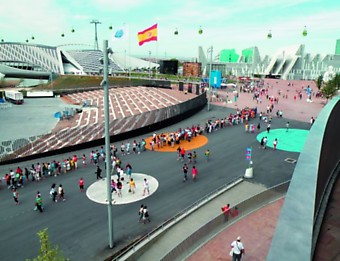
How each country does this is the key. For Lithuania, the government tasks mostly the Ministry of the Environment to deal with World Expos, and the ministry’s main man is Romas Jankauskas, the director of public information and public relations. Despite the other duties he has within the ministry, Jankauskas has found World Expos to be his “full-time part-time” job, as he takes care of announcing tenders, developing themes, hiring people and firms, and clocking up many hours of flight time.
“The main task of any country at World Expos is to tell people we are here, who we are, and where we are,” Jankauskas says.
“This can be done in many different ways. Some pavilions show long films, while others just sell goods. Our idea is to force people to remember the name of our country through the things we do well. We make good beer, we have amber, basketball, and, of course, we have plenty of things to say about water management and resources, and you can present these in many ways.
“I don’t know what’s better: to have a very serious pavilion with working terminals and statistics, with everyone coming in to spend time learning about what we produce; or to have a simpler approach with the idea of leaving a lasting impression. I have visited nearly all the pavilions, and there are just a few I remember well. I think Lithuania’s pavilion is easily in the top ten, according to this crucial criterion of simply remembering which pavilion you have visited.”
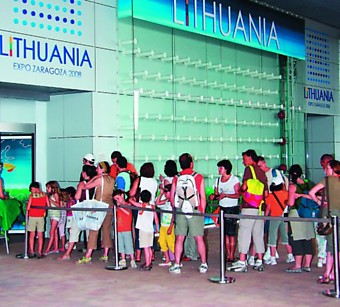
The pavilion chose an interactive approach. And the result? This could be seen best when standing outside, some metres away from the pavilion itself. On one side, a 100-metre-long queue of people stood patiently waiting their turn to enter, and on the other side people came out laughing and always smiling … and soaking wet.
El Seducción
Perhaps the hardest worker at the pavilion was its director, Neringa Vegytė. Working up to 24 hours a day (but not all the time), seven days a week (but with breaks), she maintained her bright and cheerful attitude at all times, even when she could easily have fallen asleep on her feet. Fluent in Spanish and attentive to detail, she had many tasks to perform each day and night, and one of the most important was taking care of special guests.
Having been in Saragossa since the very beginning of the Expo, she explains the essence of the pavilion: the idea of connecting Lithuania with Spain.
“Of course, virtually the only things Spaniards know about Lithuania are basketball and Sabonis.”(Arvydas Sabonis, retired, is Lithuania’s greatest basketball player, whose career included a seven-year stint leading Forum Valladolid and later Real Madrid basketball teams, where he won two league championships and one European Club championship for his Spanish teams.)
“So we constructed a sort of basketball pinball machine that covered the outside wall of the pavilion. But there was another idea. We wanted to put a telescope there to view the main cathedral of Saragossa, but for security reasons it wasn’t allowed. So instead, we made sure the glass on the front of the basketball pinball game offered a good reflection of the cathedral.
“Above all, we wanted to show our guests how creative we can be. So that when they saw the basketball, they would say ‘Oh, Sabonis!’ and we even have a basketball signed by him, which some people actually noticed.”
The basketball pinball machine kept people entertained while they waited to enter, and once inside … well, they found they could only do one thing: smile. This did not go unnoticed by Vegytė.
“I see their reactions every day. There are people who come from distant regions who know little about the Expo or Lithuania, and haven’t heard about the Lithuanian pavilion from their friends, so they come through the swing doors and they look and see our Rain House, and the children at first look in awe … and then they say ‘Ah, Mama,’ and they really are surprised.”
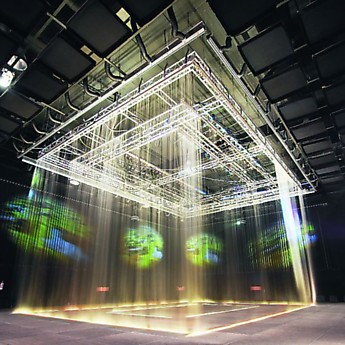 It is no wonder that the Rain House has surprised people. It was the culmination of an idea that the company Ekspobalta and its director Saulius Valius came up with after a chat with the Spanish ambassador to Lithuania. Valius discovered that, for Spaniards, rain comes in storms and floods, and they associate rain with trouble. So he proposed offering “friendly rain”, and this ultimately became the Rain House.
Just to go inside the Rain House, you have to walk all the way around it: two squares, one inside the other, of four walls of water that sounds and feels just like rain. Once you get to the end, if you want to go inside, you wait, and, from about eight metres above you, the rain stops and a little pathway opens, and in you go. But then a surprise: another wall of rain, so you stop and wait for the pathway to open, and go on further into the middle. There, you can view pictures reflected on the rain itself.
But something totally unexpected happened which took the staff of the pavilion very much by surprise. Spaniards, unlike, say, the more reserved Lithuanians, didn’t necessarily like to wait for the pathway to open. With average summer temperatures in Saragossa hovering above 30 degrees, a friendly rain shower was just the ticket, and the Spaniards would plant themselves straight under the rain. And they got soaked!
“Some of the people waiting to enter,” Vegytė explains, “would see people leaving. They would see people all wet, and they asked ‘Will we get wet too?’ And we would tell them ‘No, if you don’t want to, you won’t get wet.’ But usually everyone wanted to get wet, even older people.”
But this also created a problem. Believing that most people would not want to get wet, when the opposite occurred, a health issue came up: keeping the rain properly sanitised. The pavilion found that it had to clean the water all the time, and this wasn’t cheap. So the cleaning and sanitation companies said it would be much cheaper not to let people get wet. So for a week, no one was allowed into the Rain House, and this was unpopular, as Vegytė recalls.
“For five days, we didn’t let people go into the Rain House, and there were lots of complaints. They would say ‘My friend told me I could get wet here and enjoy your pavilion.’
“But then on the following Monday, the sanitation people, as if they, too, were getting some complaints, said ‘Neringa, please let people go into the water.’ I asked why? And they said that since we clean the water every day, it’s okay. And we were happy to let people get wet.”
The Rain House became so popular that some people, especially youngsters, would come decked out only in their swimming suits. The staff would let them ‘swim’ one time, but when they came back a second time, they would be politely turned away.
There were just too many people waiting for their turn.
Next stop: Shanghai
The pavilions also put on cultural events. The most important was the National Day, which for Lithuania occurred on 23 June and involved musicians, dancers and singers, as well as visits from prominent Lithuanians, and all through the summer, films, documentaries, art and music, as well as scientific lectures and forums, were offered.
What next? Although Expo Saragossa has yet to finish, plans for the next Expo endeavour are already under way. “Better City, Better Life” is the theme of the 2010 World Expo in Shanghai in China.
The challenge in Shanghai will be much bigger. Whereas in Saragossa eight million visitors were expected, in Shanghai the number forecast is 70 million.
“So there’s no time for relaxing and resting on our laurels,” explains Jankauskas. “The site there is nearly ten times bigger, and, as usual, we’re running full blast just to stand still. However, I believe that success in Saragossa will help us to get things moving now for Shanghai.”
*
Welcome to the Pavilion
Upon entering through the swing door, there is a sign greeting you in Spanish, “Welcome to Lithuania”, and a large placard with a rather serious welcoming message about the need to conserve water resources from President Valdas Adamkus.
The Rain House takes up the largest space, and interactive information stations are placed all around it.
The first gives general information about Lithuania.
The second gives information about Lithuanian flora and fauna from the Ministry of the Environment.
The third information station is about sound: music, nature and dialects.
The fourth is about water and sustainable resources in Lithuania: water resources and how Lithuania is maintaining and preserving them.
The fifth is about amber, one of the national treasures of Lithuania.
Another popular attraction is the “water table”, in which guests can make their own picture in a pool of water using their fingers. They “paint” a picture when the table senses the temperature difference, and, once completed, they can make a photocopy to keep as a souvenir.
At the front of the Rain House is the Bar, which has been very popular, and on another side is the Amber Shop, offering traditional Lithuanian gifts.
Upstairs, there is a VIP lounge, which is kept nice and cool, with space for 25 people.
By Aleksas Apynys

Social media