THE LIONS OF LITHUANIAN THEATRE (American Theatre, May/June, 2007)
The archetype of the auteur director continues to reign in post-Soviet Lithuania You’re not supposed to smoke in the café of the Vilnius Youth Theatre. Through thick blue clouds, the waitress begs director Jonas Vaitkus to stop. “Please,” she says. “People at other tables will want to know why you can and they can’t.” Vaitkus smiles with kind resignation, presses his cigarette into a pile of ash and pushes the saucer away.
 Vaitkus, 63, has been artistic director of two of Lithuania’s leading theatres, the Kaunas State Theatre (1977–88) and Lithuanian National Theatre (1989–95). He’s a freelancer now and busier than ever. His next premiere is at the Youth Theatre, founded in 1965 and is dedicated not to “youth” so much as to presenting bold and daring plays.
Vaitkus is one of four directors—along with Rimas Tuminas, Eimuntas Nekrosius and Oskaras Korsunovas—upon whom Lithuania’s strong theatrical tradition has come to rest. Independent now for 16 years and having recently gained membership in the European Union, the country is still economically poor. Yet Vilnius (pop. 700,000) has four legitimate theatres (three Lithuanian and one Russian), two children’s theatres, a world-class opera company and vital independent theatre scene. Festivals—such as the annual Sirenos in Vilnius—and internationally funded co-productions have raised Lithuania’s global profile further, and the country has become a social magnet and destination for European theatre lovers. It’s a bargain as well. Partly due to state subsidies, tickets are usually priced between $4 and $16, and shows are often presented with simultaneous English dubbing.
It’s also a theatre that is still deeply rooted in its history. “Lithuanian theatre appeared out of our singing, which is very deeply based in our culture, which is why it so lyrical, so poetic, so inventive,” says Audronis Liuga, prominent critic and head of the Lithuanian Theatre and Cinema Information Center. “Yet it remains quite archaic, rooted in the living mythology of people who are still close to paganism.”
The country’s first period of independence, from 1918 to 1940, brought a flowering of plays by new Lithuanian writers. In the early 1930s Michael Chekhov, in exile from Soviet Russia, taught and directed in Lithuania’s temporary capital, Kaunas, side by side with Stanislavsky-trained native Lithuanian actors. The 1940 Soviet occupation led more than a decade of brutality and mass deportations—but the Soviets also invested heavily in theatre. Young talents were sent to Russian schools like the prestigious GITIS (Russian Academy of Theatre Art) to train as directors and pedagogues. They returned to direct and teach the next generation.
Lithuanian artists of the period developed a theatre of metaphor and parable, now referred to as “Aesop’s language,” to articulate their situation—a style that went out of fashion in the revolutionary ’80s. “The real theatre was in the streets,” says actor/director Arvydas Dapsys. “In those days we sat wondering when the audience would come back.”
These days, without dispute, Lithuanian theatre belongs to its directors—and while many audiences and critics, including Liuga, posit a need for new models and dialogue—the directors themselves have their own agendas.
For the past hour, over wine and coffee, Vaitkus and his key actors have huddled in the back booth brainstorming about Ivona, Duchess of Burgundy, by the Polish writer Witold Gombrowicz. It is the beginning of the rehearsal process and his actors have been doing most of the talking. From time to time Vaitkus calmly drops a bombshell: “I had to assist the village mortician in preparing my father’s corpse. There was no one else.”
The actors are momentarily stunned. In a few minutes they will get on their feet and enter a painstaking, line-by-line exploration of the play. He will coax and coddle them to deeply grounded, multi-layered, bold yet subtle actions, in a three-month process. Vaitkus has been called tyrannical by some for his exacting perfectionism. But it is easy to find actors who revere him. “Working with Vaitkus is like learning to fly,” says one.
As Elona Bajoriniene, artistic director of the Sirenos festival, puts it: “Vaitkus is very strict in building a total theatre. He finds great collaborators and makes collages where set design, lighting and the actor are all equal elements of the performance. He demands total commitment from his actors, pushing them through a kind of Artaudian frontier. Earlier, he was a dictator. Now he’s moved away from that. He’s concentrating on the work with actors and going into the deepest territory of human psychology.”
KESTUTIS NAKAS: How has your creative process changed over the years?
VAITKUS: I never “lived through art” but rather made art by processing my own life. An artist can’t live one life in art and a different one in private. One inspires the other, as long as you are alive. Your conflicts and crossroads are what determine your projects.
But with experience comes the realization that the further you go, the less you understand. Why am I alive? What is death? How will I meet it? Since my language is the theatre, I want these questions to unfold on stage, here and now, in communion with actors and spectators. My relationship with the actors has changed. I look for actors who struggle to understand and resolve what’s within them. If they are too versatile or professionally slick, I’m not interested.
I pay attention to the actors’ individual points of view—their burning issues of life, death, family, daily life, politics, society. I take in their fantasies, their hurts. I bombard them with my own; from that is born an actual theme for the play. Meeting here and now we realize that issues vital to us could well be vital to our audience. This material becomes the substance of the message we’ll send. Then we have to find the right tools; the appropriate scenic materials, words powered by both meaning and emotion. It must all work on an emotional level so that the spectator cannot logically explain his excitement. He must encounter the torments or joys of what’s on stage as a provocation to meet death wide-awake and conscious.
In the Soviet times your plays were received with great hope and expectation. Do you still feel a responsibility to your public?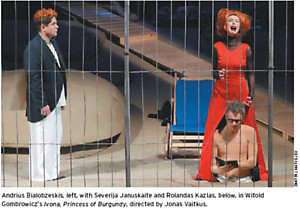
Before, there was a clear political structure: official censors, ideologues and propagandists. We were subject to all that. Now we are hearing more about what was really hidden behind that façade. We were all beggars, pressured and stifled. That put us all on one side of the barricades. We shared a common pain that we wanted to articulate: the pain of the state’s aggression and its destruction of the individual’s essential being, freedom, morals and family.
Now it is like the contents of a jar that sat and sat and then was suddenly overturned. As the disturbed sediment mingled, the ideologue and the censor disappeared along with all taboos. But now the sediment’s settled to the other side and what do we see? The new censor is even scarier, operating though greed and people’s desire to use each other without attention to spiritual contact or common understanding. The real artist is left even more isolated, deciding alone what to perform, what matters. It is easy to sense if an artist cares, if his surroundings, his society, world events, the troubles of others, the nature of his state matter to him. So that sort of concerned actor is basically the same kind of concerned artist as in the old days.
But today there are others who use the profession as a kind of personal trampoline to help themselves into the middle class. Then the censor was political, now the censor is financial. All that’s changed is that now you can truly know who is the actor and who is the merchant. Only there are fewer artists left who are sincerely interested in what’s going on, why there is so much injustice, untruth, brutality, falseness.
Can you speak about how you’ve trained many of Lithuania’s top actors and directors?
In teaching I just throw them in the water. There is no real teaching, just meeting them and giving them experiences and exercises that either liberate or poison them. Maybe the student will find out that he can’t live, work or communicate apart from the theatre. He needs theatre to live not as a vehicle toward money or success.
If a person needs to be an actor he will acquire the professional attributes he needs. He’ll train his voice and body in order to realize his vision. But without a burning vision or idea you can only become a professionally polished corpse. So first there is the hunger, desire for truth, and then his professional skills are motivated. He knows why he wants to sing, dance, fight, act. When he realizes that without skills he will not communicate, he will be driven to train himself.
 When Lithuanian director Rimas Tuminas turned down the artistic directorship of Moscow’s prestigious Vahktangov Theatre last fall, it was front-page news in Lithuania. The reason? His personal dedication to the Vilnius Small Theatre, which he established in 1990, the same year Lithuania declared its independence from the Soviet Union. “We are as old as independent Lithuania,” the 55-year-old auteur says proudly. His mission is to bring his lyrically poetic, text-based productions of classical and contemporary plays to Lithuanian audiences and to develop the work of like-minded artists.
Tuminas often co-directs with Arvydas Dapsys, an actor who has been working with him for over two decades. Tuminas is also known for a dreamlike style that draws heavily from non-realistic theatre traditions. Several years ago he produced and directed Madagaskaras, about a 1930s-era Lithuanian visionary with a plan to relocate the nation to the island of Madagascar. It toured internationally and won critical praise in Moscow. I found his 2001 [CK] Inspector General magnificent. Visually stunning and broadly acted, I expected it to be side-splittingly funny. It was, but Tuminas also deftly underscored the human devastation wrought by the Inspector’s visit, making the play memorably tragic. He talked to me during a cigarette break while conducting a forceful, inspired master class to acting students at the Lithuanian Academy of Music and Drama.
What was it like when you were young and just starting to make theatre?
TUMINAS: There was an unpleasant, dangerous, murky atmosphere then. We could feel under our skins what sort of ideological bind we were in and what our responsibilities were. We were struggling toward belief, toward light, toward truth. I imagined our theatre like a special church where people found acceptance, comfort and forgiveness. In fact, a miracle was at work then. We found our nation, our ancestral home, not in the towns and villages we came from but in the theatre. It was a powerful, impressive feeling, unforgettable even today—that discovery and realization of homeland, of identity in common with the actors on stage through metaphor, through symbol, even in silences.
Once I needed a crucifix on stage, which was forbidden, so I hung seven crucifixes knowing they’d be taken down. But we said, “All right, take down six but leave us just one.” And they said okay. If we had only put one, they would have certainly taken it down. We had to be smart. But through things like that we found ourselves. I miss those feelings.
Now we are just searching for any kind of contact with our audience, because we are losing it. But trying for just any kind of contact makes us begin to pander. So I respect directors who uncompromisingly seek their own individuality, and there are not a few such directors in Lithuania. But still the tendency is to wonder what the public wants. That’s a huge mistake. Better to know what you yourself want.
I am seeking a sanctified sense of life and harmony in a world going insane. Lithuania’s accommodation to that insanity is spineless. Is Lithuania content to melt into the vast space of the European Union without us first asking ourselves who and what we really are? Do we assume ourselves good? What sense do we make of ourselves, a singular people with a particular history and a right to our own perspective?
Some say we have suffered enough. We have many decent, industrious people; we do not need to return to the pain of our history to understand ourselves. We just want the future—just the future. So the theatre must return to its mission. Theatre, I believe, will again seek sanctity, harmony and embrace the eternal carnival of both joy and sorrow. We must become like the sacred sculptures from which we can’t turn away, which tell us to stay together, be faithful, love one another and to fulfill our destiny. We must find again that fellowship we found in the theatre when we were united, strong and felt for a brief moment our deep intrinsic worth. That moment of worth must live in our plays.
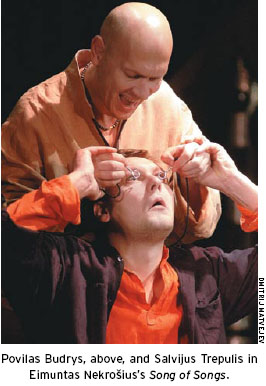
Four ropes lie parallel to one another along the floor, with actors at the ends of each rope. One flicks the end of a rope, sending a small “wave” across the stage. Another does the same. Then another. The waves intensify until all the ropes are off the floor, oscillating in glowing counterpoint, lit by a bright yellow light. Is this a field of pure energy, a throbbing universal intelligence or the mind of God? Faust, played by Vladas Bagdonas, is slowly walking downstage toward the ropes. Transfixed, his half closed eyes gaze out over the audience. Sure as a sleepwalker, he strolls into the midst of the pulsations without disturbing their rhythms. Then he panics, grabs his heart and falls. The ropes fall too, right on top of Faust. Their luminescence is gone and we see only a man trapped in dull, thick rope. Is he dead?
With theatrics developed from basic elements, Eimuntas Nekrosius, had staged Faust’s audacity, his yearning for ultimate knowledge, his blindness, human weakness and mortality. He had found a theatrical metaphor that went to the heart of the play.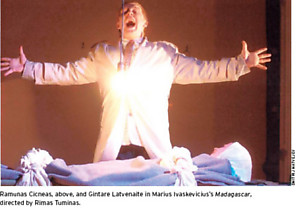
“That was supposed to be an electrocardiogram,” Nekrosius says in reference to his 2006 production of Faustus. Once the enfant terrible of the Youth Theatre and now 55 years old, he now works exclusively through Meno Fortas, which is both the name of his Vilnius production facility and his theatre company.
“Everybody says it was difficult then (during Soviet times), that artists were bothered,” Nekrosius says. “Of course, in Stalin’s day it was horrible, but from Krushchev on, it wasn’t as cruel. Artists had a survival instinct. All of us artists lived in that system, and we had to come to terms with their rules. Composers, writers, visual artists, all created great works then: Georgians, Ukrainians and others, not just Lithuanians. In this new period nothing of lasting value is being made. Artists are trying to please the public. Art doesn’t dictate, the consumer dictates. Art is measured in grams and kilograms.”
Nekrosius’s Soviet-era productions are still well remembered. The Square depicted a life spent in prison where days, weeks, months and years are measured by counting rationed sugar cubes. The public saw it as a bold representation of Soviet life. In Uncle Vanya, Astrov’s maps were tiny postage stamps, which Yelena viewed through a huge magnifying screen. Despite his disclaimer of having a “lasting value,” his post-Soviet productions have had impact as well. Hamlet, produced at Elsinore castle in Denmark in 1997, starred a Lithuanian pop singer in the title role and featured a huge, melting chandelier of ice that hovered menacingly over the action. In 2004 Nekrosius’s five-hour Cherry Orchard received top prizes at the Golden Mask Festival in Moscow.
These days, Nekrosius’s productions are financed through international co-productions and are presented more often abroad than in Lithuania. Still, he is revered in his homeland as one of its theatrical. He articulated people’s anguish in Soviet times and continues to earn international respect for his country’s arts culture.
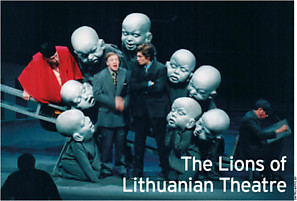
Of all the talented directors in Lithuania today, only one has been able to achieve the influence, staying power, critical acclaim and international reputation of the “three lions.” Oskaras Korsunovas, who was a student of Jonas Vaitkus, is the natural inheritor of Lithuania’s directing tradition. He burst upon the scene in 1990 and quickly acquired a huge cult following. Characterized as a “stage hooligan” by some, his company Oskaras Korsunovas Theatre (OKT) bombards spectators with sex, nudity, violence, loud sounds, rock music, absurdity and unconventional settings: Romeo and Juliet in two competing bakeries; Oedipus the King in a child’s playground with a chorus wearing Mickey Mouse–inspired masks; Marius von Mayenburg’s play Fireface, in which pungent smoke filled the stage and wafted into the audience in thick clouds while loud music blared and the lead actor teetered on high, shaky set pieces, like an unsteady aerialist. “Oskaras became an instant cultural figure among the young generation who no longer spoke in metaphors,” says his international tour manager, Audra Zukaityte.
But not everybody in Lithuania is as enthusiastic. To some, OKT wallows in cheap, shallow tricks; others agree that Korshunovas’s edgy works are unsettling but argue that they offer fresh perspective and compelling strategies to draw in spectators.
Still, as Sirenos’s Bajoriniene confirms, Korshunovas is considered the leading director of a new generation of Lithuanian directors. “But if we want Lithuanian theatre to stay alive,” adds Bajoriniene, “we need to discover the next Korsunovas.”
This September, theatremakers and audiences from all over Europe are gathering again for the fifth annual Sirenos festival. Bajoriniene is stepping down as artistic director; Zukaityte, OKT’s tour manager, is taking her place. Rather than “space,”—the theme for the 2006 festival—2007’s edition will focus on “archetypes.” Participants will explore eternal and mythological themes. This shift is intriguing—for the first time, Lithuania will focus not on something its theatre lacks, but rather on something it has in abundance.
Kestutis Nakas is a playwright, author, performer and director of Lithuanian descent. He is currently associate professor of theatre at Roosevelt University in Chicago.

Social media