


THE EURO-ATLANTIC CHOICE OF LITHUANIA: BENEFITS, CHALLENGES, PERSPECTIVES AND ADVICES TO UKRAINE (No.1 2008 ,p. 12-20)
The spring of 2008 marks the 4th anniversary of, I dare to say, the greatest achievement in Lithuania’s foreign and security policy during its independence years. It is hard to overestimate the fact that as of 2004 Lithuania enjoys full-fledged membership of the family of Euro Atlantic democracies.
The membership in the EU and NATO had a tremendous impact on Lithuania’s political, economic and social life. To assess that impact briefly is not an easy task; it inevitably entails a certain reduction. I believe, however, that the membership can be compared to Lithuania’s baptism in the 14th century; now, like then, the fundamental sense of the identity of Lithuanians, as a European nation, has come to fulfilment. After joining the key Euro-Atlantic institutions, Lithuania is finally a part of the Western system of trade and security.
Having four years of experience as the members of the EU and NATO, what concrete membership benefits and accomplishments should we consider the greatest?
Let me start with the economic development. Lithuania enjoys the beneficial economic growth of over 8 percent in the recent years. Before the completion of its integration into the EU, there were many expectations and many fears. So far, the expectations of growing wealth have proved to be justified, and this is probably one of the reasons why Lithuanians remain among the nations most supportive of the EU. However, as expected, the continuing economic growth has been accompanied by increasing price levels, and the opening of internal borders in the EU single market facilitated the migration of labour from Lithuania towards the richer member states. But, despite these trends, overall business and consumer optimism remain on the rise, and most economic analysts predict this trend will continue.
Reforms aimed at introducing liberalisation and privatisation were successfully implemented. Lithuania experienced economic slowdown at the start of the reforms. However, already since 2000, Lithuania has been reaping the fruits of reforms and its openness to the European and global economy. It soon became one of the fastest growing economies in the region. This economic dynamism has been followed and reinforced by the declining level of unemployment, which reached its lowest level during the last decade, coming down from more that 17 per cent in 2001 to just 4.3 percent in 2007. Recent years have even witnessed shortages of labour in certain sectors, and the growth of wages in most of them.
Overall, the opportunities provided by EU membership created a favourable environment to deal with the remaining challenges.
Energy security is probably the biggest challenge for Lithuania today, being one of the key preconditions for economic and national security. Although from political and economic points of view Lithuania is an integral part of the EU, in terms of energy it remains isolated. An energy infrastructure link with other EU states, ensuring the supply of energy resources from alternative sources, still remains to be created.
According to the EU accession agreement, Lithuania is committed to shutting down the Ignalina Nuclear Power Plant, which satisfies 70 per cent of its electric energy needs, by 31 December 2009. Therefore, security of energy supply from 2010 is becoming the key issue in Lithuania. After the closure of Ignalina NPP the share of gas in energy mix will increase significantly. Taking into consideration dependence from the single external gas supplier as well limited possibility for electricity import due to the lack on interconnections with the rest of the EU, Lithuania could face the real threats for its energy and national security. Therefore, Lithuania is going to initiate consultations with the EU partners on this matter and believes that common solutions will be found.
Seeking to reduce the dependence from Russian energy resources, Lithuania seeks to connect its electric power grid to the largest energy system in the world, the UCTE (Union for the Coordination of Transformation of Electricity), which includes 24 European states. The biggest hopes for energy security in the oil sector are connected with the implementation of the Odessa-Brody-Plock-Gdansk oil pipeline, which would enable the import of oil from a Ukrainian port on the Black Sea, and in the future from the South Caucasus and Central Asia as well.
Obviously, energy issues are the ones where cooperation and partnership is extremely important. They cannot be solved by a single country because in today’s world of energy we are all interconnected. This reality becomes even more evident during such crises as the gas-cuts experienced recently by Ukraine. It is obvious that all energy related issues require dialogue, goodwill and international cooperation. The EU is important to Lithuania in this respect as well. First, by developing the list of priority projects of trans-European energy networks, it encourages with financial and political means the expansion of energy links between EU states. Second, the firmer and more unanimous position of EU states could help to defend their interests in negotiations with Russia as the main supplier of energy resources. Therefore, Lithuania strongly supports further development of the solid EU external energy policy and implementation of solidarity principle.
Lithuania is bringing the energy security issue to NATO agenda as well. Disruption of the vital energy flows is one of the major threats for security of the Alliance. Diminishing of energy security of any Ally may lead to the growing vulnerability of NATO as a whole. Therefore, NATO, as a key security provider, should determine its role and add value in safeguarding energy security interests of all Allies. We note with satisfaction that Bucharest Summit Declaration endorsed our reading of what NATO should do in this field.
The membership in the defence alliance provides a tangible opportunity to have a word on issues of our concern. One of such issues was the protection of airspace of Lithuania. Since the very first hour of our membership, the airspace of Lithuania has been patrolled by fighters from NATO countries. For Lithuania, this was not only both concrete and symbolic demonstration of the responsibility shared by Allies (being a rather costly mission, it is only partly paid for by Lithuania), but had great financial benefits for Lithuanian infrastructures as well. More than 50 million euros have so far been invested by NATO in developing the airport, as well as in creating the conditions for its proper operation. Since a significant number of personnel are involved in each such mission, the economic benefits to the city and the population have also been considerable, estimated in millions of euros.
Looking back to the time when the membership in the EU and NATO was not so evident, one may acknowledge that the membership required bold efforts, streamlined and stout resolution of the government, as well as of all the political forces of Lithuania. The commitment was demonstrated manifestly by the Agreement of all parliamentary parties on the Main Foreign Policy Goals and Objectives, which postulated the consensus that membership in Euro-Atlantic structures and other international organisations contributes to greater security and the well-being of the people, as well as ensuring better conditions for the development of the state and the nation.
The political parties’ Agreement also says that Lithuania should continue to pursue an active foreign policy, aimed in particular at strengthening of co-operation of the Eastern neighbours of Europe with the European Union and NATO.
***
Our experience in getting closer to the EU is still fresh, and at the same time we already have the inside perspective now. I believe that the experience we got from the pre-accession and accession processes and on the observations from the recent years might provide some useful lessons for Ukraine as well.
Throughout its history, the EU has demonstrated that it was a very successful project, one of the greatest success stories in the post-war Europe. For almost fifty years the EU has been consolidating peace and stability on the European continent. It has created conditions for prosperity in the largest common market in the world and facilitated democratic and economic transformation beyond its borders. The enlargement of the EU in 2004 was a historic development on the way of unification of Europe. The enlargement brought economic gains to all member states and added to Union’s strength for pursuing its objectives on the international arena.
Lithuania supports further integration of the EU. We seek that the EU as a whole would be able to move forward, to perform more cohesive and stronger Common Foreign and Security Policy, to formulate Common European Energy Policy, to achieve Europe that speaks with one voice, Europe that is able to safeguard core values and basic interests of its members.
It will not come as a surprise that Lithuania’s priority in the EU is to expand the area of stability, good governance, rule of law, free market and democracy eastwards. We consider it as a vital prerequisite for good neighbourly relations and successful development of Lithuania in the long term. Therefore Lithuania is engaged in the EU internal discussions about the future of ENP, assists its neighbours to carry on economical and social reforms, promotes development and strengthening of civil societies, rule of law, respect of human freedoms and rights.
Neighbourhood policy towards Eastern Europe should be firmly based on the concept of integration, focusing primarily on economic/sectoral integration and internal market. Such integration would provide a sufficient framework both for the EU and its Eastern European neighbours to develop mutual co-operation across EU Eastern border.
I believe that Ukraine has a great potential for enhancing the ENP’s East dimension. This should be our task now, as we believe that regional cooperation should be expanded, not only bilaterally, between the EU and its European neighbours to the East, but also among the European neighbours themselves. This cooperation would give a huge new impetus for the whole region’s economic growth, prosperity and democratisation.
It is obvious, that Ukraine has to think about the Euro-Atlantic integration in terms of the strategic choice. Of course, the perspective of EU membership has much more sense and attractiveness than any other kind of relationship with the EU. Transition countries require a significant impetus to transform their economies, political and administrative structures and it is much more difficult to mobilize the institutional, political and financial resources as well as public opinion, without such a clear goal. Our own experience says that driving force of structural reforms is a clear target as well as a firm encouragement of partners.
Therefore, Lithuania advocates strongly the “open door” for Ukraine in the EU and NATO. We believe that although the membership itself is not a question of immediate urgency, we should be more outspoken in providing the clear membership perspectives for Ukraine. It is our strong conviction that the firm perspective of membership will create more genuine partnerships and will only strengthen European stability and security in the long run.
Still, I would like to stress that the EU membership requirements should be based, as it was in the past, on the fulfilment of strict criteria. Countries that see their future in the European Union need to go through considerable domestic reforms.
Here are some lessons which I believe reflect our experience well; and a few frank advices on how to deal with the challenges of the integration.
First, get the broadest possible domestic support and be consistent in your efforts
Many countries conducting reforms face problems with sufficiently strong domestic anchors. There are political, economic and social constraints of reform, and they must be addressed accordingly. If we look at our case, Lithuanians have never given up their principles and values for some pragmatic but narrow interests, and our political, business and academic establishment was able to agree on the issues of major importance to the country, such as market reforms and foreign policy goals.
In 1995 Lithuania officially applied for the EU membership. Since 1996, each Parliament of a new convocation began work with acceptance of the resolution on the basic purposes and continuity of foreign policy. The resolution to the NATO integration also was confirmed repeatedly the same way. There was a general consensus that the necessary reforms should be based on stable and a predictable course of foreign policy of Lithuania.
Public support is a key to achieve success in the overall process of preparing and acceding to the Euro-Atlantic institutions. It is crucial to gather support from society and ensure the needed political consensus. For this, people have to have a wide access to trustworthy and comprehensive information. It is especially important to reach as many people as possible, and also to target those who are undecided or sceptical about the membership. With the view of making the information about the EU available for the wider population, we in Lithuania, for example, established nine European Information Centres. A particular attention was given to the rural areas and small towns.
Last year, with the same task of raising the awareness of the broad public in Ukraine, Lithuania opened two information centres on European integration in Lvov and Donetsk.
Lithuanians gave a robust support for their country’s membership in the EU at the referendum in 2003 – over 90 percent of people who came to vote said “Yes”. Today, the EU is still seen as a positive thing by most of Lithuanians. What is also interesting is that we can see an increased support for the membership from previously most sceptical part of the society – farmers and others who live and work in rural areas and in agriculture sector.
Second, do your homework.
Integration process gives acceding country a big chance in terms of enhancing economic and political institutions. EU serves as a kind of external anchor of reforms or a kind of safeguard against temptation to take another road. However, to benefit from this, country has to accept certain rules of the game. And the main rule is – conditionality.
EU relations with third countries – be it candidate countries or other partners - are based on strict conditionality. If you want to get something from the EU you have to obey its requirements. This rule might seem to be unfair or too rigorous, but that’s the way the EU works.
Homework we had to do during our accession was formulated in the entry criteria set in June 1993 by Copenhagen summit. Associated countries of Central and Eastern Europe were referred to three groups of problems:
1. Stability of institutions guaranteeing democracy, the rule of law, human rights and respect for and protection of minorities.
2. The existence of a functioning market economy, as well as the capacity to cope with competitive pressure and market forces within the Union (economic pillar).
3. Ability to take on the obligations of membership including adherence to the aims of political, economic and monetary union (institutional pillar).
In practical terms, that meant harmonization of the national laws and standards with those of the EU, making economy more competitive, attracting foreign investment, promoting country in global markets, enhancing administrative capacities, establishing new institutions etc.
Lithuania’s experience indicates that there is also a strong correlation between economic and political reforms. In other words, political progress is very important for economic progress, and vice versa. Half-reforms, or for that matter, half-integration into the EU, don’t work. Indeed, examples of some countries suggest that countries which have failed to embrace both political and economic change may face a period of serious, long-term decline.
Speaking of NATO, we might admit that Ukraine has been acting nearly as de facto member of the Alliance for many years already: by cooperating in the framework of the Intensified Dialogue and NATO-Ukraine Action Plan, by implementing political, economic, defence and security sector reforms, by being the only partner country participating in all Alliance’s operations. Lithuania especially values the presence of the Ukrainian medics who serve in the Ghowr province in Afghanistan, along with the Americans, Danes, Icelanders and Croats within the Lithuanian–led Provincial Reconstruction Team. Ukraine certainly deserves an adequate and fair reflection of its efforts. We welcome the Alliance’s pledge as it was clearly expressed in the final declaration in Bucharest. Lithuania has always supported and will support Ukraine’s Euro-Atlantic aspirations and stands ready to assist you in achieving your goals.
***
I would like to conclude with the encouragement to our Ukrainian friends to continue with the course towards the European Union and NATO. We know very well that it is not an easy task – it was not simple for us either. Ukraine belongs to Europe and the community of shared Euro-Atlantic values; and Europe will not be united if Ukraine is left outside the European project.
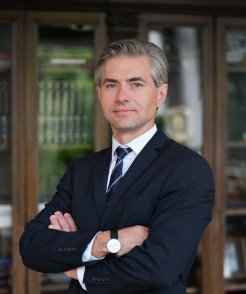
Petras Vaitiekūnas
Minister of Foreign Affairs of the Republic of Lithuania
Social media


