THE EU SHOULD EXHAUSTIVELY EVALUATE POSSIBILITIES TO TAKE UP MORE AMBITIOUS COMMITMENTS IN THE FIELD OF CLIMATE CHANGE, LITHUANIAN FOREIGN VICE-MINISTER SAYS
On 14 April, at the round table discussion on the EU climate change and energy policy that kicked off in Vilnius, Lithuanian Vice-Minister of Foreign Affairs Egidijus Meilūnas noted that prior to taking up more ambitious commitments to reduce greenhouse gas emissions, the EU had to carry out an exhaustive evaluation of whether this was not a burden to the economy and a threat to the competitiveness of its member states.According to the Vice-Minister, the commitments of other international partners should be also taken into account.
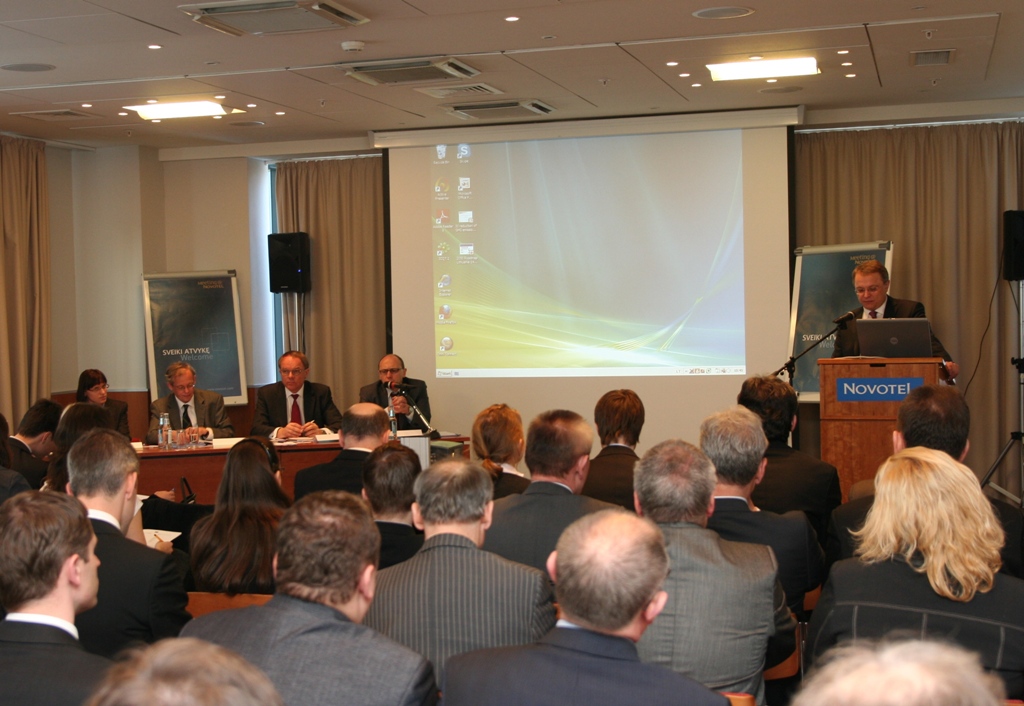
The round table discussion presents the feasibility study on implementation of Lithuanian commitments in the field of climate change for 2020 that Lithuania has prepared with the financial support of the European Social Fund.The discussion is attended by representatives from the Ministry of Foreign Affairs, the Ministry of Environment and the Ministry of Energy, and guests from the European Commission, Denmark, the United Kingdom, Latvia, Finland, Germany and other countries, also the authors of the feasibility study, environmental experts and specialists.
In the welcoming speech, E.Meilūnas stressed that the goal of the event was not only to present the study, but also to reflect on the ambition level which could be reasonable for the European Union and Lithuania itself in the field of climate change and energy.
 According to him, this is not a simple question, and there might be many different views, however, a comprehensive approach should include both new opportunities and risks. The Vice-Minister noted that it was important to assess collective commitments of the Member States of the European Union, so that they would not become a burden to the economy and a threat to our competitiveness.
“If we move further than other international partners, will we be able to stop climate change? Will our industry stay competitive enough, if we have the strictest commitments? These are reasonable concerns and we can not ignore them,” the Vice-Minister said.
He pointed out that on the other hand, climate change and energy goals may be perceived as the opportunity of our generation. They can become the basis of decades-long economic growth.
“It is a revolution of green technologies and Europe must not be left behind. We need to make sure that enough funds are provided to our scientists and our entrepreneurs; we need to make sure that wise decisions are made when choosing energy mix, when planning future ways of transportation,” the Vice-Minister E.Meilūnas said.
The Vice-Minister believes that the decisions will essentially determine whether the European Union stays technologically and scientifically competitive in the long run vis-à-vis with China, India, and the USA.
“We have to find common ground in order to move forward. That is the area where discussions can be very helpful, especially when we have facts and calculations to base our arguments,” - the Vice-Minister E.Meilūnas said.
The discussion was organized by the Ministry of Foreign Affairs. Please visit the website of the Ministry of Foreign Affairs to read the feasibility study “The costs of implementing Lithuanian commitments in case of the EU’s move to 30% reduction of greenhouse gases emissions”, which includes efficiency comparison of possible measures for the implementation of this goal.

Social media