


THE DYNAMIC SPIRIT OF BUSINESS GIVES LIFE TO THE SILK ROAD ALL THE WAY TO THE BALTIC SEA (Jūra.More.Sea, 2007/05 )
When they look at a map of Kazakhstan, a big country rich with natural resources, many Lithuanians remember the legendary Silk Road that connected Asia and Europe. Even geographically part of Kazakhstan’s territory falls in Europe. Today many Lithuanians are rediscovering a Kazakhstan that lies over two continents and has a wide variety of unique cultures and countless traditions.
Lithuania – an experienced guide for integrating transatlantic structures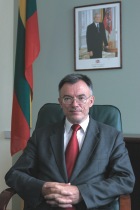
Lithuania also lies in a unique geopolitical place connecting North and South, East and West, and is ready to open the gates for Kazakhstan to the markets of Europe. Our country, just like Kazakhstan, is experiencing impressive economic growth. Even though the two countries are thousands of kilometers away from each other, they are united by a dynamic spirit of business and are striving to use all opportunities to improve their economies so that people will be better off.
I am glad that during the past several years Kazakhstan became the main political, economic and cultural partner of Lithuania in the region of Central Asia. The enormity and variety of the natural resources of Kazakhstan, as well as the strategically important geopolitical status, allow Kazakhstan to attract foreign investment and take advantage of opportunities as a transit country between Asia and Europe.
Lithuania, being a member of European and Euro-Atlantic structures for the third year, can not be treated as a newcomer to the European Union. Rather it is an experienced guide, helping change other countries with similar historic paths by sharing the experience of reforms and assisting in the development of multiple connections with the Euro-Atlantic community.
There is an interest in the energy resources of Kazakhstan
It is obvious that Lithuania and Kazakhstan have huge unused potential in cooperating in areas of energy, transport and trade. I hope that in the near future we will be able to develop it successfully.
Lithuania, like the entire EU, is interested in diversifying its energy resources. That would ensure energy-related safety for EU countries and better competition for energy providers. Lithuania, like other countries that import primary sources of energy, has a strategic goal of ensuring oil’s stable provision at acceptable prices.
Lithuania has a big interest in fully cooperating with Kazakhstan – a solid and reliable partner in Central Asia. I am sure that it is in Kazakhstan’s interest as well to have several energy-related trading partners (Lithuania being among them), keeping in mind Kazakhstan’s large oil resources in the region of the Caspian Sea and their huge reserve of natural gas.
In the future Kazakhstan is planning to increase the export of oil and gas, therefore Lithuania is greatly interested in importing energy resources from Kazakhstan, thus ensuring an extra source of oil and gas. At the same time, it is very important that the eyes of the EU are turning more towards the Caspian region as it has big potential for energy-related cooperation. This allows us to expect that in light of good relations between the EU and Kazakhstan, there might be an agreement on reviving the Odessa-Brody-Plock-Gdansk oil pipeline project. Then there will be an opportunity to import oil from the Caspian region into Central Europe and Lithuania.
The energy specialists of our country value the possibility of signing long-term agreements and buying oil and gas directly. Meanwhile Kazakhstan could build its own terminal for exporting oil products or it could use already available capacity, including the usage of a liquid gas terminal in Lithuania.
I rejoice that our cooperation is not related only to energy. We have strong possibilities and mutual interest to cooperate in transport-related areas.
The intenational project Viking could reach the countries of the Middle East
I think that one of the most promising opportunities is to expand the shuttle container train Viking for carrying cargo to Kazakhstan and even further to China. If such a route was set up, Klaipeda port would open a gate even wider, allowing Central Asia to access the markets of Northern Europe.
Even now this international Lithuanian-Belarusian-Ukrainian project successfully unites the countries of the Black Sea and Western Europe, as well as Scandinavia. At this point the Viking is functioning with the route Ilyichevsk-Kiev-Minsk-Vilnius-Klaipeda and back. We can be glad that the volume of cargo in 2004-2006 increased more than 12 times from 1,9 thousand TEU to 23,4 thousand TEU.
Why is this train successful? The main advantages of the Viking carrying international and transit cargo are little time consumption, simplified custom procedures and good price – since the transport tariffs are one-third or even one-half lower than transporting goods by trucks. This is useful for all three countries taking part in this project. We invite other countries of Central Asia and especially Kazakhstan for closer cooperation, strengthening the connections in the transport area and ensuring the expansion of the Viking’s route.
Having in mind that Kazakhstan is part of the TRACECA corridor, and that in 2001 an agreement of cooperation between Aktau and Klaipeda ports was signed, Lithuania is considering the possibility of expanding one of the branches of the TRACECA corridor from Kazakhstan’s Aktau through the ports of Azerbaijan, Georgia, and Ukraine, up to Klaipeda port. We hope this route would be useful for Kazakhstan as well, especially considering that Klaipeda port is universally known as deep-water and the most northern ice-free port on the eastern coast of the Baltic Sea.
There are 19 large reloading, ship-repair and construction companies working in Klaipeda port that provide services related to sea business and cargo. I want to emphasize that the quality of service is in agreement with all EU requirements.
The Klaipeda port and Lithuanian Railways are ready for constructive dialogue
Our port city is the biggest and most important transport center in Lithuania, connecting water, land and railways from the East and West. From here, by land, the distances to the most important industrial regions of Eastern Europe are the shortest. There are also major routes to Western Europe, Southeast Asia and America.
Klaipeda port reacts with flexibility to the changes in the market, and is a modern and constantly self-adapting port. Therefore, Klaipeda witnessed a remarkable volume of cargo in 2006 – 23,6 million tons. In comparison with first six months of last year, during the same period this year the volume of cargo increased an extra 13,6%. Even though the volume of mutual trade with Kazakhstan has increased significantly in the last several years, the volume of Kazakh goods reloaded in Klaipeda port is decreasing. Wishing to encourage the growth of volume of Kazakh cargo, the Klaipeda port and Lithuanian rail are ready for a constructive dialogue with national, as well as private, companies.
As mentioned above, mutual trade between Lithuania and Kazakhstan is growing considerably. During the first 5 months of 2007 the export from Lithuania to Kazakhstan increased by 58% and the import from Kazakhstan increased by 46% compared to the same time period last year. This fact gives hope that economic ties in the future will only become stronger, bringing our countries together in other areas as well.
Diplomatic office will help with business connections
I am sure diplomatic representatives of Lithuania will continue to effectively represent our developing business relations. After visiting the hospitable country of Kazakhstan I was convinced that friendly, mutual cooperation is our common goal. We have a good basis for cooperation in effectively expanding the historic Silk Road to the amber Baltic Sea.
Lithuania’s membership in the EU and Kazakhstan’s participation in trans-regional projects opens even bigger opportunities for economic cooperation, especially in energy and transport sectors.
While visiting Kazakhstan this April I saw that Kazakhstan is also interested in expanding cooperation with the EU, applying Lithuania’s experience and hoping for Lithuania to play a significant role in this process. I can assure you that Lithuania takes such a role with great responsibility.
About EU energy politics in Vilnius
Thus we invite Kazakhstan to participate in the energy-sector related conference that will take place in Vilnius on the 11th of October, 2007. Most attention will be focused on EU energy-related politics in relation to its Eastern neighbors. There will also be a focus on means and ways to strengthen the cooperation of energy producers, consumers and transit countries. Lithuania, being the initiator of this event, is ready to address energy-related issues important to Kazakhstan. The leaders of countries from the EU, Caspian and Black Sea regions, as well as Russia, are invited to take part in the conference together with the President of the European Commission and other important officials. After his visit to Lithuania, Walter Steinmeier, the Minister of Foreign Affairs of Germany, also has indicated his intent to support Kazakhstan.
I am sure that the important officials, guests and experts who will gather in Vilnius will have an excellent opportunity to look into new possibilities of cooperating in the spheres of energy, transport and infrastructure. I also hope that in the future the cultural and scientific ties will only get stronger. We have excellent scientists, prospective students and outstanding artists who could successfully cooperate and participate in the international projects.
Kazakhstan is also dear to us for having accepting many exiled Lithuanians and other victims of the Soviet regime. I would like to express gratitude to the country that guards the memory of the repressed and exiled ones, and that takes care of the Lithuanian community and its needs. Even today there are a considerable number of Lithuanians still living there; meanwhile Lithuania has a Kazakh community as well. I think that both communities can have significant input into the development of a relationship between their mutual countries. The most important factors bringing the nations together are direct connections with people and mutual exchange of knowledge, therefore developing tourism and cooperation with bigger and smaller cities, as well as business investments, is so important.
This year we will celebrate the 15-year anniversary of diplomatic relations between two independent countries – Lithuania and Kazakhstan. I am glad that during this time Kazakhstan became the leader of the entire Central Asia region, working on issues of economic integration, political and economic stability, terrorism and prevention of extremism, as well as other urgent matters. I am sure that Kazakhstan, having clear guidelines for its development, will remain our friendly and important partner.
Petras Vaitiekunas
Minister of Foreign Affairs of the Republic of Lithuania
Social media


