ON THE EASTERN TIP OF EUROPE AND THE EASTERN TIP OF ASIA: A SHARED SPIRIT OF REVERENCE FOR HISTORY AND NATURE (The Palace, 2007 Spring Vol. 61, p. 2-3)
Interview with Dainius Petras Kamaitis, Ambassador Extraordinary and Plenipotentiary of the Republic of Lithuania in Japan.Interviewer: Kunihiko Saito Saito: Lithuania and Japan have built up a good relationship that dates back a long time. Partly through the humanitarian efforts made by Chiune Sugihara during the Second World War, we Japanese feel a special affinity with Lithuania. Sixteen years since your country’s independence, the relationship between our two countries is getting closer and closer.
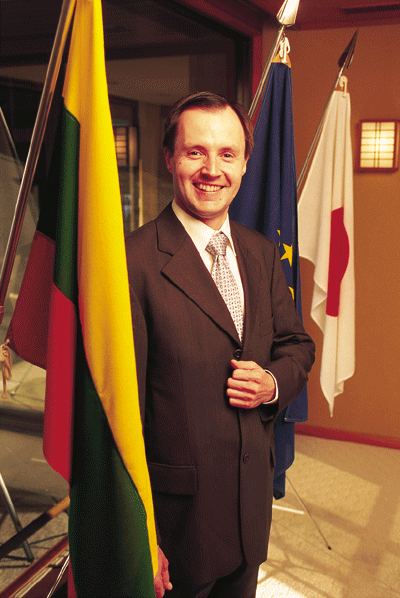 Ambassador: As you say, the friendly relations between our two countries have a history going back more than eighty years to 1922. The people of Lithuania have great respect for the actions of Chiune Sugihara, who issued thousands of life-saving transit visas*. Lithuania was occupied by the Soviet Union for fifty years after the end of the war, but the relations between Japan and Lithuania have continued unbroken since before the war. Foreign Minister Aso became the first Japanese cabinet minister to visit Lithuania last year, and this May we will be honored with a visit by Their Majesties, The Emperor and Empress. This will be an extremely happy event for us.
Saito: Lithuania joined the European Union in 2004, and I was wondering if there had been any changes as a result of this.
Ambassador: With enlargement of the European Union, the area of Europe that enjoys peace has expanded. There was concern in Lithuania that any rise in the standard of living would be accompanied by a rise in the cost of living, but 70 percent of the population were in favor of joining the European Union. On the diplomatic front, all kinds of new possibilities are opening up before us, such as the participation of the three Baltic nations for the first time in the Asia-Europe Meeting (ASEM).
Saito: I’m afraid I’ve never had the good fortune to visit Lithuania, but I believe it is a very beautiful country and is especially popular among Europeans as a tourist destination.
Ambassador: Lithuania is a small country, around four-fifths of the size of Hokkaido, but there is plenty to see. We have plentiful forests, we look out onto the Baltic Sea, and the four seasons are clearly distinguished. There are three World Heritage Sites in Lithuania: Vilnius Historic Center (the old town of Vilnius), the Curonian Spit (a landscape of sand dunes), and the Kernave Archaeological Site. The number of Japanese tourists visiting our country is gradually increasing.
Saito: As far as industry is concerned, I believe that your laser technology is very advanced. For what purposes is this technology?
Ambassador: Sales of Lithuanian laser technology amount to some three billion yen a year, with exports accounting for 90 percent. We are supplying our technology to research institutions in Europe, North America and Japan as well as to the US Department of Defense. Lithuanian technology for measuring extremely brief durations gauged in picoseconds (trillionths of a second) is being used by Rolex for quality control, and in the field of medicine for cancer treatment.
Saito: In the field of sport, I understand that Lithuania is particularly well known for its strength in basketball.
Ambassador: That’s right. There are currently many Lithuanian basketball players active in the NBA and the university league in the United States as well as in professional leagues in Europe. The Lithuanian basketball league is itself flourishing. Basketball has become a kind of national sport. Children become interested in it before entering primary school, and there are even a number of specialist basketball schools!
Saito: It was in 1998 that you first came to Japan as the Charge d’Affaires ad interim. Having returned to Japan on this occasion, have you noticed any differences between now and your previous stay?
Ambassador: I was surprised by all the new buildings springing up everywhere. My impression is that all this talk of recession is something restricted to the newspapers.
Saito: What would you say are the points that Japanese people share with Lithuanians, and what are the differences between our two peoples?
Ambassador: I feel we share a great respect for nature and a pride in our respective national histories. As to differences, there is little that springs immediately to mind, although I might mention those that come about as a result of the differences in our respective populations. For example, in Japan everyone has his or her own field of specialization when engaged in a joint activity, but in Lithuania everyone has to fulfill a variety of roles at the same time.
Saito: When you served as Charge d’Affaires in 2000, you worked on the “East-East” project that involved exchange between our two countries with emphasis on geographical similarities as regards Japan’s position in Asia and Lithuania’s position in Europe. How do you intend to realize this project in the future?
Ambassador: Partly because I studied architecture at university, we began exchange in the field of architecture. In the summer of 2002, we invited seven Japanese architects including Fumihiko Maki to take part in a project that involved lectures and activities by university students from both countries. We are planning new avenues for exchange at the present time.
Saito: Thank you very much for sparing your time to talk to us today.
* As Japanese Council in Lithuania, he saved the lives of Polish-Jewish refugees by issuing transit visas for Japan.

Social media