


NOT TAKING ADVANTAGE OF THE SUPERIORITIES OF OUR COUNTRY IN THE EUROPEAN NEIGHBOURHOOD POLICY WOULD BE A DETRIMENTAL MALPRACTICE FOR LITHUANIA
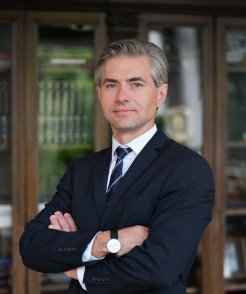
On 13 February, during the public discussion ‘The European Neighbourhood policy: the case of Ukraine and Georgia’ in the Seimas of Lithuania, Undersecretary of Lithuanian Ministry of Foreign Affairs Laimonas Talat-Kelpša indicated that the European Neighbourhood policy was an incitement to step forward and develop a system in compliance with European principles. ‘We can argue about how fast and in which direction – deeper or broader – this system should develop first. However, nobody will deny that the consolidation of the principles of cooperation and concord in the neighbourhood, synchronization of its heart beats with the rhythm of Europe is the fundamental European, therefore, also the Lithuanian interest,’ said the Undersecretary of the Ministry.
According to L.Talat-Kelpša, a need to strengthen the system of the European countries – the European Union is especially important for Lithuania, a little country on the very border of the Union. And the specialisation in the European Neighbourhood policy allows harmonising the parameters of the ‘depth’ and the ‘width’, in the way that is the best for Lithuania.
Speaking about the Lithuanian integration into the EU and the network of the country’s connections, harmonising the steps in the neighbourhood with the European countries, L.Talat-Kelpša reminded of two-year old events, when looking for an answer who and why had cut the gas supply to Ukraine at that time, Lithuanian diplomacy roamed even to Paris.
‘And it is good that we do not stop in the middle of the way, because when somebody cut the gas supply to Belarus a year later, the European Union was already attentively waiting for the most recent news from Vilnius,’ indicated the Undersecretary of the Ministry.
Would such network be created in other areas than foreign policy, for example, energy, finances or culture policy? The answer, according to the Undersecretary of the Ministry, depends on the capacities of our country’s politicians to formulate political tasks in these areas and on the functioning decision-making mechanism, which is settled in the European Union.
During the discussion L.Talat-Kelpša stressed that in the Neighbourhood policy it was important for Lithuania that the Eastern neighbourhood would not be discriminated against the Southern one.
‘It is important to develop free trade with neighbours, because we export goods and services to these countries for 3 billion litas already. If we included Russia, the number would reach 9 billion litas. It is important to open the borders of the European Union to the neighbours as wide as possible, because while travelling people not only spend money, but also exchange their experience, ideas, stimulate the labour market and new methods of management,’ said L.Talat-Kelpša.
And the most important is that, according to L.Talat-Kelpša, while strengthening relations with neighbours in the East, Europe continues to unify preparing to face the challenges of growing competition with India, China, and other world powers of today.
‘Strengthening the Neighbourhood policy, the European Union invests first of all into itself, into its border security, bigger consumption, therefore, bigger production in the future, and into the new, more secure ways of energy supply provision,’ said the Undersecretary of the Ministry of Foreign Affairs.
According to L.Talat-Kelpša, the Neighbourhood policy is and will remain to be the area, where not taking advantage of the superiorities of our country would be a detrimental malpractice for Lithuania’s interests.
‘If Lithuania does not consciously exclude itself from the European Union, then its interests are also Lithuania’s interests. Georgia and the whole of the Southern Caucasus cannot be estranged to Lithuania only because this is a faraway region and we do not have one geographical border with it. Kosovo is also far away. Also entire Mediterranean region is far away. Those spaces and their inhabitants are just as strange to us, as we ourselves feel strange and misfit in the European Union,’ stated the Undersecretary of the Ministry.
L.Talat-Kelpša highlighted that both Ukrainian and Georgian success, as well as the success of other neighbourhood countries, is understood as their continuous full integration into the European and Euro-Atlantic structures, is a guarantee of Lithuania’s independence and its firm position in the New Europe.
Among the participants of the public discussion, organised by the Seimas of Lithuania, there were members of the Georgian and Ukrainian Parliaments, members of the Lithuanian Seimas, foreign diplomats, and representatives of governmental institutions, the society and the media.
Social media


