MYSTICAL HILL IN LITHUANIA (City Paper, No.112, September 2008, p.30-31)
The Hill of Crosses in northwestern Lithuania has become a worthy tourist destination as well as a religious Catholic pilgrimage spot. In England it’s the Big Ben, in Italy the Colloseum, in Egypt the Pyramids – in Lithuania it’s the Hill of Crosses. You haven’t seen Lithuania if you did not visit the mysterious hill which is situated some 12 kilometers in the middle of an arable land northeast of the town of Siauliai.
It is easy to reach the hill taking a taxi or a regular bus from the Siauliai bus station.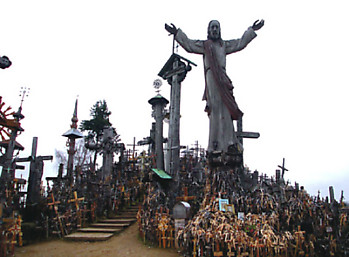
The hill is an amazing sight to behold whether you are religious or not.
Vytautas Navaitis, director of Factum, a Guinness records-type agency said there are 55,000 crosses on the hill. The Guinness Book has refused to acknowledge it as the world’s record.
“The Guinness Book of World Records refused to register it, because there are no such similar hills anywhere else and they say it cannot be a record because of this,” Navaitis said.
The hill is actually two mounds. You climb the hill only to see that there is another hill and both of them are covered with crosses. And crosses are covered with other crosses.
Navaitis’ figures are already old. There are more crosses being planted and hung up every single day.
The crosses were first counted in 1900. There were 130 crosses on the hill by then. Catholics (and many non-Catholics as well) bring them to ask God for health and success or to thank God for some good event in their life. Some have inscriptions that explain the intention of the person who brought it.
Many thank God for the freedom and independence of Lithuania. Soviet time deportees bring crosses thanking God for their return from Siberia. There is a cross in memory of Pope John Paul II’s visit to the hill. “Thank you, Lithuanians, for this Hill of Crosses which testifies to the nations of Europe and to the whole world the faith of the people of this land,” John Paul II said visiting the hill in 1993. Later in Rome, during one of his public speeches, he described the hill as “a Colosseum of our age”.
There are crosses brought there by Lithuanian émigrés who are visiting their native country. Some plaques reveal that they have been brought from great distances: the United States, Canada, Uruguay, and Brazil.
The Lithuanian cross crafting is a traditional Lithuanian art. The Hill of Crosses is greatest aggregate of such folk crafting. The traditional Lithuanian crosses are decorated with floral or geometric symbols of pre-Christian origin, and sometimes adorned with small statues, and are usually one to five meters high. In 2001, the UNESCO enrolled the Lithuanian cross crafting into the list of Masterpieces of the Oral and Intangible Heritage of Humanity.
There are no tickets to buy or opening hours for visiting this magic place. The hill remains under nobody’s jurisdiction. Therefore, people are free to build crosses as they see fit. There are tables laid out at the entrance of the site to buy crosses for putting them up as acts of thanksgiving or petition.
There are inscriptions in many languages on the crosses which are planted on the hill or hanged on the other crosses and it shows the variety of pilgrims and tourists who came there from all over the world.
The crosses come in all shapes and sizes. Some of them are higher than 5 meters, while others stand at only 5 centimeters. They are made of different materials: wood, metal, granite, concrete, amber. There are also some religious sculptures and paintings on the hill. Rosaries, pictures of Jesus and the saints, and photographs of Lithuanian heroes also decorate the larger crosses. On windy days breezes blowing through the forest of crosses and hanging rosaries produce a uniquely mystical and beautiful music.
Historians believe the crosses started to appear after an unsuccessful anti-Russian uprising in 1831. In 1795, Lithuania became part of the Russian Empire, but the Lithuanians never accepted the Russian rule. The first crosses are supposed to have been raised in memory of those who died for the freedom and independence of the fatherland. More crosses were put up in memory of those tragically killed in the anti-Russian rebellion of 1863.
After the Lithuanian independence was restored in 1918, the number of crosses on the hill was some 50. The number of crosses reached several hundred till the Soviet occupation of 1940. Only then, the number started to grow by thousands each year.
During the Soviet occupation of Lithuania, Communist authorities shaved the hill of crosses several times. Locals say the hill was ravaged in 1961, 1973, 1974, and 1975. Wooden crosses were pulled down, broken and burnt. The iron ones were taken away for recycling. However, they always reappeared.
Herein lays the mystery. The locals know what happened to those who fought against the holly hill. Locals say nobody who took part in its destruction survived. Gustavas Ulcinas was born in a village close to the mysterious hill and has spent his life in Siauliai where he worked as a driver in the state company which business was to transport milk. Now a pensioner who moved to Kaunas, the second largest Lithuanian city, Ulcinas knows a lot of horror stories about the fate of cross breakers. These stories are widely spread in the Siauliai area and well known throughout Lithuania.
“More than 40 years ago, the hill of crosses sat within the territory of the Meskuiciai state farm. The farm was called Raudonoji Veliava (“The Red Flag” in Lithuanian). The chairman of the farm was Girdaitis. He was kind of a strong-man, a German-style character and his farm was famous of its agricultural achievements throughout Lithuania. Being faithful to the Communist Party, he decided that the hill was not suitable for the ‘new Soviet life style’ and asked Reklaitis, head of the Siauliai militia (Soviet-time name for police), to clear the hill of crosses,” remembered Ulcinas.
“Militia and KGB blocked the ways to the hill. Girdaitis asked some local vodka-loving volunteer tractor-drivers for help in clearing. Payment for them was as always in Soviet times – vodka. Payment was given in advance near the hill.”
“One volunteer tractor-driver downed as much vodka as possible and said, ‘Thank you for the feast. But I didn’t build this hill, so I won’t destroy it. Good-bye.’ Others, however, carried out the dirty work.”
“Two weeks later, Girdaitis started to feel an enormous pain in his head,” continued Ulcinas. “He died soon after. Girdaitis’ last words were “It is because of the hill.’ Everybody in Meskuiciai believed that it was punishment for its destruction.”
According to Ulcinas, soon after the hill-clearing action, Reklaitis went with his wife and two children for a picnic to nearby Kurtuvenai Lake.
“When they were lying on the grass, their children jumped into car. They accidentally released the brake and the car was driven into the lake. Both were drowned. Reklaitis also died soon after, of some strange disease. During the funeral, his wife said near his grave ‘It is a punishment from God because of the hill,” said Ulcinas.
Locals tell the same tragic stories about others who raised their hand against the hill of crosses. Another way to scare the faithful Catholics from the hill was sewage pipe from the pigs’ farm to the Kulve River which runs nearby the hill – the atmosphere around the hill was rather smelly during the Soviet times. However, those days are gone and now a trip to the hill is opportunity to enjoy some fresh air.
Don’t smoke, light candles or beg on the hill. These three types of activities in this saint area are banned by the Siauliai municipality. The first two activities are forbidden because of fear of fire on this hill which is full of wooden crosses. The third one is a measure against aggressive drunken beggars who used to station there and terrorize tourists in recent years. In case you want to donate for maintenance of the unique hill – just place some coins on the stone which is situated near the entrance to the hill – it became a tradition there. And don’t forget your camera.
In 2000, the Franciscan monastery was opened nearby. This move of the Franciscan guys into the area of the Hill of Crosses was rather controversial. The conservationists claimed that this Italian style monastery is not suitable to the wild folklore-style hill. However, now the passions over this architectural intrusion are forgotten. The monastery is built 300 meters away from the hill and has sixteen cells. It is also open to the people who look for silence and peace – probably, it is a good thing to stay for a while in the monastery for more sensitive persons after visiting this rather astonishing and emotional site of the highest density of crosses and human hopes in the world.
By Rokas M. Tracevskis

Social media