Minister Linkevičius: the commitment by NATO countries to increase defence spending is particularly relevant in the face of current threats
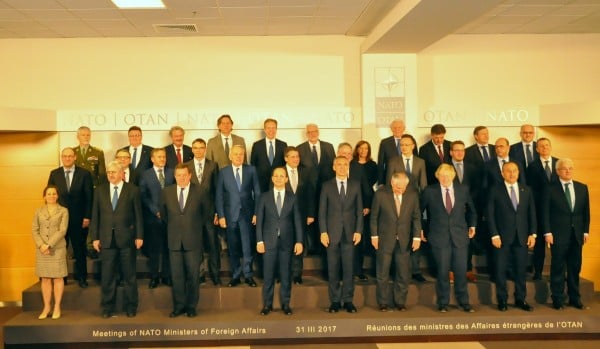
At the meeting of NATO Foreign Ministers in Brussels on 31 March, Linas Linkevičius, Minister of Foreign Affairs of Lithuania underlined the significance of strengthening defence in the face of challenges posed by Russia.
“Lithuania’s commitment to allocate 2 per cent of its GDP to defence is firm and supported by all the political parties,” Mr Linkevičius said.
According to him, experience proves that there is not a single NATO member protected from cyber-attacks, disinformation campaigns, or military provocations; that is why we have to invest more in our defence and pay adequate attention to our most vulnerable places.
The Minister drew attention to Russia’s aggressive activities in the Baltic Sea region: militarisation of the Kaliningrad Oblast, including deployment there of ballistic missiles Iskander capable of carrying nuclear warheads, and the large NATO-targeted military exercises Zapad set for this year.
“The success of our previous efforts to strengthen NATO’s collective defence and deterrence capabilities depends on investment into our armed forces, which would precondition reaching a high level of readiness, sustainability and interoperability,” Minister Linkevičius said.
He also thanked the new US Secretary of State Rex Tillerson, who attended the Ministers Meeting for the first time, for underscoring resolution to strengthen the transatlantic bond and a bedrock commitment to the principle of collective defence.
The Minister said that the role of the US as a leader in NATO’s further adaptation would help achieve the ambitious goals and ensure that the command and capabilities structure of the Alliance is best suited to addressing today’s challenges.
At the same time Linas Linkevičius emphasised a necessity to maintain the strong unity of the Euro-Atlantic community and to send a unified message while talking with Russia.
“With the aggression against Ukraine still going on, the usual cooperation between NATO and Russia continues to be suspended. However after the Warsaw Summit Meeting decided to leave communication channels open, they should be employed for demanding Russia to withdraw from Ukraine and for raising questions about dangerous military activities close to the borders of NATO countries,” the Minister said.
On the same day, the meeting of the NATO-Ukraine Commission at the level of Foreign Ministers was held to discuss a security situation in Eastern Ukraine, the progress of reforms, and NATO’s further support to Ukraine.
At the meeting, Minister Linkevičius noted that NATO should assist Ukraine in enhancing its security and resilience to Russia’s subversive actions, which would contribute to the favourable environment for carrying out political and economic reforms. The Minister believes that it is not Ukraine’s conflict; it is Russia’s aggression against Ukraine.

Social media