


Minister Linkevičius reviews Baltic cooperation and key challenges in Riga
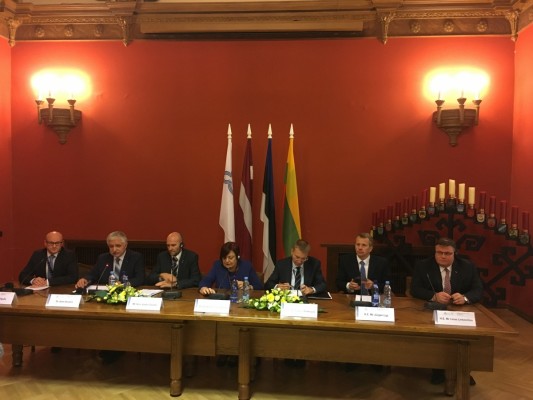
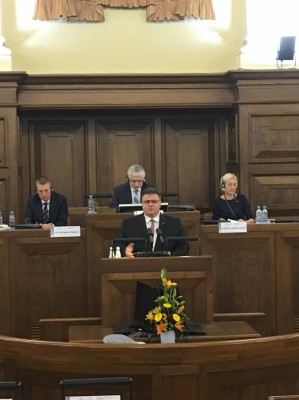
At the 22nd Baltic Council on 28 October in Riga, the Minister of Foreign Affairs of Lithuania Linas Linkevičius reviewed the trilateral cooperation among Lithuania, Latvia and Estonia in 2016, noting the achievements and challenges facing the Baltic states in the fields of security and defence, strategic communications, energy, transport and other areas of cooperation.
“This year, we celebrate the 25th anniversary of cooperation among the three Baltic states. We have proved to the entire world that when working together unanimously, we can achieve a lot of things. Once our eastern neighbour’s former zone of influence, we have become a prosperous and peaceful region, which has resumed its historic place within the European family. We are linked to Europe through our values, identity and a strong will to defend freedom and democracy,” said Linkevičius at the Saeima (Parliament) of Latvia.
The head of Lithuania’s diplomacy reviewed the main challenges of today. “In a complex geopolitical situation and in the face of emerging common threats, we must be united and make a joint effort in order to achieve our priority objectives,” said Lithuania’s Foreign Minister. He also called for the strengthening of national defence capabilities and the implementation of deterrence measures, the coordination of the fight against hybrid threats, the strengthening of regional energy security and the development of transport links, as well as the maintenance of a values-based policy.
In his speech, Linkevičius raised an issue that is of importance to the entire region – nuclear safety.
“In violation of international requirements, nuclear power plants are being built in Lithuania’s neighbourhood. The Belarusian NPP in Astravets raises our particular concerns. We must all together simultaneously raise fundamental requirements for Belarus to ensure that the Astravets NPP project is monitored and controlled, and send a serious signal warning that they cannot trade electricity in Europe, if it is produced in violation of international environmental and nuclear safety standards,” stressed Lithuania’s Foreign Minister.
The Baltic Council adopted a joint statement on priorities for the Baltic cooperation in 2017 – the strengthening of cooperation in the field of security and defense, the development of regional energy markets and transport links.
On 28 October in Riga, Lithuania’s Foreign Minister met with the Latvian Foreign Minister Edgars Rinkēvičs, the Minister of Foreign Affairs of Estonia Jürgen Ligi and the Vice Prime Minister of Ukraine Ivanna Klympush-Tsintsadze. During the meeting, Linkevičius expressed his belief that the EU would be able to take important decisions for Ukraine until the forthcoming EU-Ukraine summit in Brussels on 24 November.
“To ensure a visa-free regime to the EU for its citizens, Ukraine has met all the required criteria, thus, it is high time we completed due procedures within the EU. Hopefully, following the referendum, which was held in the Netherlands on 6 April 2016, the Government of this country will be able to find and, as soon as possible, reach a mutually satisfactory solution,” said Linkevičius.
Lithuania’s Foreign Minister stressed that the EU-Ukraine Association Agreement, which was sought by Ukraine for so long and is economically beneficial on all sides – the EU member states and Ukraine – should be kept in place in spite of its rejection in the Dutch referendum.
Social media


