LIVELY LITHUANIA, THE CAPITAL OF CULTURE (The Copenhagen Post, Issue 8-February 28, 2008)
Lithuania’s ambassador expresses gratitude for Denmark’s early recognition of her country’s 1990 independence and its assistance ever since, and is enthusiastic about the role of Vilnius as European Capital of Culture next year
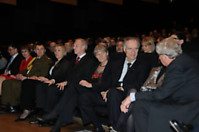
A pyramid of red, yellow and green flowers decorated the grand piano at the Lithuanian Embassy - the colours of the flag of Lithuania - evidence of the celebrations last week of the 90th anniversary of the restoration of Lithuanian statehood in 1918.
 Independence is highly-prized and worth celebrating explains Ambassador Rasa Kairienė as she arrives carrying a bundle of booklets and brochures about her country.
‘But next year we will have even more to celebrate. Our capital city, Vilnius, is to be a European Capital of Culture [one of two, along with Linz in Austria]. More importantly perhaps, we will also celebrate our own millennium. It will be 1000 years since Lithuania was mentioned in a written historical source for the first time, in “the Annals of Quedlinburg”,’ she says proudly.
One of Kairienė’s pleasant duties over the next year is ensuring that the Danes are aware of the multitude of exciting events when Vilnius as the capital of culture hosts its ‘Culture Live’ in 2009.
The idea for Culture Live was inspired by an avant-garde culture movement Fluxus (to flow) that contends that culture is alive and ever-changing. Its stated ambition is ‘to de-elitise’ high art, and ‘de-vulgarise’ mass culture. A detailed handbook of events and information is already available. You can get a copy from the embassy and become a ‘cultural ambassador’ yourself.
Though the Lithuanian summer is short, the season will be packed with festivals and events throughout the land. For centuries it has been home to people of Slavic, Jewish and Prussian descent and this multiculturalism has enriched the culture with tolerance and openness.
‘Lithuanian people love to take an active part in celebrations, so if you visit you’ll find them dancing, singing in the old town centres where visitors are always welcome,’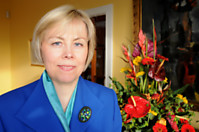 says Kairienė.
‘Since 1991 Lithuania quickly developed its own form of tourism, in particular country-tourism and spa hotel holidays, both of which are still very reasonably priced.’
She explains that since the declaration of the second republic in March 1990, over 300,000 Lithuanians have gone abroad to live in countries like Ireland, the UK, Norway and Denmark, where an estimated 10,000 have lived.
‘But the information and know-how they bring back with them is invaluable. Nowadays we have some sectors with the same labour shortage problems as Denmark,’ says Kairenė.
‘Denmark has “hero” status in my country,’ says Kairienė. ‘It was almost the first country [Iceland was the first] to recognise our independence and ever since relations have been extremely close. My country had to start completely from scratch in 1990, and the Danes were instrumental in helping us to rebuild government institutions, the infrastructure, agriculture and a market economy.’
An economics lecturer at university, Kairienė was selected in 1993 to study market economy for four months on Bornholm. She had a wonderful time, cycling around the island in her spare time and learning to love Denmark.
She joined the Ministry of Foreign Affairs soon after and spent eight years in the office responsible for co-ordinating technical assistance, much of it dealing with Denmark.
After a posting to Stockholm and a spell at home, the position of ambassador to Denmark was a heaven-sent opportunity, which she and her family love.
‘Today economic and defence policy are the two areas of bilateral co-operation. Denmark is the second largest investor in Lithuania, surpassed only recently by Poland when it purchased a major oil refinery. There is active co-operation between Danish and Lithuanian defence forces on international missions, training at brigade level and many smaller bilateral projects between our national defence systems.
‘Has life improved for Lithuanians since the new independence? The sense of freedom is probably strongest. People travel, people return. EU subsidies have helped farmers get on their feet, and industry to grow. We now feel like a normal society and part of a strong community of nations. That’s the most important for us. But come and find out for yourself.’

Social media