LITHUANIAN RENAISANCE BECKONS FOR CULTURE CAPITAL (The Copenhagen Post, Issue April 10, 2008)
Mesmerising but strange music from two young, highly-talented, innovative musicians from Vilnius provides an exciting glimpse of what to expect when the city becomes European Capital of Culture next year
 Spring normally heralds renewal, rejuvenation and rebirth. But next year in Lithuania spring won’t just happen in nature; there will also be a cultural rebirth.
The more people who discover the exciting programme in Vilnius, the harder it will be to get a flight and a room. From New Year’s Eve and throughout 2009, Lithuania will be focusing all its cultural energy on its capital Vilnius.
The promotional film alone was enough to entice the most cynical traveller. Lithuania appears as a combination of Denmark, with its coastal dunes and flat green fields dotted with white houses and churches with red-tiled roofs, and Finland, with its myriad lakes, forests and rivers. But it is in the capital that the cultural lid will come off.
Appropriately held at the Danish Design Centre last week, many gathered to meet Elona Bajorinienė, the director of Vilnius, European Capital of Culture (VECOC). She was visiting Copenhagen to present her city and its programme.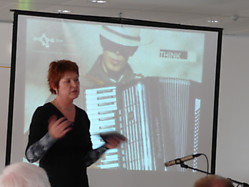
‘Our cartoon logos use the idea of the synergy and the merging of atoms to form larger more exciting matter,’ she said. ‘These symbolise the floating spirit of creativity.’ She added that for 50 years the Baltic countries’ culture had been completely wiped off all international maps, and that VECOC would showcase a culture that has blossomed and strengthened since 1991.
The highlight of the event was a performance by two brilliant young musicians using instruments that ranged from a trumpet to a plastic hosepipe and funnel attached to a glass bowl of water. Their fascinating music evoked many countries and styles. It was a small but exciting taste of what to expect in Vilnius next year.
The VECOC team had previously approached its citizens to write short ‘haiku’ verses about their country, and in virtually no time they had compiled over 6500 verses from 4000 people. It was from these poetic ideas the programme was evolved.
The year-long programme has been divided into six areas (all described in a neat flip-over brochure available at the Lithuanian Embassy) and includes many events.
In mid-June, a new national gallery will open along with a new arts printing house in a beautiful central building that luckily escaped privatisation.
There will be a rock concert on the border with Belarus. The loudspeakers will face Belarus so its people can share the event, but the musicians will face the audience in Lithuania.
Culture Night will be held on the shortest night of the year, June 21, when 40 projects will be available, free throughout the city.
‘We want culture to spread, merge and grow like the atoms in our logo,’ said Bajoriniené. ‘Like a good virus that spreads fast throughout the land, and wider into the world.’

Social media