Lithuanian Foreign Ministry’s Political Director: Cooperation with Poland has become increasingly important
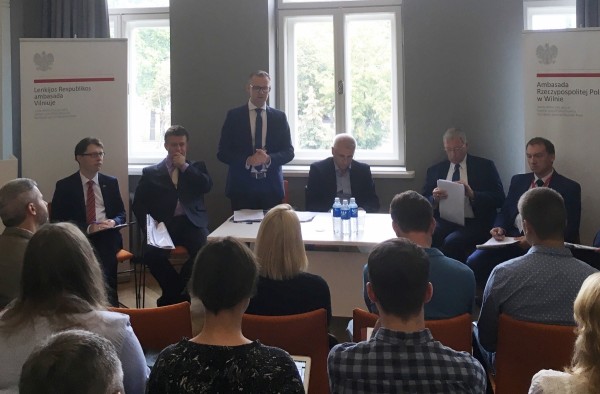
On 16 September, the Political Director of the Ministry of Foreign Affairs of Lithuania Rolandas Kačinskas participated in a conference “Dynamics of Lithuanian-Polish Relations”, dedicated to the 25th anniversary of the re-establishment of diplomatic relations between Lithuania and Poland at the Vytautas Magnus University.
Kačinskas together with Jan Parys, Head of the Political Cabinet of the Minister of Foreign Affairs of Poland, the European Union Ambassador to the Russian Federation Vygaudas Ušackas, an analyst at the Polish Institute of International Affairs Marcin Terlikowski and lecturers at the Vytautas Magnus University – Šarūnas Liekis and Giedrius Česnakas – took part in a panel discussion entitled “Poland and Lithuania after 25 years of resumption of their diplomatic relations – where are we now and where are we striving together? How can we contribute to a stable and prosperous Europe?”.
In his speech, the Lithuanian Foreign Ministry’s Political Director reviewed the relations between Lithuania and Poland over the past 25 years and identified the key areas of cooperation.
“Lithuania and Poland are neighbours and strategic partners. In the current complex geopolitical context, our cooperation has gained even greater importance, because we can be heard a lot better when we speak with one voice,” said Kačinskas. He welcomed the active bilateral cooperation in the field of security and defence, and noted that the decisions of the NATO Summit in Warsaw would make a significant contribution to the efforts to ensure security in the whole region.
“Our common history teaches us that we are the strongest and most effective when we act together. We must never lose sight of the strategic objectives that are important to both countries: the implementation of NATO’s deterrence measures, support for Ukraine and Georgia, creating conditions for further sustainable economic growth, conservation and preservation of historical memory and cultural heritage,” said Kačinskas at the conference. He also pointed out that Lithuania complied with the principle that security should be indivisible, therefore, as one country defended another NATO country, it also defended itself, all the other NATO countries, and the idea of the Alliance itself.
The participants of the conference also discussed the situation of the Polish minority in Lithuania, particularly the issue of education. Kačinskas informed the participants about the situation, noting that Lithuania’s ongoing educational reform applied equally to all citizens, regardless of their nationality, and that schools of the Polish national minority received 20% more funding. It was noted that the Vilnius Joachimas Lelevelis secondary school would be moved to another building and would become one of the most modern schools after its renovation. The most questions have been raised over the issue of moving the secondary school to another building recently. The Political Director noted that Lithuania had the largest network of Polish schools in the world and that our country offered a unique access to education in Polish, as the language of instruction, from kindergarten to university. Kačinskas said that he could not deny that there were some problems, but these problems were being discussed in public and there a normal democratic process was taking place aimed at solving them.
The conference was co-organized by the Vytautas Magnus University, the Embassy of Poland in Vilnius, and the Polish Institute in Vilnius.

Social media