


LITHUANIA READY TO STRENGTHEN ITS ECONOMIC STRATEGY (Jūra.Mоре.Sea, № 6/2006)
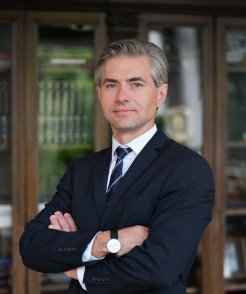
The international business magazine JURA MOPE SEA talks with the Minister for Foreign Affairs of Lithuania Petras Vaitiekunas, whose inauguration to lead the ministry coincided with the complicated international political situation caused by relationship with our neighbor and business partner Russia.
- For many years Lithuanian economy had been under direct dependence on Russia. A few years ago, when Russia started implementing its policy Russian cargo – via Russian ports, the port of Klaipeda lost the most of its cargo; the port had to be re-orientated and search for new business possibilities. Having overcome the difficulties, our port has increased cargo handling volumes cooperating with other countries. Russian cargo makes up only a few percent. Recently, the issues of Russian oil supply have risen. For some period already, oil refinery Mazeikiu Nafta has not been supplied with Russian crude oil, and therefore it has to look for alternative supply resources in Scandinavia, Kazakhstan.
Russian policy on railway tariffs gives grounds for incessant discussions on future of transport corridors, such as Trans – Siberian Railway. They say the project can exist only with the presence of the Russian interest and its willingness to negotiate for more favorable railway tariffs. Otherwise, alternative means in transportation from Asia to Europe will have to be found. Russia is not satisfied with the EU decisions on its transport policy.
- Why has such a situation occurred and what kind of influence might it have on the European and Lithuanian economy? How could Russia influence the change in the world, if alternative solutions to this problem would be found? What is the direction Lithuania should choose in order to diminish the influence of the Russian decisions onto our national economy?
- Really, sometimes it seems that Russia strives to safeguard its national interests not taking into account new cooperation possibilities provided by globalization and the EU enlargement. We in Lithuania do realize that with the growth of regional economy and the cooperation development between the European Union and Russia, the ports of Klaipeda and Kaliningrad have to be treated like partners, and not competitors. With such a pre-requisite an inter-governmental Lithuanian-Russian agreement on cooperation under the project 2K was prepared and signed. Unfortunately, so far Russia does not refuse market distorting discrimination policy on tariffs against the Lithuanian port, but we hope that this problem will be solved when Russia joins the World Trade Organization.
It is also hard to understand, why Russia does not start solving the issue of resuming the supply of oil to Mazeikiai – for this reason losses are suffered not only by Lithuania, but also by Russia, aren’t they? Hopefully, the meeting of the EU member-states’ leaders with the President of Russia Vladimir Putin, which took place on October 20 in Lahti (Finland), managed to attract attention to this problem and this will help to solve it.
However, despite disorders in oil supply and a recent fire, oil refinery Mazeikiu Nafta goes on operating and is supplied with raw material by tankers.
The search for new transport corridors, the diversification of energy sources, Lithuanian integration into the EU energy and transport systems fully comply with our own interests and the interests of the whole Europe. But the creation of the new infrastructure requires large investments, and the process is not as fast as we would wish.
We are interested in resumption of the Lithuanian – Russian cooperation and are even resolute to help repairing the oil pipe-line Friendship – we try to achieve that Friendship would really become friendship.
- Lithuania pays much attention to cooperation with the Ukraine and Belarus. What are major projects under implementation with those countries and what is the future for these relations?
- Being a member of the EU and NATO, we are interested that the space of democracy, security and economic prosperity would expand further to the East. This is the interest of our Eastern neighbors, and the interest of the EU itself. We come out in favour of the EU door open to all democratic European countries that express their will to integrate into the EU backing up this objective by concrete work. Under a successful implementation of reforms in the Ukraine, Lithuania will remain one of the most active supporters of this country in its integration into Euro-Atlantic structures. This is the political support to the Ukrainian Euro-integration aspirations. Major Lithuanian-Ukrainian projects are targeting these goals.
For example, for a number of years Lithuania has been successfully carrying out a project of improving administrative skills of Ukrainian civil servants; Lithuania is an active consultant to Ukrainian officials on the issues of corruption prevention.
The Lithuanian – Ukrainian cooperation in European and Euro-Atlantic integration and regional cooperation are consolidated as well by the statements of the ministers of foreign affairs. Lithuania and the Ukraine share the projects in the following spheres:
national coordination of the EU issues for the veterinary requirements, customs regulations, free movement of capital, simplification of visa regime, refuge and migration, social development, public procurement, insurance, agriculture, law, etc.
While speaking about Belarus, I would single out cooperation on border control issues, in economy, transport, environment protection, and relationship development in neighborhood regions, in culture and while fostering the common historical legacy. An excellent example is the completion of demarking the Lithuanian – Belarusian state border; by the way, it is the first demarked EU external border in the East.
Lithuania is particularly interested in 10 million Europeans living in Belarus that they would not be cut off of human contacts with neighbouring countries and European Union. Even after Lithuania becomes a member of Shengen zone, the relations among our citizens must remain no less intensive.
Such practical cooperation between our countries contributes to the creation of a unified, secure and prosperous Europe. We hope that this partnership among the people and the states will further develop and deepen.
- Kazakhstan showed an active interest to purchase Mazeikiu Nafta. When the deal failed, the main negotiator, a Kazakh company KazMunaiGaz withdrew from Lithuania, but Kazakhstan and Lithuania are still bound with wish for cooperation. What are the prospects for such cooperation?
- Lithuania and Kazakhstan have not yet used all possibilities for cooperation. Although the Kazakh oil company KazMunaiGaz did not succeed to buy Mazeikiu Nafta, we hope that our countries will continue cooperation in this field.
Not once Lithuania has noted that it could buy oil and natural gas from Kazakhstan, still up till now we did not succeed in solving the question of transit transportation of the resources via the territory of Russia. It is very important that Russia ratifies Energy Charter.* It would help to liberalize the regime of the resources transit and would open the roads for the resources of Central Asia to Europe.
Kazakhstan’s oil resources are the richest in the Caspian region; the stock of natural gas is also rather great (respectively the eighth - tenth place in the world). Therefore, Lithuania would be very much interested in importing energy from Kazakhstan and guaranteeing an additional source to the present oil and gas importers. Unfortunately, so far, neither oil nor gas can reach Lithuania.
Kazakhstan has got connected to the oil-pipe Baku-Tbilisi-Deckhand (Azerbaijan – Georgia – Turkey) and discusses the possibility to connect to the gas pipe-line Baku-Tbilisi - Erzum (also Azerbaijan - Georgia - Turkey) by laying relevant facilities via the Caspian Sea.
Optimism is raised by the fact that the EU ‘eye’ is directed towards the Caspian Sea region with the great potential for cooperation in energy. In the context of good relationship between Europe and Kazakhstan eventually the agreement on the revival of the project of oil-pipe Odessa – Brody – Plock can be anticipated, by which the oil from Kazakhstan would reach Lithuania.
We are glad with increasing trade volumes between Lithuania and Kazakhstan. In 2005 the turnover of the countries compared with 2004 has nearly tripled. We expect such tendencies to remain in future.
With the appearance of direct communication (on January 23 this year weekly charter flights Vilnius- Almaty-Vilnius were launched), a more active cooperation among our business people and the development of tourism became probable.
Lithuanian Bank of Economy has recently established its representative office in Kazakhstan. Our EU membership and the participation of Kazakhstan in inter-regional energy projects open wider perspectives for economic cooperation. We think Kazakhstan could be interested in investment possibilities in Lithuanian sectors of transportation, industrial production and other fields.
We also hope that companies of Kazakhstan will make a better use of Klaipeda port capacities, and cargo from Kazakhstan will dominate in cargo in the Lithuanian port. **
- What priorities of Lithuanian foreign policy will prevail during the period of your leadership in the Lithuanian Ministry of Foreign Affairs?
- As I have more than once mentioned, the objectives of the Lithuanian foreign policy remain unchanged. The main goal is the best representation of Lithuanian interests, safeguarding Lithuanian security and democratic development in the context of new threats and challenges.
Euro-Atlantic cooperation is the major warrant of the national security; both NATO and the EU are the most important organizations for Lithuania.
We need to secure a solid Lithuanian position in the EU and NATO, to learn efficient ways in using the possibilities of the EU membership and developing neighborhood policy.
We will support further integration of the EU member states, taking into consideration Lithuanian national interests.
We will foster the expansion of democracy to the East and consider it to be a precondition for a long-term success of our country. Lithuania supports the open door policy of NATO and the EU. The requirements of these organizations are based on the criteria of the achieved results, and candidate-states hoping to get closer to NATO and the EU, have to carry out serious internal reforms.
I would also like to say a few words about relations of Lithuania with its neighbors.
The EU membership enables Lithuania to develop good relationship with its neighbors, primarily by active participation in forming and implementing neighborhood policy of the European Union. Our aim is to develop the Baltic region cooperation with the Eastern neighbors of Europe and actively contribute to the creation of new regional cooperation forms. In this context the favorable geographic location of Lithuania and its cooperation experience are of great value.
I would appreciate, that Lithuanian diplomacy took a better heed to actual needs of our people. To achieve this, we will develop and improve consul services, strengthen economic diplomacy and consider expectations of our business circles.
- Thank you for the conversation.
Interview by Milda Manomaityte
* European Energy Charter. Prepared in 1991 in the Hague, the European Energy Charter now has got 51 signatories. The Charter provides the code of behavior defining European principles, objectives and ways of cooperation in the field of energy. The Charter aims at increasing the safety of energy supply and stimulate the common European energy market with respect to environmental protection requirements. After the negotiations, which had lasted for more than three years, the European Energy Charter was signed in Lisbon on December 17, 1994. (W.Weidenfeld, W.Wessels, Europe from A to Z. The Manual of European Integration.-V., 1999).
** During 9 months of 2005, 676 thous. tonnes of cargo were handled in Klaipeda port, and during 9 months of 2006, 450 thous. tonnes of Kazakhstan cargo (metals, food, etc.) were handled. (the data of Klaipeda State Seaport Authority).
Social media


