LITHUANIA MILLENIUM CELEBRATIONS (The Canberra Times, 6 July 2009)
Significant year full of momentous celebrations for Lithuania By Lithuanian Ambassador to Australia Dainius KamaitisIt is my pleasure to address the readers of The Canberra Times on this historic occasion – Lithuania has just entered the second millennium of its history.
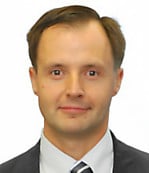 This year also marks the 60th Anniversary of the Canberra Lithuanian Community. I am confident that these memorable anniversaries provide a great opportunity to look back at the past of our country and reflect on its identity as a European state.
Sanctus Bruno, qui cognominantur Bonifacius, archiepiscopus et monachus, XI suae conversionis anno in confinio Rusciae et Lituae a paganis capite plexus, cum suis XVIII, VII. Id. Martii petiit coelos,” translates to,“In the year 1009, St. Bruno, also known as Boniface, archbishop and monk in his 11th year of conversion, was struck in the head by pagans at the border of Rus and Lithuania, and along with 18 of his brethren entered Heaven on the seventh day before the Ides of March.” This is an excerpt from the Annals of Quedlinburg (Saxonicae Annales Quedlinburgenses), which were written in the 11th century in the convent of Quedlinburg Abbey, Germany.
Although the mission of St. Bruno to baptize the pagan King Netimer had a sad ending, these annals contain the first recorded mention of Lithuania, which takes us back 1,000 years.
So let me reflect on the key moments of the Lithuanian nation and state. In 1253, Grand Duke Mindaugas was crowned as the first and only king of Lithuania. An important turning point in Lithuanian history was the coronation of Grand Duke Jogaila as king of Poland at the end of the 14th century, which led to the Christianization and Europeanization of Lithuania.
Grand Duke Vytautas the Great was undoubtedly the most famous of Lithuania’s rulers. Under his rule, the country’s military union with Poland led to the overwhelming victory against the Teutonic Order. The Grand Duchy of Lithuania stretched from the Baltic Sea to the Black Sea, reaching the peak of its power in the first decades of the 15th century.
In 1569, the Union of Lublin united the Grand Duchy of Lithuania and the Kingdom of Poland into a federal republic of the Polish-Lithuanian Commonwealth. However, the Grand Duchy of Lithuania ceased to exist in 1795, when Russia, Austria and Prussia divided between themselves the remaining territories of the Polish-Lithuanian Commonwealth for the third time. Thus the larger part of the former Lithuanian state was ceded to the Russian Empire.
From then, for well over a century until 1918, Lithuania existed neither as a political nor as a geographical entity. It was a dark period in its history, with continuous attempts by czarist Russia to suppress the national identity of the Lithuanians. However, in the latter part of the 19th century Lithuania experienced a national revival that laid the foundation for a modern state.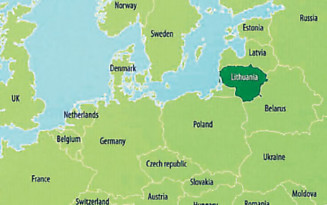 During World War I, Lithuania was occupied by the German Army, but the Lithuanian state was restored in 1918 and became a republic. In 1939, the infamous Molotov-Ribbentrop Pact signed by Germany and the Soviet Union divided Central and Eastern Europe into two areas of influence, and Lithuania fell to Soviet occupation a year later. It took as long as 50 years of Soviet control before Lithuania re-established its independence in 1990.
In 2004 we entered a new era, joining the European Union and NATO and gaining the necessary diplomatic leverage to participate in world politics.
Despite the whirlpools of its dramatic history, Lithuania was and continues to be an integral part of Christian Europe, and the history of Lithuania was and continues to be the history of encounters, links and dialogues with other European peoples, states and cultures. Therefore it is no coincidence that along with the commemoration of the millennium of the first recorded mention of Lithuania, its capital Vilnius has taken the baton from Liverpool and Stavanger to become the European Capital of Culture in 2009 together with its Austrian partner city of Linz.
The national program “Vilnius – European Capital of Culture 2009” aims to promote dialogue and tolerance, strives to elevate culture as a virtue in modern society and the driving force in city development, which will distinguish Vilnius as one of the most modern and dynamic cities in Central and Eastern Europe, known in the world as a contemporary cultural centre, and one with a unique and apparent identity that is open to new ideas and investments.
For the whole year, the streets of Vilnius, squares, museums and art centres, theatres and concert halls will turn into a huge arts platform for hundreds of events that will involve not only local and international artists, but the citizens and guests of Vilnius as well. As participants or spectators, everyone will add a touch of originality and warmth to the program.
So taking this opportunity, I would like to invite you to visit Lithuania during this memorial year and experience the vital celebration of creativity yourselves.
Celebrate 60 years of Canberra Lithuanian Community
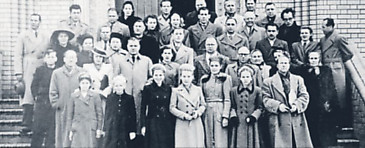
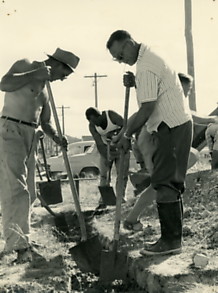 Lithuanian refugees from the Second World War began arriving in Canberra in 1948.
They soon organised themselves, and the first community meeting was held in January 1949 at the Capital Hill Hostel.
Over the following decades choirs, folk dancing groups, scouts, a sports club, a returned servicemens’ organisation, pensioner’s groups and other organisations were established. The Lithuanian-Australian Club was built at Lyneham in the early 1960s, and formed the centre for many community activities until it closed in 1999.
A significant milestone was the Australian Lithuanian community’s gift to the people of Australia for the Bicentenary celebrations in 1988 of a sculpture in Glebe Park.
Notable events for the community in recent years included the establishment of a Lithuanian display at Cockington Green, the visit of Lithuania’s President Adamkus in 2006, and the visit of the first Lithuanian Ambassador to Australia, Mr Dainius Kamaitis, in 2008.
In addition to its Canberra-based activities, the community supports cultural and educational initiatives elsewhere in Australia and in Lithuania.
Two examples are:
- assistance for needy students from the Siauliai High School in Northern Lithuania to make the transition to university. The High School has developed an enhanced English language teaching capacity, and maintains strong links with Australia;
- support for the Lithuanian Studies Society at the University of Tasmania. The Society funds an annual $5000 postgraduate scholarship at the university, maintains a library for Lithuanian studies, and has published an annual journal ‘Lithuanian Papers’ since 1987.
 Further details of the society’s activities may be obtained from Dr Al Taskunas OAM; phone (03) 6225 2505, or email A.Taskunas@utas.edu.au.
21st celebration in Glebe Park
2009 marks the 21st birthday of Egle, a young woman who lives permanently in Glebe Park, Canberra.
Egle is a statue, presented to Australia by the Lithuanian community of Australia for Australia’s Bicentenary celebrations in 1988.
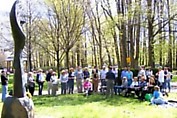 She was the first sculpture to be erected in Glebe Park, and represents an ancient Lithuanian fairy tale, ‘Egle, Queen of the Serpents’.
That story deals with the universal themes of family, love, separation, acceptance and transformation, in many ways reflecting the World War II Lithuanian migrant experience.
The statue was designed and translated into bronze by the sculptor Mrs Ieva Pocius of Adelaide.
The country at a glance
Location: On the eastern coast of the Baltic Sea. Lithuania is one of the ‘Baltic States’, along with Estonia and Latvia, and borders Poland, the Russian Federation, Belarus and Latvia.
Territory: 65,300 sq. km., similar in size to Tasmania. There are 722 rivers, over 2,800 lakes, and 28 per cent of the land is forested.
Climate: The average July temperature is around 23C, while the average January temperature is around -5C.
Population: 3.4 million.
Language: Lithuanian, one of the oldest of the living Indo-European languages, uses a Roman alphabet.
 Head of State: Presidential elections in May 2009 resulted in former European Union Budget Commissioner Ms Dalia Grybauskaite elected as Lithuania’s first female President. She will be sworn in on July12, 2009.
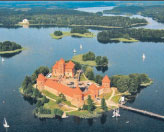
Capital: Vilnius (population 550,000) was established in 1323. UNESCO has listed the Old Town on the World Culture Heritage List, and the European Union has selected Vilnius as a 2009 European Capital of Culture.
Currency: the Litas, which is pegged to the Euro. Lithuania is currently working towards joining the eurozone.
Travel: no entry visas are required for Australian citizens planning to visit for less than 90 days.
For the original version of the page please click here.

Social media