


Lithuania invited to become associate member of CERN
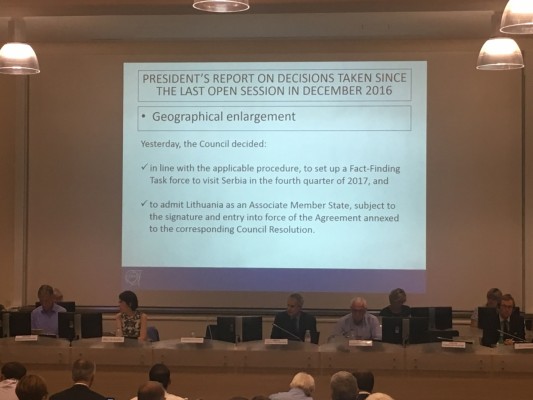
At the 185th session on 16 June, the Council of the European Organization for Nuclear Research (CERN) invited Lithuania to become an associate member. An agreement between Lithuania and CERN on the status of the country will be signed on 27 June in Vilnius, at the Office of the President, by the Minister of Foreign Affairs of Lithuania Linas Linkevičius and Dr. Fabiola Gianotti, CERN Director-General, who will arrive in Lithuania with a delegation.
Lithuania started to cooperate with CERN scientists in 1990, while a cooperation agreement was signed in 2004. The agreement provides for the development of scientific and technical cooperation in the field of high-energy physics. The country opened talks on the associate membership in 2016 after the President of Lithuania Dalia Grybauskaitė and the CERN Director-General Gianotti had discussed partnership conditions.
Lithuania will cooperate with CERN in the areas of science and research, education, business and healthcare. The Lithuania-CERN agreement on the associate member status will allow Lithuanian scientists to participate in CERN research programs and activities of its management bodies. It will also open up additional job and internship opportunities for graduate students, students and young researchers at CERN. In addition, Lithuanian companies will be able to participate in CERN procurements.
During the new phase in Lithuania-CERN relations in the medium term, we aim at strengthening the Lithuanian team of scientists, engineers and information technology specialists. The Lithuanian team that complies with international science and technology standards would participate in large international science and technology projects in the fields of physics, radiobiology, medicine and nuclear physics.
Lithuania will become the fifth associate member of CERN and, thus, join the organization that has 22 member states and hosts about 12,000 scientists. The organisation seeks answers to questions about the universe. CERN has built the world’s largest particle accelerator and discovered the Higgs boson. A scientist at CERN Tim Berners-Lee invented the World Wide Web in 1989 and developed the first website.
Social media


