LITHUANIA INDEPENDENCE DAY (The Japan Times, February 16, 2008)
Building a bridge of democracy across Europe It is my pleasure to address the readers of The Japan Times on the happy occasion of the 90th anniversary of the restoration of the State of Lithuania.
 Looking at the Lithuanian calendar, one might be surprised to find as many as three national holidays related to the commemoration of statehood. Although this fact explicitly reveals the Lithuanian nation’s zeal to cherish its state and independence, I believe a more detailed explanation to the readers who might not have come across the whirlwinds of the history of Lithuania, would be helpful here.
I will start with the Day of the Coronation of King Mindaugas, the ruler of the united Lithuania, in 1253, which we celebrate July 6. Historians consider this date as the foundation of the State of Lithuania. Second, February 16 marks the declaration of the restoration of the State of Lithuania, which was proclaimed by the Lithuanian Council in 1918. This determining message to the world was a clear confirmation that the Lithuanian nation, despite hundreds of years of oppression, was alive, pursuing freedom and ready to take up the responsibility to restore its state. And last but no less important to us is March 11, which enshrines the restoration of independence from the Soviet Union declared in 1990.
These numerous rebirths of the Lithuanian state are inseparable from the reflections on the nature of the Lithuanian national identity. I haven’t seen anything better than the following passage by Algirdas Julius Greimas, the world-famous linguist who laid the foundations of the Paris School of Semiotics, to illustrate best why a tiny Lithuanian nation made its way through the hardships of history:
“A nation rising from the antiquity like a shadow from the fog, pushed by history into a forsaken corner of the Baltic, squeezed by its two great neighbors – the Slavs and the Germans – but cut off from the sea; freed from serfdom and reawakened to a national rebirth by its town doctors and village priests in the second half of the 19th century. What right does this land have to a life of freedom?
“A feeling of pride swelling from the depths of the soul is Lithuanian’s first response to queries regarding its nationality. Pride not so much in kings and dukes – for who did not have them! – not so much in (Grand Duke) Algirdas, who struck down the gates of Moscow with his sword, nor in (Grand Duke) Vytautas, who vanquished the Teutonic orders, but in the long road and the brief space of three or four generations, during which time the Lithuanian nation advanced from its smoky cabins and forked wooden plows to modern social structures, to the mastery of science and technology, to the creation of its own cultural values. A nation is not only a glorious or sorrowful past, not only the elusive and often incomprehensible confusion of today, where vileness cannot be distinguished from heroism; a nation is its collective energy, its refusal to accept a collective death, its struggle to live on.”
I believe this excellent excerpt gives the reader a rather comprehensive idea of who we Lithuanians are, and where we came from to the contemporary world. And that will help you to understand why Lithuania re-established its independence again in 1990, after 50 years of the Soviet regime. It entered a new era in 2004, joining the European Union and gaining the necessary diplomatic leverage to participate in world politics. 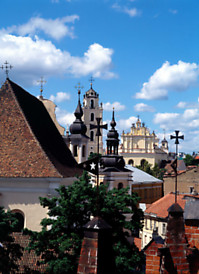
Lithuania takes every effort to contribute to the Millennium Development Goals of peace, economic growth and social stability, and the reduction of disparities between countries and regions. Taking advantage of its own experience, Lithuania is building a bridge of democracy from the west to the east of Europe. It advocates the aspirations of Ukraine, Georgia, Armenia and Azerbaijan to integrate into the European region, supports pro-democratic forces in neighbouring Belarus. The Lithuanian military takes part in NATO peacekeeping operations in such remote areas as Afghanistan and Iraq.
Turning to the relations with Japan, Lithuania was officially recognized in 1922, and especially after the re-establishment of diplomatic relations in 1991, both countries enjoyed truly good ties. But it was not until Lithuania joined the EU that this relationship began to produce substantial results. The first visit to Lithuania by the Japanese foreign minister in 2006 paved the way for the epoch-making visit of Their Majesties Emperor Akihito and Empress Michiko last May, which perfectly highlighted the rising bilateral ties. And the first resident Japanese ambassador to Vilnius is scheduled to assume his post by spring, filling the missing link in the bilateral relationship.
In this regard, I am pleased to announce a small but nevertheless dear anniversary. This year will also mark 10 years since the establishment of the Lithuanian Embassy in Tokyo. In a flashback, I see myself setting foot on Japanese soil in 1998 as the first Lithuanian diplomat residing in Japan. Since then, the Embassy has expanded in quantity and quality, and recently a newly appointed Lithuanian cultural attaché has assumed her duties at the embassy, which I am sure will lead to strengthening the people-to-people relations between our two countries.
And last but not least, next year my country will celebrate the millennium of the first recorded mention of Lithuania in 1009 in the “Quedlinburg Annals.” Also in 2009, the Lithuanian capital Vilnius will take the baton from Liverpool and Stavanger to become the European Capital of Culture together with its Austrian partner city of Linz.
The program of Vilnius - European Capital of Culture 2009 was named “Culture Live” to reflect the dynamic, changeable and innovative character of culture that Vilnius is developing with zeal. The essence of the project is bringing an authentic creativity sparking here and now to all spheres of life, building new relationships between people, organizations, cities and countries.
The program will embrace European art, live history, culture rediscovery and culture enjoyment sections, involving participants from neigbouring and distant countries. It is interesting to note that there is the Japanese dimension in the program, too. A contemporary art project by the famous composer Ryuichi Sakamoto and artist Shiro Takatani, which by a mere coincidence bears a perfectly matching title of “LIFE – fluid, invisible, inaudible,” is expected to highlight the festival LUX in November 2009.
In addition, among the appetizing events launched last year, the most successful appeared to be a poetry project “Haiku to Vilnius,” which invites the residents and guests of the city to share their emotions in the traditional Japanese verse form. As many as 7,000 haiku have already reached the organizers by e-mail and post. They were compiled by the people from all walks of life, from ordinary people to professionals in literature and the arts coming not only from Lithuania but from foreign countries as well, including Japan. It was decided that the most successful haiku pieces will be exhibited at various public spaces in the Lithuanian capital.
So taking this opportunity, I would like to invite all of you to join and send your entries to www.haiku.lt and mark Vilnius as your holiday destination in 2009.
By Dainius Kamaitis
Ambassador of Lithuania

Social media