Lithuania and Sweden – Divided but Also United by the Baltic Sea (Made in Lithuania, Vol.19, No.1, 2006)
Sweden, the largest source of Foreign Direct Investment in Lithuania, is extending its hand in friendship. Cultural relations between the two countries, which are divided and at the same time united by the Baltic Sea, have developed into friendship and co-operation in many fields. The rapid development of economic relations is a source of great hope for the two neighbouring nations. In our interview, Ambassador of Lithuania to the Kingdom of Sweden, Petras Zapolskas, told us more about these issues.
— How would you characterise Swedish assistance to Lithuania during the Lithuanian struggle against occupation? What kind of assistance was given and what impact did it have on regaining independence for our country?
— Swedish delegates, who came to the presentation ceremony of the book of reminiscences by Juozas Lukšas, wondered how in the middle of the twentieth century Lithuania went through three occupations and still managed to fight in a fierce resistance war until the middle of the 1960s. They were amazed when they were told that in some countries diplomatic representations of Lithuania operated until the eve of re-establishment of independence. This surprise reflects the general tendencies in the relationship between this Nordic country and Lithuania during the twentieth century. The coalition government in Sweden recognised the occupation of Lithuania and other Baltic States. During the period of the Cold War, the Baltic Sea seemed like a threatening but also a stable barrier to the Swedish people – most of the information available came from Moscow rather than from the other side of the Baltic Sea.
After the citizens of the Baltic States began rallying for freedom, the General Consulate of Sweden in the then Leningrad created three sections for Estonia, Latvia and Lithuania. Monday meetings to support the Baltic States were held in the Norrmalmstorg Square in the Centre of Stockholm. Along with immigrants from the Baltic States, Swedish politicians and ordinary citizens also took part in these weekly meetings. When Soviet tanks were driving through Vilnius, the Lithuanian politicians were given the rostrum in Stockholm to convey the truth about what was happening in our country. The Prime Minister of the Moderates, Carl Bildt, formed a special working group whose task was to help the Baltic States on their road to Freedom. On the 28 August 1991, Lithuania restored diplomatic relations with Sweden and the rest of Scandinavia. On the 19 December 1991 the Cabinet of Ministers in Sweden decided to allocate 10 million kronas to each Baltic State to allow them to open their own embassies in Stockholm. Prime Minister Bildt is probably one of our greatest supporters in our struggle for freedom.
— Now that the political goals have been achieved, what is the prevailing opinion about Lithuania in Sweden?
— Although the distance from Stockholm to the shore of any Baltic State is shorter than the distance to Mãlmö, the Iron Curtain formed a different geopolitical view for the people on the two sides of the Baltic Sea. Even nowadays, it does not surprise me when an ordinary Swede asks what language people speak in Lithuania and whether the Lithuanian language is the same as Russian. The Swedes remember the theory formed by Soviet propaganda that the Lithuanian and the Latvian languages belong to the group of Slavonic and Baltic languages. When I meet people in Lithuania who are not related to foreign affairs I can also hear such distorted views – for them, Sweden is somewhere far away and not on the other side of the Baltic Sea. For them, the Swedish Kingdom is that famous place from Astrid Lindgren’s fairy tales.
— In what ways do the two countries co-operate and what are the prospects for such co-operations?
— Today, Lithuania and Sweden are two reliable partners in the eastern region of northern Europe. They are consistently carrying out difficult assignments in many fields, strengthening bilateral relations, and creating an image of a successful region – the region where there is a balance between economic development, entrepreneurship and social security for their people. Bilateral co-operation is carried out in different forms - their acronyms have already become generic for any knowledgeable Lithuanian businessperson. They are known as NB6, NB8, and BJVT.
The daily routine in these co-operations is intensive and reflects our regional challenges. Currently we are working on ambitious plans through close co-operation with the Nordic Council of Ministers. The Nordic Council of Ministers itself is an example of a successful co-operation between countries whose histories contained contradictory pages – it may serve as a model for solving our own regional problems.
Lithuania’s membership of the European Union has produced a new task for us – to search for valuable experience and partners in order to further Lithuania’s interests. Sweden and other Nordic countries have vast experience and knowledge of how the European Union mechanisms of decision preparation and decision making functions. They can and do provide us with constructive and useful advice.
— What tasks have Lithuania and Sweden undertaken in their bilateral co-operation?
— The changed international environment created a new task for the Embassy in Sweden. Prior to Lithuania’s membership of the European Union, Sweden was Lithuania’s supporter – it provided assistance for many social activities. Now we are equal partners helping each other to ensure regional interests, and helping Europe to improve its relations with Russia, Belarus, and Ukraine. We can say with great satisfaction that due to our joint efforts the themes and the issues under discussion by the European Union are becoming wider and are being explored in greater depth. Both Sweden and Lithuania are concerned about the pollution of the Baltic Sea and about the ever-intensifying economic activity in the sea and around it. These usually illegal activities completely disregard the impact on our environment. The two countries work in unison in their efforts to advance democracy in Belarus and Ukraine. Whether the European Union will have a unanimous position on its relations with Russia depends on how unanimous and how influential the Baltic and the Nordic countries will be in their work to formulate a position in this matter.
— How is friendship between the two countries promoted within the context of cities and organisations?
— Due to disputes at various levels about what represents Lithuania best in the world and the inability to find common ground, the answers to these questions are usually dictated by simpler things. The most important way to promote friendship remains making contacts between people and their cultural and economic activities. Swedish assistance provided through the twin towns programmes and assistance to the activities of municipal and social councils allow the inhabitants of Lithuania to learn first hand about real and working self-governments. It would be difficult to find a town or a county in Lithuania which has no contact with a region in Sweden.
The Friends of Sweden and Lithuania groups, public organisations which provide assistance to Lithuania, the kind patronage of Queen Silvia of Sweden all help to create an exceptionally positive and humanitarian environment for direct contacts between the two nations. During the last year alone three large groups of teachers from Lithuania and experts from the Centre for Folk Art Heritage studied the Swedish experience in education and learnt from various organisations, which support children’s homes and old age homes.
I always say that there are no insignificant causes in our work. If we have the opportunity to find partners for the Tauragë Sport School football team and help the future Narbekovs attend an international tournament on the island of Göttland, it should be as important as holding a lecture at a university or a reception for dignitaries.
— What about cultural relations between the two countries?
— Many of my colleagues probably would have felt great pride if they were able to open a Lithuanian artists exhibition or if they were able to present Lithuanian musicians to a wider audience. The two year music exchange programme between Lithuania and Sweden, Muzikiniai ryšiai (Musical contacts) rose to a crescendo in the final concerts, which were held in the largest concert halls of Vilnius and Stockholm. At the beginning of October this year, Lithuania participated as a guest in the Gothenburg Book Fair - the largest book fare in the region. National attendance in these events showed the cultural potential of Lithuania - a Lithuania where historical accents are harmonised with modern art, book publishing and illustration, a Lithuania which is able to compete with the best international competition on equal grounds.
Through Musical Contacts, Swedish listeners had the opportunity to become acquainted with Lithuanian music - from modern improvisations of traditional folk singing by the Children’s ensemble Kivi to the purely classical pieces performed by the Vilnius String Quartet, as well as by Edgaras Montvidas and Petras Geniušas. I am convinced that it would be quite difficult to find a Lithuanian artist who has not performed in Sweden.
Lithuanian art works by A.Sutkus, A.Petrulis, and Tadas Gutauskas are on display at the Embassy.
About seventy different cultural events are held annually in Sweden. A favourable medium has been created for direct exchange of artists. Eight books by Lithuanian authors have been translated into Swedish and I am certain that this intercultural enrichment will continue in the years to come. We also plan to have multicultural projects with two other Members of the European Union – Poland and France.
— What are the main Swedish investments in Lithuania currently?
— According to the Department of Statistics data, at the beginning of 2005 Swedish direct investment in Lithuania totalled about LTL 2.5 million (705 million euro) or 15.04 per cent of all direct investment. The number of companies which invested in Lithuania has also increased from 151 in 2002 to 174 at the beginning of 2005. Compared with 1 January 2004 Swedish investments increased by as much as 21.2 per cent and compared with 1 January 2002 – by as much as 42 per cent. I am truly convinced that some of these investments found their way to Lithuania due to the Embassy’s activities.
Many Lithuanians go about their daily lives unaware that the service that they receive in many businesses are of the same quality as in Western Europe or in America. This is due to Swedish investment of funds and know-how into the following Lithuanian companies: SEB invested in Vilniaus bankas, Telia Sonera – in Lietuvos Telekomas, Vattenfall A/S in Lietuvos Energija, Tele2 – in Tele 2, and Amber Mobile Teleholding invested in Omnitel. Currently around 4000 Lithuanian citizens work for Swedish capital companies in Lithuania.
— How well do Lithuanians export to Sweden?
— The latest statistical data show that in the first quarter of 2005, Lithuania’s exports to Sweden increased by as much as 4.5 per cent. In 2004 Lithuania’s exports increased by as much as 47 per cent and a surplus of LTL 153 million replaced the annually decreasing trade deficit. One can buy Lithuanian furniture, textiles, and natural minerals all over Sweden. When you buy a product at Lund I advise you to look carefully at the label – in Vilnius the price might be lower.
— What role does the Embassy play in attracting Swedish investment? What can Lithuanian exporters expect from the Embassy?
— Indeed the Embassy has undertaken a new role – to promote economic activity between the two countries. We are working not only in the field of trade – it is very important for us to attract investments across the border. We have to show Swedish companies Lithuania’s potential and advantages – we want to encourage them to move their production lines to Lithuania. We have prepared a memorandum to Lithuanian businesses about the traditions and the customs of Swedish business and the possibilities to find partners. We have a rule at the Embassy: every Lithuanian or Swedish businessperson who requires our assistance will receive a consultation or answers to all his questions immediately. If more time is required than is available the businessperson will receive an answer by electronic mail in the immediate future. I say to every Lithuanian businessperson I meet that the Embassy cannot sell goods or set up a joint enterprise for him / her – they must do it by themselves. However, we can help them on their way.
The Embassy works to provide information about the current business environment; to create a timely assessment of the market and the tendencies prevailing in the market; and to support a better climate for economic activity through strengthening institutional bilateral co-operation. The Swedish business community looks sceptically at partners who have no electronic communication means or fail to respond to such communication, Partners who have no Internet website or are unable to communicate in English are also seen as unsuitable. We have noticed that different, even specialised business missions to Sweden are much less appreciated than the practical provision of information about an enterprise and its prospects.
— What advice would you give Lithuanian exporters who intend to look into Sweden?
— A simple advice to a businessperson is: if you have not formed a one-page presentation of your company and have not drawn up your business plan in English yet, you should not go on any missions – go and do your homework. It is time we gave up our Lithuanian modesty – be sure that your company is unique and the product that you manufacture is the best in its field and at the lowest price possible. Establish a contact first - negotiations is another stage.
We travelled throughout the country many times, gave lectures and met politicians and business people. Tendencies to move production to Lithuania have already been seen in the processing, metal, and polygraph industries. In the future production transfer from Sweden to Lithuanian should increase in the electronics and machinery equipment sectors – sectors, which require a higher value-added tax.
A new and far-reaching bilateral economic co-operation project, which attracted business interest and which expresses Lithuania’s integration into the regional infrastructure, is the cross-Baltic electricity bridge between Lithuania and Sweden. I believe that this project will be initiated in the coming years.
— The small Baltic Sea is the only natural barrier which divides and at the same time unites Lithuania and Sweden. What are the tourism perspectives for both countries?
In 2004 the number of tourists from Lithuania to Sweden increased by as much as 21 per cent. We are an open Embassy – any Swedish person may call us or come to the Embassy and receive information about tourism. In 2005, in co-operation with Lithuanian tourism industry representatives we held a tourism show in Stockholm. On 9 May 2004, in co-operation with the new Member States of the European Union, we disseminated information about Lithuania in an information booth in the centre of Stockholm.
Currently we are co-operating with the Tourist Department’s Head of the Information Bureau in Finland who initiated the Swedish language Internet website. Due to the fact that 83 per cent of the Swedes use computers, this has to be the perfect way to provide information about Lithuania. Now every Swede who enters the www.litauen.se website in his computer can find all the information he needs.
In the autumn, we supported three groups of journalists’ visits to Lithuania. One group, which consisted of 40 people, conveyed positive views about Lithuania upon its return. We keep on doing what we do. I invite more people who work in the Lithuanian tourism industry to take part in the annual Tourism Fair to be held in Gotenburg this spring. Every year the Lithuanian Department of Tourism creates better opportunities for companies to introduce themselves and their products at that fair.
— Lithuanian immigrants are scattered all over Europe, including Sweden. How do they promote Lithuanianness in that country?
I belong to that group of optimists who think that the Lithuanians who leave Lithuania for foreign countries are the phenomenon, which should be regarded as an opportunity rather than a problem. I know that it is unpopular to say so, yet I say this openly both to the representatives of the Lithuanian community in Sweden and to the nationals who do not participate in the activities of the community.
I regularly meet the representatives of the ever-decreasing generation of the post-war immigration – they were forced to leave their country and had no option to return. Current immigration is economic in its nature, such immigrants have the right and the possibility to choose.
The fate of Lithuania, as a state, is complicated. A belief that all Lithuanian citizens could live better immediately is unrealistic. If we want to create a better future for all Lithuanians we have to do it together without complaining or blaming anybody. If someone is not positive when he/she thinks about his/her native country, it should not be a tragedy. I, on the other hand, maintain close personal relationship with those Lithuanians who hold Lithuania in the highest regard, who are able to act, and who are able to create small ‘Lithuanias’ in Stockholm or somewhere else. We discuss our problems and celebrate holidays together.
I take pride in the old and young generation of Lithuanians in Sweden. Most of them are honourable people who have found their place when faced with new circumstances. Every year the decorated Christmas tree in my home in Stranvagen Street attracts not only the young Lithuanians who attend the Lithuanian Saulë Sunday school but also those who live in the suburbs of Stockholm. At the beginning of last summer, in co-operation with enthusiasts from Lithuanian institutions, the Lithuanian community and Saulë school we held a meeting of regional Sunday schools in Sigtung, the regional capital in Sweden. Representatives from Sunday schools in Sweden, Denmark, Norway, Germany, Holland and Ireland were in attendance. The meeting could become a tradition because the Lithuanian School in Ireland decided to take over this initiative. Discussions about future events will continue.
During the last fifteen years, a solid basis was formed for good relations between Lithuania and Sweden. The idea that the Baltic region as well as Northern Europe are part of the most homogenious region of the European Union is becoming a reality in both countries, as well as in the other countries in this region. The strong chemistry between our two countries is a contributing factor to solving internal and external affairs.
 |
 |
 |
 |
|
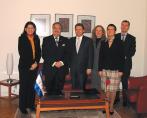
The employees of the Embassy of the Republic of Lithuania with the diplomats from the Honduras Embassy after establishing the diplomatic relations on 26 January 2005. From left: the Counsellor of the Honduras Embassy Klaudia Maria Rodrigez Godoy, Ambassador Ivan Romero-Martinez, Ambassador of the Republic of Lithuania Petras Zapolskas, Counsellor Lyra Puišytė, First Secretary Indrė Dagilienė, Counsellor Vaidotas Karvelis |
A reception at the Embassy of Estonia on the occasion of accession of the Baltic States to NATO, on 5 April 2004. From left: Ambassador of Latvia to Sweden Artis Bertulis, Minister of Foreign Affairs of Sweden Laila Freivalds, Ambassador of Estonia Toomas Tiivel, Ambassador Petras Zapolskas |
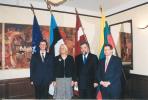
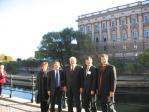
A delegation of the Republic of Lithuania after the meeting with the Prime Minister of Sweden G.Persson at the Office of the Government. 17 October 2005. From left to right: Head of the Protocol Department of the Prime Minister of the Republic of Lithuania Miglė Jankauskienė, Ambassador Petras Zapolskas, Prime Minister Algirdas Mykolas Brazauskas, State Secretary of the Ministry of Foreign Affairs Algimantas Rimkūnas, Government Adviser on the foreign policy issues Darius Pranckevičius |
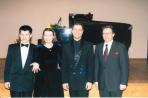
Concert in Stockholm on the occasion of the 16 February 2003. |
|
|
 |
 |
 |
|
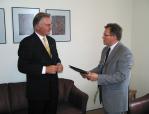
Leaving for the Royal Palace for the ceremony of presenting Ambassador Petras Zapoliskas’ credentials to the King of Sweden Carl XVI Gustaf, 14 November 2002. |
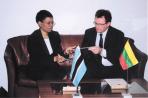
Establishment of diplomatic relations of the Republic of Lithuania with Botswana, 17 February 2004. |
Establishment of diplomatic relations with Honduras. |
Presenting the credentials to Honorary Consul of Lithuania Halmstade Evert Grahn 26 August 2003. |
|
|
 |
 |
 |
|
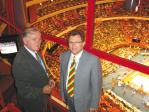
Two-three hours are left before the Lithuanian basketball team scores victory in the European Basketball Championship. The 12th floor of the Stockholm Sports Arena is occupied by the keenest fans President of the Republic of Lithuania Valdas Adamkus and Ambassador Petras Zapolskas, 16 September 2003 |
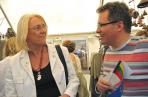
A friendly conversation in the informal surroundings with the Minister of Foreign Affairs of Sweden Laila Freivalds in the Central Square of Stockholm on 9 May 2004 |
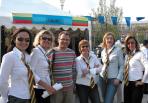
Presentation of Lithuania in the centre of the city of Stockholm on 9 May 2004. From left to right: Second Secretary of the Embassy Asta Radikaitė, Attaché of Culture Liana Ruokytė-Jonsson, Ambassador Petras Zapolskas, Head of the Registry Nerilė Marcinkevičienė, Second Secretary Lina Ramanauskaitė and Swedish Lithuanian Vita Garba |
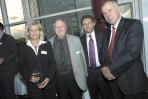
At the Göteborg Book Fair: Attaché of Culture of the Republic of Lithuania in Sweden Liana Ruokytė, Vytautas Landsbergis, Petras Zapolskas, Minister of Culture Vladimiras PrudnikovasLithuania’s stand at the Fair |
 |
 |
||
|
Lithuania’s stand at the Fair |
Congratulation to the first Congress of Lithuanian Sunday Schools The Bridge of Friendship in Sigtuna on 18 June 2005. |

Social media