Linkevičius: A consolidated effort needed to address threats posed by the Belarusian NPP
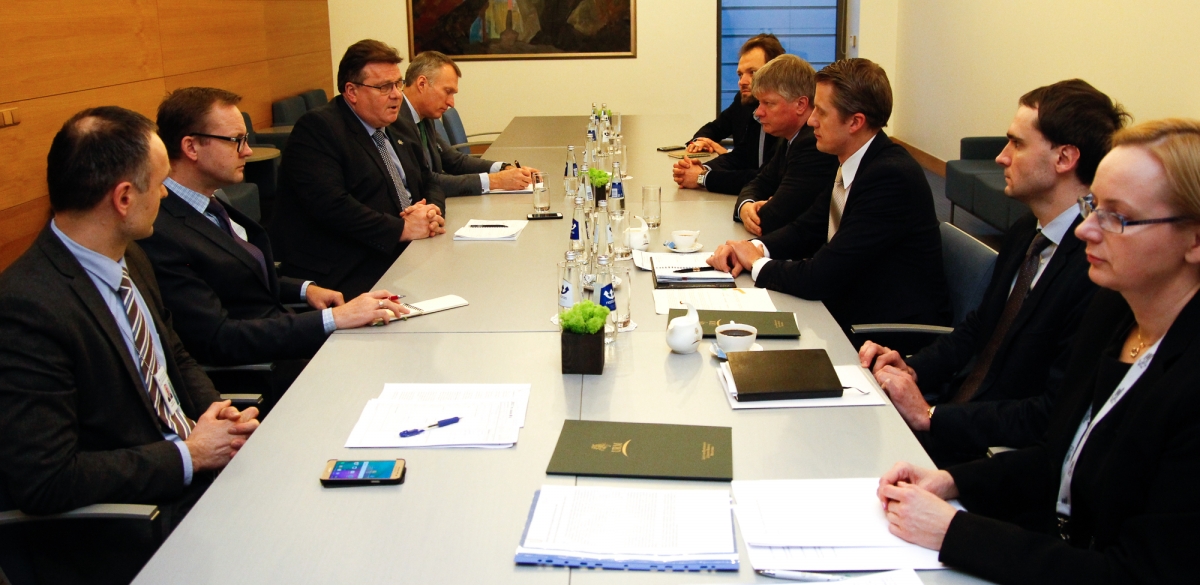
On 3 January, the Minister of Foreign Affairs of Lithuania Linas Linkevičius, the Minister of Environment Kęstutis Navickas and the Minister of Energy Žygimantas Vaičiūnas discussed further cooperation among state institutions on an unsafely implemented nuclear power plant (NPP) project in Astravets.
Linkevičius underlined that a consolidated effort of all state institutions and political parties was needed to address threats posed by the Astravets NPP.
“Today, together with the Minister of Environment and the Minister of Energy, we have agreed not only to continue, but also to improve the coordination of efforts and activities of Lithuanian state institutions at both national and international levels,” said the Foreign Minister.
The Ministers also agreed to coordinate their activities more closely and to make use of the existing bilateral and multilateral instruments, diplomatic and other contacts to actively mobilize the international community’s support for preventing the implementation of an unsafe Astravets NPP project, as this would pose threats to Lithuania’s national security.
“All political parties in Lithuania can make their contribution – not only by providing suggestions or making use of their own contacts, but also by taking responsibility. So we should work even more closely together to deal with those threats,” said Linkevičius.
Today, the Ministers also decided to appoint an Ambassador-at-Large, who would coordinate Lithuania’s actions towards the Belarusian NPP project.
The Ministers also signed letters to the highest-ranking officials of the European Commission and the Director General of the International Atomic Energy Agency (IAEA) Yukiya Amano, drawing their attention to already the sixth incident at the Astravets NPP and asking these organizations to ensure the implementation control of the Astravets NPP project. Lithuania believes that if Belarus continues to implement the Astravets NPP project in an unsafe manner and fails to comply with international safety standards, the NPP project must be stopped, as it will pose a threat to security of the entire region.
In 2009, Lithuania expressed its willingness to participate in the Environmental Impact Assessment (EIA) procedure for the project according to the Espoo Convention. It’s been more than seven years that the country has been seeking to have Belarus comply with the provisions of this Convention. Nevertheless, the Astravets NPP project has failed to comply with international requirements set out in the Espoo and Aarhus Conventions. Moreover, Belarus has also failed to provide answers to questions raised by Lithuania about a possible impact of the Astravets NPP on the Lithuanian population and environment, has failed to perform its obligations and carry out promises to invite the IAEA’s Site and External Events Design (SEED) mission and to perform stress-tests in accordance with the EU methodology.
Lithuania expresses a major international concern over nuclear safety, environmental and radiation safety problems, as well as recurrent incidents at the Astravets NPP. Lithuania is aware of even six incidents that occurred in 2016 alone. The country has learned about the incidents from the media, not from the official Belarusian sources. It should be noted that after the incident on 10 July 2016 at the Astravets NPP, during which a 330-ton unit fell down from a height of 4 meters, it was only due to Lithuania’s principled position that Belarus agreed to replace the damaged reactor vessel.
Lithuania’s key questions about nuclear safety and environmental issues remain unanswered, including why and based on what criteria the construction site was chosen just 50 km from the Lithuanian capital Vilnius, whether alternative sites were considered, when Belarus will invite the IAEA’s Site and External Events Design (SEED) mission, which seismic studies were performed for the assessment of the ground, when Belarus will perform stress-tests, would a reactor containment building withstand an impact of a crash of a heavy airplane, how would water from the River Neris be used for power plant cooling, how would constant water supply for power plant cooling be ensured, what will be the NPP’s impact on the Neris River ecosystem and drinking water, what will be the impact of the NPP’s exploitation on the Lithuanian population and environment under normal conditions and in case of incidents, what emergency preparedness plans will be drafted, how will radioactive waste and spent fuel be managed, as well as other issues related to nuclear and radiological safety, and environmental protection.

Social media