L.TALAT-KELPŠA. EVENTS IN GEORGIA: REAL AND ASSUMED TRUTH (Delfi.lt, 4 September 2008)
Events of the past weeks in Georgia have had wide international repercussions. Lithuania is no exception, as the events in that small country in the southern Caucasus have reminded many people here of the events of 13 January: the same tanks, the same curses, and the same disregard for international law...
Today in Lithuania we are encouraged “to listen to both sides”: purportedly this will enable us to better assess the situation and identify the objective truth. The same method was applied after January 13th — back then there was also the second “truth” which tried to convince people that Lithuanian nationalist snipers were supposedly shooting their own people in the back and that people were throwing themselves under the tanks, etc. They even produced falsified evidence to allegedly confirm such statements.
Back then there was enough common sense to assess the situation adequately and to avoid getting involved in fruitless discussions about who was to be blamed and why they had started it. Now the mechanism of analyses and assessments is working ceaselessly. At least this is the impression one get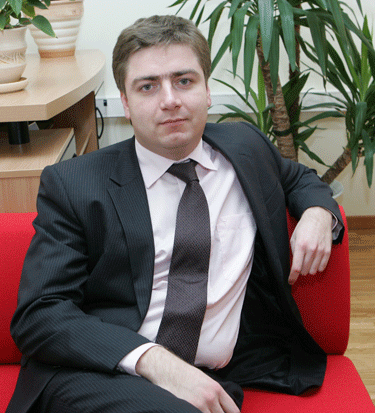 s after reading Lithuanian media websites.
Naturally, the situation has changed completely. Eighteen years ago it was mostly events themselves rather than media comments that shaped decisions and public opinion in Lithuania.
Over those 18 years the progress of Lithuania towards a postmodern society has been sensational. Not only do we have the highest number of mobile phones per capita in the European Union, but virtual space in our small country has expanded to such an extent that sometimes we ourselves are already not able to distinguish between reality and assumed reality.
Such manifestations of the virtual world can be traced in reviews of the events in Georgia over the past few weeks, for example, the statement that “Georgians themselves started it”. Both the Lithuanian and the international press borrowed this statement, even though precisely in this situation we must peer into the story and both sides must be heard. Unfortunately, the version of events presented by Russia is reminiscent of the old Soviet disinformation propaganda, whereby there is no chance of verifying assumptions, as international observers have been prevented from entering South Ossetia until now.
In the meantime, Georgia raises questions that need some effort and willingness to answer. For instance, is it possible to mobilize a few thousand troops, aviation, heavy weaponry, and a fleet in a couple of days and then open two (!) fronts and deploy 3,000 tanks in order "to stop the aggression" and all that with the knowledge that in the worst case scenario you will be confronted by only 200 Georgian tanks? And if such plans of “defence” were prepared at the Russian military headquarters in advance, who were they really directed at?
Georgians will remind you that in the middle of last year Russia announced its withdrawal from the Treaty on Conventional Armed Forces in Europe and immediately increased the amount of weaponry in the north Caucasus. In February this year, Russia started repairing the road between Dagestan and Georgia, which upon Russia’s decision was closed in 2006 after the imposition of a trade embargo; in June Russia turned its focus to the railway connecting Georgia and Abkhazia. Why would the military repair infrastructure that is not in use?
In July, Russia organised military manoeuvres in the north Caucasus called “Caucasus 2008”, which were attended by 8,000 military personnel. The officially declared aim of the manoeuvres was to prepare for "peace enforcement" operations. Isn’t it strange that one month later the same wording was used in speeches by Russian generals with regard to the events in Georgia?
How did hundreds of pieces of Russian military equipment emerge on this side of the Roki Tunnel on the morning of 8 August, if armoured equipment can only move along this tunnel in single file and at a limited speed? And why were the main Georgian armed forces still located in the West of the country, in Senaki, if, as Russian generals insist, Georgians had planned wide-scale “aggression” against South Ossetia, which is on the other side of the country?
Georgia maintains that during all these years its appeals to the international community to at least give attention to what was going on were to no avail. It is hard not to agree with this, in particular, having in mind the reaction to the speech by Valdas Adamkus, the President of the Republic of Lithuania, at the United Nations last year. Therefore, in assessing who the instigators were and who were those defending themselves, it is very important to see the entire context and respect the established rule of law.
If you look at the 1974 United Nations General Assembly Resolution 3314 (XXIX), Definition of Aggression, you will find the following 7 characteristics that qualify as an act of aggression:
a) The invasion or attack by the armed forces of a State of the territory of another State, or any military occupation, however temporary, resulting from such invasion or attack, or any annexation by the use of force of the territory of another State or part thereof,
(b) Bombardment by the armed forces of a State against the territory of another State or the use of any weapons by a State against the territory of another State;
(c) The blockade of the ports or coasts of a State by the armed forces of another State;
(d) An attack by the armed forces of a State on the land, sea or air forces, or marine and air fleets of another State;
(e) The use of armed forces of one State which are within the territory of another State with the agreement of the receiving State, in contravention of the conditions provided for in the agreement or any extension of their presence in such territory beyond the termination of the agreement;
(f) The action of a State in allowing its territory, which it has placed at the disposal of another State, to be used by that other State for perpetrating an act of aggression against a third State;
(g) The sending by or on behalf of a State of armed bands, groups, irregulars or mercenaries, which carry out acts of armed force against another State of such gravity as to amount to the acts listed above, or its substantial involvement therein.
None of these characteristics apply as regards to the actions of Georgia, in particular if we acknowledge that neither today nor on 8 August did the independent state of South Ossetia exist. It is even harder to deny, according to 6 out of the 7 specified characteristics, that Russia’s actions against Georgia could be qualified as anything other than aggression.
Another important document is Article 39 of the UN Charter, which states that the UN Security Council determines the fact of aggression and decides which measures should be taken. As a permanent member of the UN Security Council, Russia has exceptional rights to address other members of the Council and ask them to assess actions of third parties and give sanction to act. However, what happened on the night of August 8 in South Ossetia, and in particular prior to that, was not discussed at the UN Security Council, the OSCE, or even in the CIS. Russia made a decision to act unilaterally and this not only violates the principles of multilateralism declared by Russia, but also diminishes the reputation of the UN.
When looking for self-justification, Russia usually draws out the Kosovo card: there the West behaved in exactly the same way, so why do they condemn Russia now? Unfortunately for our neighbours, it was in the case in Kosovo that the West did everything to protect the UN’s reputation. Prior to the NATO intervention, the issue of Kosovo was discussed several times at the UN Security Council and resolutions No.1160 and No. 1199 were adopted with the threat of "additional measures" if the authorities of Yugoslavia did not stop actions of violence against its own (!) citizens.
Do you remember when the situation in South Ossetia was last discussed at the UN Security Council?
On the eve of the NATO operation, the UN Security Council also acknowledged that the humanitarian situation in Kosovo was critical: 230,000 refugees and the actions of Yugoslavia’s authorities were recognized by prosecutors of the International Criminal Tribunal for the former Yugoslavia (appointed by the UN Security Council!) as “falling under the mandate of the Tribunal.” Considerable concern was also expressed by the OSCE and the European Union (at that time – European Community) observer missions operating in Kosovo prior to the NATO operation.
What critical point did the situation in South Ossetia reach on the eve of 8 August? The only thing that draws particular attention is that life in South Ossetia had been returning to normal over the past two years due to the efforts of the government of Georgia. Schools and infrastructure were under repair, a cinema theatre was opened... The process was actively supported by the European Union and the OSCE. The Lithuanian government was also among those participating in the revival of the water supply system in Tskhinvali.
It is more likely that the patience of the Georgian government had reached a critical point, because despite all efforts to reinstate peace and stability, the government of South Ossetia was further provoking the conflict by distributing passports of an alien state and organising various referendums whereby the suggested proposals were supposedly supported by 99 percent of the voters.
Patience is also running out for over 200,000 refugees from Abkhazia and South Ossetia, who have not been allowed home by the authorities of the separatist territories for more than a decade already. However, Georgia’s efforts to discuss this issue at the UN Security Council have been and are still being blocked by… Russia.
The aim of the NATO operation in Kosovo was humanitarian prevention and not the independence of Kosovo. Violence and ethnic cleansing were clearly recorded by the UN Security Council as acts that were taking place, but as the UN Security Council failed to find ways to stop them, the initiative was taken up by NATO. It should be noted that NATO did not make this decision as a separate actor, but by following the agreement of its 19 member countries. This operation, viewing it purely formally, could have taken place even without the UN mandate, because neither Yugoslavia nor NATO were members of the UN at that time.
Despite this, after the NATO operation was completed, all possible steps were taken to bring the issue back to the authority of the UN Security Council. The next day, resolution No. 1244 was adopted. According to this document, the administration of Kosovo was assigned to the United Nations (not NATO, the USA or, say, Albania) and it was confirmed once again that Kosovo remained within the territory of Yugoslavia, and that its status in the future would be determined by further negotiations. It took more or less another ten years to find a legal method for settlement of the conflict until a decision was adopted — which was, perhaps, the only possible solution — to recognize Kosovo’s independence.
What goal was the Russian army pursuing in Georgia if, after signing the ceasefire agreement, Russia not only blocked the UN Security Council resolution backing the ceasefire, but also unilaterally and rapidly recognized the independence of South Ossetia and Abkhazia? And what UN moderated peace negotiations between Georgia and the separatist regions have you heard about over the past 10 years?
Russian authorities insistently call for the international community to “understand” its position. The problem is that looking from the position of a modern European who respects international law and international institutions, it is practically impossible to understand Russia’s actions by using common sense. They contradict not only well-established standards of international law, but also Russia’s own declarations and national laws.
Within the context of this lawlessness and these untruths, the proposal of the Russian president to create new European security architecture” sounds threatening.
Therefore one has to look for the truth not by listening to “silovik” type verbal contemplations, but by reverting to values that are simple and clear for all.
By Laimonas Talat-Kelpša
The author is Undersecretary of the Ministry of Foreign Affairs of the Republic of Lithuania. Mr. Talat-Kelpša performed the duties of special representative of Lithuania’s Ministry of Foreign Affairs during the events in Georgia from the beginning of August till the beginning of September 2008.

Social media