


L.Linkevičius: EU discussed its role in resolving crises in Syria and Iraq, situation in Ukraine
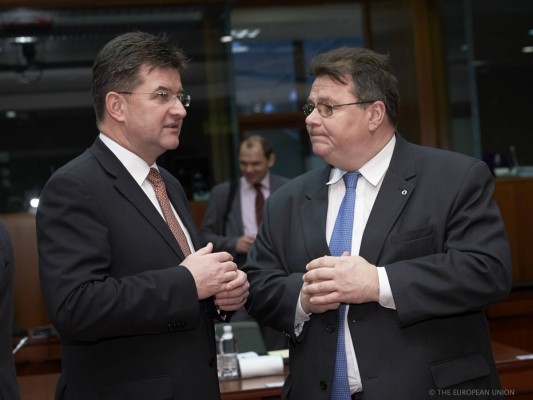
On 15 December in Brussels, Lithuania’s Minister of Foreign Affairs Linas Linkevičius attended the EU’s Foreign Affairs Council meeting, which discussed the political and security situation in Syria and Iraq, as well as the situation in Ukraine.
The Ministers discussed the EU’s role in resolving the Syrian crisis, where the situation is continuously deteriorating due to the ongoing conflict.
On the eve of the Council, the Ministers held an informal meeting with Staffan de Mistura, UN Special Envoy for Syria.
“The EU supports the efforts of the UN Special Envoy and speaks out on the need to find a political solution to the crisis in the country, fully implementing the UN Security Council resolutions 2139 and 2165, and ensuring unimpeded access for provision of humanitarian assistance to the country. Syria must put an immediate halt to violations of human rights,” said Minister L.Linkevičius.
The EU Ministers also discussed the political and security situation in Iraq and in the region, and the issue of foreign fighters. EU’s High Representative for the Foreign Affairs and Security Policy Federica Mogherini presented the EU’s comprehensive regional strategy for Syria and Iraq as well as the ISIL/Da'esh threat that is being newly developed.
According to L.Linkevičius, the EU has to support efforts of the Iraqi Government, its national program and cooperation with the Kurdistan Regional Government, all countries in the region should be involved in the fight against ISIL.
“Though the EU is involved in the international fight against ISIL and is providing military and humanitarian aid, there needs to be a more substantial effort to address the root causes of the conflict by supporting political reforms, socio-economic development and ethnic reconciliation. The EU must have a long-term EU regional strategy and also fight the spread of ISIL ideology,” said Minister L.Linkevičius.
Paying due regard to increasing needs of humanitarian aid, Lithuania allocated aid in the amount of EUR 171,300 for the Middle East region in 2012-2014. This year, Lithuania contributed 26,000 EUR of international humanitarian assistance to help children in Iraq through the United Nations Children’s Fund (UNICEF). There are plans to provide technical assistance and medications, to participate in a military training mission.
The Ministers discussed the situation in Ukraine, preparations for the EU-Ukraine Association Council on 15 December and the visit of F.Mogherini to Kyiv on 16-17 December. Before the Council, the Ministers attended the informal meeting of the Group of Friends of Ukraine, which was attended by EU Foreign Ministers and Ukraine’s Minister of Foreign Affairs Pavlo Klimkin. The Ministers stressed the need for urgent reforms in Ukraine and confirmed the EU’s aim to continue to support Ukraine.
According to L.Linkevičius, the Foreign Affairs Council must give continuous attention to Ukraine.
“One must say that the situation in eastern Ukraine remains tense and the truce is practically ineffective –the Minsk agreements are not respected, there is still no political solution to the crisis. Ukraine needs the EU’s support due to the poor performance of the country’s economy. Lithuania, in turn, supports Ukrainian reform efforts, delegated an advisor to the Ukrainian Government, and provides humanitarian aid and other assistance. Lithuanian experts share their experiences in various fields,” said the Minister.
According to L.Linkevičius, in its policy towards Russia, the EU must be patient and consistent; it has to give current sanctions time to work.
“Rushing to normalise relations between the EU and Russia would be unproductive at this moment. It is necessary to prepare reinforcement measures for the implementation of the EU’s non-recognition policy regarding the illegal annexation of Crimea until the European Council in December,” said the Minister.
Photo: Council of the European Union
Social media


