


KNOWLEDGEABLY CURIOUS (Lithuania in the World, 2007 No5, p. 14-17)
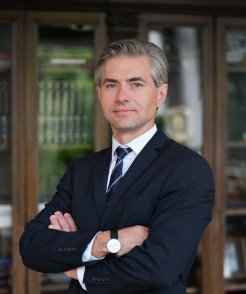
John A. Cloud, the American ambassador to Lithuania, speaks about his life here and the past and present of Lithuania-US relations For a representative of what political analysts like to call a “hegemonic power”, John A. Cloud cuts a remarkably approachable figure. The first impression, and one that he gladly confirms in conversation, is one of a man who is at ease with himself and at home in his work.
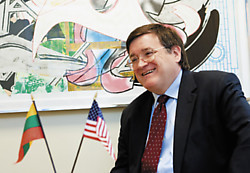 Indeed, for a career diplomat in the US Senior Foreign Service, professional life can only be a kind of special mission. Together with his wife Mary and their two daughters, Cloud has lived much of the last two decades in Central Europe.
Personal touch
Cloud was appointed ambassador to Lithuania in May 2006. Previously, he had served as deputy chief in Berlin, Brussels and Warsaw, and as economic counsellor at the American embassy in Bonn.
This left him with just a few short years on American soil, serving most recently in Washington from 2001 to 2003 as special assistant to the president and senior director for international economic affairs on the powerful National Security Council.
But even with such a high-flying career, Cloud is a man with his feet on the ground. With typical American candour, he shifts effortlessly in conversation from international politics and world history to sharing his impressions of daily life in Lithuania.
And with less than two years on the job, he already has a great deal to say about this new environment. The ambassador clearly has an inclination to travel off the beaten track, and has visited an impressive list of Lithuanian towns, including Telšiai, Skuodas, Druskininkai, Mažeikiai and Akmenė, to name but a few.
On these frequent trips, Cloud makes a point of meeting students at schools and universities, and of attending local festivals and events.
“You see, I have the good fortune of being the ambassador to Lithuania, and not just to Vilnius,” he smiles.
“My family and I enjoy visiting the various ethnographic regions. We recently visited Telšiai [in the Žemaitija region], and intend to spend a weekend in Varėna [in the Dzūkija region], at the autumn mushroom festival.”
Asked if he likes picking mushrooms, Cloud says he prefers to rely on the experts.
“I don’t know how to tell them apart yet, and so I wouldn’t want to poison anybody by picking them myself!”
He says that he values such festivals, with their demonstrations of local cuisine and culture, because they offer a glimpse into what life might have been like in an earlier age, when everything was simpler and people lived closer to nature.
This is not that he looks to the past as a refuge from the complications of the modern world. On the contrary, he looks to the lessons of the past to guide his work today. He is well versed in the long history of US-Lithuanian relations, which he describes as “humbling”, given some of the great historical figures involved.
In short, John A. Cloud has the rare combination of knowledge and curiosity, which makes him an ideal ambassador of the world’s most powerful nation to one of the smallest.
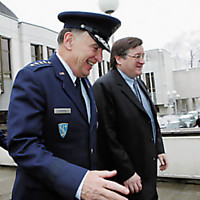 A special relationship
In January 1918, as the Great War drew to a close, and as the Hapsburg and Ottoman empires disintegrated, President Woodrow Wilson voiced his famous Fourteen Points, including his strong support for the principle of national self-determination.
Wilson’s speech gave hope to many stateless nations, including Lithuania.
On 16 February 1918, the Act of Independence was signed by the Council of Lithuania, proclaiming the restoration of the independent state. But American recognition was not immediately forthcoming.
The Wilson administration felt that claims on the territory of the former Russian Empire, which was wracked by war, revolution and anarchy, should be postponed until the country had got back on its feet.
By 1921, however, the Bolsheviks were in firm control, and Lithuania had negotiated a treaty with Soviet Russia. It became a member of the League of Nations on 22 September, and was granted official recognition by the principal European powers on 20 December.
Moreover, by this time, the sizeable and growing Lithuanian community in America had begun to make its voice heard. Shortly after Warren G. Harding replaced Wilson as president, he was presented with a petition signed by a million Americans asking him to grant official recognition to Lithuania.
The USA ultimately did so on 28 July 1922, and the relationship has continued unbroken ever since then. On 28 July 2007, Ambassador Cloud and President Adamkus presided over a solemn ceremony commemorating 85 years of diplomatic relations between the two countries.
Renascent nation state
What motivated the US to recognise the nascent state of Lithuania?
The decision reflected the international policy priorities of the US administration at that time. President Wilson had voiced several ideas in 1917 and 1918 that became core principles of US policy. There is a strong moral element in US foreign policy, to which the more traditional notions of realpolitik take second place.
Why do you describe the US-Lithuanian relationship as a special one?
The long history of US-Lithuanian diplomatic relations is special because it was never interrupted. This was especially important with the signing of the pact between Hitler and Stalin.
The USA refused to recognise the Soviet annexation of the Baltic States [in 1940] and continued to recognise Lithuania’s independence. The Lithuanian embassy in Washington never closed, and the Lithuanian flag always hung in the State Department’s Hall of Flags.
President Roosevelt had served under Wilson as deputy secretary of the navy, and so his decision was part of the same support for self-determination. Our decision to recognise Lithuania’s independence in 1922 was the right thing to do at the time.
As the Cold War progressed, and as even more nations were forced into the Soviet camp, it became increasingly the right thing to do.
Aside from the recognition issue, what else is noteworthy about US-Lithuanian relations.
The personal relationships between Lithuanians and Americans are even older than our official diplomatic relations. This was driven primarily by the mass emigration of Lithuanians to the United States and the strong contribution these people have made to the development of the USA.
Ever since the 1880s, there have been several major waves of emigration from Lithuania to the USA. Even if today a lot of Americans may not realise their neighbour happens to be a Lithuanian-American, we are aware that they have played a big role in helping to build our country.
Can you give some examples? 
Lithuanians have played a strong historical role in promoting democracy in the United States, and this history goes back to the times of the grand duchy. Most famously, General Tadeusz Kościuszko came to help us fight our revolution. Your 1791 Constitution was in some ways modelled after our constitution, and so our political relationship goes back to the very beginnings of my country.
If you want an example outside politics, take basketball. The name of Darius Songaila is a household word in the USA today, but in fact, the “basketball diplomacy” between our nations began in the 1930s with Frank Lubin.
How important is Lithuania’s support in the War on Terror? How can such a small country make a difference, in view of the enormous military resources of the USA?
You have to remember that nationals from ninety different countries were victims of the attacks of 11 September 2001, including Lithuanians. The USA is working with Nato and other collective means to create a more stable and democratic world, and Lithuania’s contribution to this effort, in Afghanistan, for example, is not to be underestimated. Terrorist organisations focus on the weakest link in the chain of global security, and so the War on Terror can succeed only if all countries participate.
Lithuania has a big role. It is making a very positive contribution to Nato’s efforts in the Ghor province of Afghanistan.
Lithuanians often tell me how small their country is. They seem to think they have a small impact on world affairs. But Lithuania is not just a consumer of security provided by other states, but an ambitious provider of security. This is something for which Lithuanians should feel very proud.
The country is also a member of the two most powerful international organisations in the world, the EU and Nato. All members have an important voice in the policies of these institutions. The USA benefits from having a like-minded ally such as Lithuania at the heart of these organisations.
How about our neighbour to the east?
As for Russia, I think the USA and Lithuania share a similar approach. Russia is a big player in Europe, and deserves to be treated as such. We work effectively with Russia in a number of global areas, while we disagree in other areas, and we are frank about our disagreements.
I believe that Lithuania’s approach to Russia is positive, responsible and straightforward. You use EU and Nato membership to improve your position, but never treat Russia as though it were still the Soviet Union. Russia should be glad that it has such strong democracies as Lithuania as its neighbours.
One of the challenges in Lithuanian-US relations concerns visa issues. Lithuania has become accustomed to visa-free travel to Europe, and would like to travel to America with the same ease …
The vast majority of Lithuanians who apply for visas today get them without any problem or delay. This might not have always been the case in the past, and so some people have the mistaken impression that they will have problems when they come to apply for a visa.
I would also note that President Bush has made a special effort to have Lithuania, along with other friends and allies, join the visa waiver programme, which allows tourism and business travellers to travel to the USA without a visa. It may not happen this year or next year, but I can envisage the day when Lithuanians will travel to the USA visa free.
How about American tourists to Lithuania? What do they say about the country?
I meet a lot of Americans who come here for all kinds of purposes, from business to culture, politics and sport. Some of them have a Lithuanian background, but a lot of them were not connected to Lithuania before.
These people had no idea what to expect before they arrived, and they are all really impressed with what they see. They always leave this country with wonderful impressions, and they tell us that they are definitely going to come back.
Tadas Kosciuška
Tadas Kosciuška (, 1746–1817) is known as a Polish and Lithuanian national hero, a general, and a leader of the 1794 uprising (which bears his name) against the Russian Empire.
He arrived in America in 1776 to support the American War of Independence. A great admirer of the US Declaration of Independence, Kosciuška became a close friend of Thomas Jefferson. Commissioned by Congress as a colonel in the Continental Army, he served for seven years, and was eventually promoted to brigadier general and granted American citizenship.
On his return to Poland-Lithuania in 1784, he promoted liberal reforms, supported the Constitution of May 1791 (the first modern European constitution, which was modelled on the American one), and fought in the war in defence of the constitution as a major general.
Pranas Lubin as
as
Pranas Lubinas (, 1910–1999) is known to many as the “grandfather of Lithuanian basketball”.
Lubinas was born in the east side of Los Angeles, California, into a family of Lithuanian immigrants. He became an Olympic champion with the US team in 1936 in Berlin, and a European champion with the Lithuanian team in 1939 in Kaunas. In 1997 he entered the University of California Hall of Fame.
All through his long life he made a seminal contribution to the growth of basketball in Lithuania.
By Violeta Davoliūtė
Social media


