


In the UNHRC urgent debate, Lithuania’s Foreign Minister Gabrielius Landsbergis demands that effective international mechanisms be established to punish Russia for its offensive against Ukraine
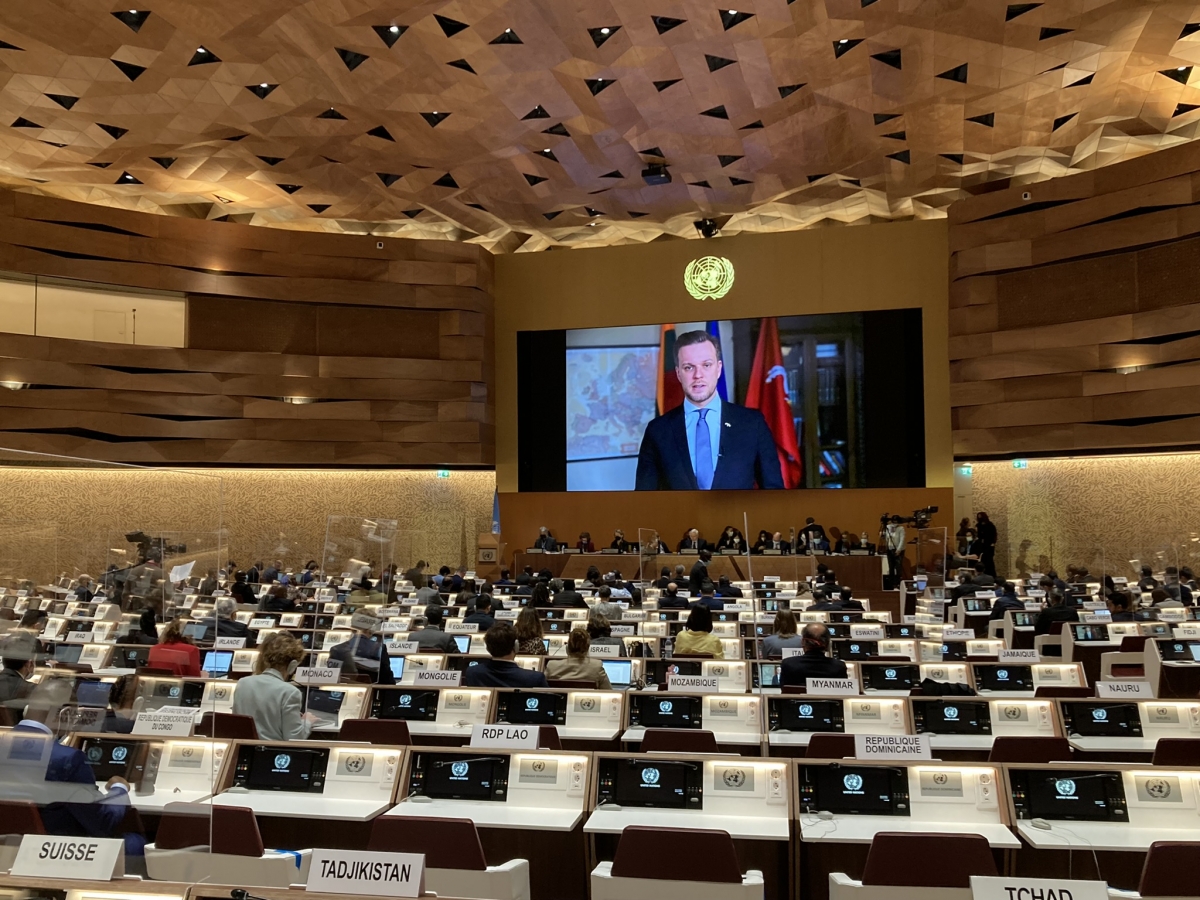

On 3 March in Geneva, Switzerland, the Minister of Foreign Affairs of Lithuania Gabrielius Landsbergis remotely participated in the United Nations Human Rights Council (UNHRC) urgent debate on Ukraine's human rights crisis caused by Russian aggression.
The Foreign Minister noted that, while international discussions were taking place, the people in Ukraine were defending not only themselves and their state against Russia's brutal aggression, but also the international order that had arisen from the ashes of World War II. “The ongoing military offensive by Russia in Ukraine violates all principles of international law. Civilians have been killed and urban infrastructure has been destroyed, including kindergartens and hospitals. There will be enormous consequences for the human rights and humanitarian situation in Ukraine,” Landsbergis said.
“Now the people of Ukraine need all possible support and assistance, while Russia, as the aggressor, and Belarus, as the enabler, must be held to account for possible war crimes. Moreover, it is crucial to ensure the establishment of a humanitarian corridor from Ukraine to allow safe passage for civilians fleeing Russian onslaught,” the Foreign Minister said.
Landsbergis recalled that a few days ago, the European Court of Human Rights had ordered "the Russian government to refrain from military attacks on civilians and civilian objects." The country was also obliged to immediately ensure "the safety of medical institutions, personnel and rescue services within the territory attacked or besieged by Russian troops." Russia must comply with this order.
Landsbergis also encouraged the UNHRC, together with the international community, to establish accountability mechanisms to punish Russia for its offensive against Ukraine and atrocities more actively.
Lithuania's representative expressed pride and admiration for the courage and the unbreakable spirit of the Ukrainian people, struggling for freedom and independence of their state. Landsbergis also voiced support for peaceful protesters, who had taken to the streets across Russia and Belarus to protest Russia's war, despite the threat to their personal safety and lives, and the risk of jail.
The 49th session of the UN Human Rights Council began on 28 February. At Lithuania's initiative, the UN Human Rights Council voted to hold an urgent debate on the situation of human rights in Ukraine stemming from the Russian aggression. 28 other members of the Council voted to support this initiative. At the end of the urgent debate, the Council plans to adopt a resolution, condemning Russia's aggression, demanding an immediate ceasefire, and mandating the establishment of a special mechanism - a Commission of Inquiry on Ukraine - to investigate all violations of human rights that have been committed by Russia since its military aggression.
Social media


