HEALING IS POSSIBLE (Lithuania in the World, Vol. 16 September – October 2008, p. 11-15)
Hundreds of thousands of pilgrims this year are expected in the small town of Šiluva Four hundred years ago, 250 years before Lourdes and more than 300 years before Fatima, the Virgin Mary is believed to have appeared in the tiny town of Šiluva. It happened in 1608, and was her first apparition on European soil.
A Papal bull issued by Pope Pius VI on 17 August 1775 authenticates the event. Šiluva is one of five sites in Europe that the Vatican recognises as the location of an authentic apparition of the Virgin Mary.
This September an estimated 150,000 to 200,000 pilgrims are expected to descend upon this small town, with a population of 790, to mark the 400th anniversary of Mary’s miraculous appearance to a group of shepherd boys.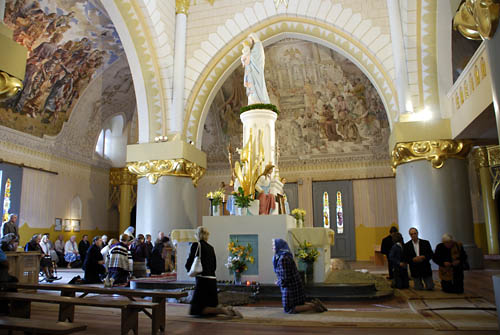
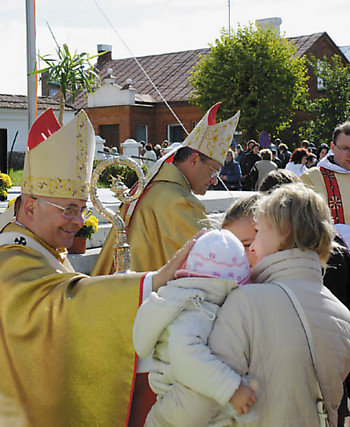
During the week of 6 to 15 September, there will be processions, prayers, congresses, spiritual and physical healing sessions, and specially dedicated Masses, including a Mass to be celebrated by the papal nuncio on 14 September in the presence of foreign dignitaries.
Pilgrims will arrive on foot in processions from locations as far away as Lourdes in France, where the Virgin Mary is believed to have appeared in 1858, and from as close as the monastery in nearby Tytuvėnai. They will kneel around the shrine of Mary in the Chapel of the Apparition, praying for health and spiritual strength.
More than 500 years
Šiluva first became known in 1457 when the nobleman Petras Gedgaudas built a wooden church there and dedicated it to the Nativity of the Blessed Virgin Mary and the apostles Peter and Bartholomew. Few churches at the time were dedicated to the Virgin Mary.
The Catholic Church celebrates Mary’s birthday on 8 September.
The tradition of the eight-day feast, beginning on the first Sunday in September, and called “Šilinės” in Lithuanian, has taken place in Šiluva for well over 500 years. Thousands of pilgrims bearing crosses and banners descend on the town in a spirit of prayer and thanksgiving. Each day of the octave is dedicated to a particular theme or group. In modern times, these groups have included the military, the police, health care workers, the Church, families, children, young people and the sick.
During the Imperial Russian repressions in the 19th century, when the Latin alphabet was banned, book smugglers would smuggle Lithuanian books across the border from Prussia and distribute them during Šilinės. Despite active measures taken against the book smugglers, few were ever caught.
The tradition of the processions held in Šiluva every September has survived Lithuania’s tumultuous history and is a live link to the past.
The people’s devotion
 Located in western Lithuania, Šiluva is an island of traditional cottages, many of them left over from the 19th century, surrounded by kilometres of open fields and forests. The neighbouring town of Tytuvėnai, eight kilometres away, houses a monastery and is a popular starting point for processions to Šiluva. The closest city is Kaunas, at a distance of a little more than 100 kilometres.
Walking through the town of Šiluva and its environs, every few metres one comes across wooden wayside crosses and folk sculptures of Mary, each one unique and erected by the local people. It is not unusual in Šiluva to see a farmer pass through the town centre on a wooden horse-drawn cart, piled high with hay, or to see elderly women covering their heads with white scarves in the old tradition.
Although the newly constructed Pope John Paul II Centre, built in 2003 to commemorate a decade since the visit of Pope John Paul II on 7 September 1993, has become a hub of activity, the local villagers are engaged in “sowing and ploughing” just as they were 400 years ago when Mary appeared on a rock in the fields.
Daily life in Šiluva takes place in the shadow of a looming 18th-century stone basilica. This church, which was elevated to the status of minor basilica in 1974 by Pope Paul VI, was built between 1760 and 1775 in the Late Baroque style.
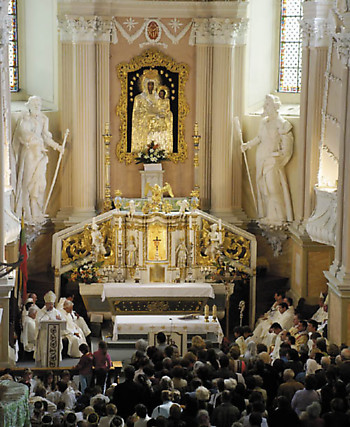
It houses a famous painting of the Virgin Mary, believed to possess curative powers. The origins of the painting are a mystery. However, art historians believe it to be an early 17th-century copy of the icon of St Mary in the Basilica di S. Maria Maggiore in Rome. This image, in the iconographic style of old Byzantine Hodegetria, was popular throughout Europe at the time.
Belief in the curative powers of the painting of Mary of Šiluva are so strong that at the end of the 17th century votive offerings in gold and silver were pounded into a silver and gold inlaid dress for the Virgin. A coronation of the image took place on 8 September 1786.
Opposite the church stands the Chapel of the Apparition, built around the rock upon which Mary is believed to have appeared, and beside which legend dictates that a long-hidden iron-clad chest containing deeds proving the Catholic Church owned the surrounding land were buried.
The Chapel of the Apparition, a 44-metre-tall white tower with a cruciform base, was designed by the well-known architect and sculptor Antanas Vivulskis, and was built between 1912 and 1924.
Although the Chapel of the Apparition was completed in 1924, its decoration was finished only in 1999. For half a century, the Soviet authorities had blocked its completion. But that was not the only project to be postponed by war and the Soviet occupation.
More than half a century later, the archbishop of Kaunas Sigitas Tamkevičius has overseen efforts to expand the main esplanade from the church to the Chapel of the Apparition several hundred metres away. This project was first conceived in 1939, but the onset of the Second World War interrupted it. Work is also under way to upgrade the information centre, create hygiene facilities and improve road access to the small town.
The past
Coming back to the beginnings of Šiluva, when the first church was built in the mid-15th century, the story goes that the founder of the church travelled to Rome and brought back a magnificent painting of the Virgin Mary holding the infant Jesus. However, the fate of that painting is not known. The original wooden church burned down in 1500, and a new one was built.
By the middle of the 16th century, the local governor of Šiluva was a zealous Calvinist. He forced his will upon the people. Property owned by the Church was confiscated and turned over to the Calvinists.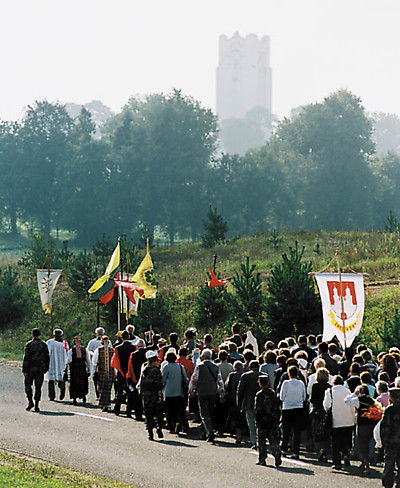
Before the church was surrendered, around 1569, the last parish priest of Šiluva built an iron-clad chest and is believed to have placed inside it liturgical vestments and documents that proved that the land where the church stood belonged to the Catholic Church. He sealed the chest and buried it near a large rock.
Years passed, and Catholicism in the area gradually died out. Only a few of the oldest villagers remembered that there had once been a Catholic church in the village. The village children were raised as Calvinists.
By the early 17th century, though, the Catholic Church began to stir, and again there were tensions between Protestants and Catholics. Catholics began legal proceedings to regain the land where the original church had once stood. However, the documents were missing, complicating the case. Then, Mary appeared.
The apparition
The story of the apparition is recorded in a Church document dated around 1651:
“Shepherd children were tending to their flock on Church grounds when they saw a girl with flowing hair standing on a large rock. She was holding an infant in her arms and crying bitterly.
“The children ran and found two Calvinist leaders and told them what they had seen. The Calvinists approached the rock and also saw the Virgin Mary standing there crying.
“They mustered up their courage and asked: ‘Girl, why are you crying?’ She answered: ‘I am crying because my son was once worshipped in this place and now people only sow and plough the fields here.’ After saying these words, she disappeared.”
The news of the apparition reached a blind man who was over 100 years old and lived in a neighbouring village. He recalled a night years before when he was still a young man. He told the villagers that he had helped the parish priest at Šiluva bury an iron-clad chest beside a large rock.
The villagers led the old man to the site of the apparition to see if he could help locate the place where the chest was buried. As the legend goes, no sooner had the old man reached the spot, when his sight was miraculously restored. Falling to his knees with joy and gratitude, he pointed to the exact spot where the chest had been buried.
The iron-clad chest was dug out of the ground. When it was opened, inside, perfectly preserved, were several gold chalices, vestments, deeds and other documents. Today the iron-clad chest is held in the inner chapel of the church.
What exactly was found in that chest is not known. However, records show that in 1622 documents that had been dug out of the earth were used to win a dispute against the Calvinists, and the land was returned to the Catholic Church. The present-day basilica and chapel stand on this land.
Heaven is for everyone
 Catholics consider it significant that in Šiluva, Mary appeared to non-Catholics. Many Protestants object to the veneration of Mary, this being one of the main differences between Catholicism and Protestantism.
Archbishop Tamkevičius sees an ecumenical dimension in the message of Šiluva.
“At a time when Christians of different confessions couldn’t live together in peace, the apparition shows that heaven is concerned with everyone, not just Catholics,” the archbishop says.
Tamkevičius spent the 1980s imprisoned in Siberia for founding and editing the Chronicle of the Catholic Church in Lithuania, the longest-running underground samizdat publication. For 17 years until 1989, it reported on human rights abuses and the persecution of the Catholic Church in the Soviet Union, and was regularly smuggled to the West, where it was translated into English, French, German and Spanish, and disseminated internationally, making it a real thorn in the side for the Communist Party.
Šiluva survived the Soviet occupation
Tamkevičius regards the intercession of Mary in Šiluva to be a source of strength that has helped the Lithuanian nation survive centuries of trials.
“In the four hundred years since the Virgin Mary made her appearance in Šiluva, the Lithuanian nation has been tested dramatically,” he says.
“In the 17th and 18th centuries it defended itself against Russian and Swedish invasions. Then there was starvation and plague. Half of the country’s population died during the plague. During the 19th century the tsars tried to destroy Catholicism in Lithuania. They destroyed prayer books and banned the language. During the Soviet occupation again the Catholic Church and the people were persecuted. I don’t know how Lithuania would have survived all of these challenges if it wasn’t for the intercession of the Virgin Mary.”
During Lithuania’s first period of independence, from 1918 to 1940, the faithful would travel to Šiluva in processions of up to 100,000 people. At that time, congresses were first held around 8 September at which films, plays and other cultural events took place.
The tradition of prayers and processions on 8 September survived the repressions of the Soviet era. First, the Soviets tried to destroy it through slander in the press. When that did not work, from 1960 onwards, they sent in the police.
The police would stop cars and motorbikes on the road to Šiluva on the days leading up to 8 September. They would check papers and invent reasons why the cars were not safe to operate.
In 1974 the Chronicle of the Catholic Church in Lithuania reported:
“In early September thousands of people began flowing into Šiluva to celebrate the apparition of the Virgin Mary. On Sundays the cars no longer fit in the town of Šiluva and were directed by automobile inspectors to be parked in rows in the fields outside of the town. The auto inspectors then demonstratively began writing down each license plate number. This year 50,000 communion wafers were distributed.”
In 1979 the Soviet government declared a swine flu epidemic in Šiluva, quarantining the town. None of these measures effectively stopped the processions. Typically, anywhere from 10,000 to 40,000 people would walk in procession to pray at Šiluva every 8 September throughout the years of the Soviet occupation.
The archbishop recalls one of these roadblocks:
“When I joined the priesthood in 1962, another young priest and I got on a motorbike and rode to Šiluva on the morning of 8 September. That year the date fell on a Sunday. None of the other priests who’d applied for permission through the authorities to attend the event were given permission to go. There was not a single priest available to say Mass that day or to hear confession.
“We didn’t ask for permission. We just went. The police were stopping every car and motorbike on the road to Šiluva and checking documents. If they found the slightest thing wrong, the cars were not allowed to proceed.
“Very few of the cars made it past the checkpoint, but we did. All day long we heard confession. As it turned out, we were the only two priests who made it through the checkpoint.”
Marian Day
Today at Šiluva old traditions are continued and new ones evolve. In 1981 a new tradition came into existence at Šiluva. This is Marian Day, the 13th of every month. It is a day of processions and prayer, asking Mary for special protection, but prayers are offered for Lithuania especially. Since the country’s independence and the tumultuous years leading up to it, Marian Day has become more and more a day to pray for good health and strong family relationships.
“I haven’t missed coming here on the 13th once in ten years,” says 70-year-old Bronė Jonikienė. “My health is excellent. I’ve never been hospitalised.”
Jonikienė comes by bus from the town of Tauragė. She is not alone. She is accompanied by several dozen, mostly older, women from her town, who make the trip together each month to pray and meditate.
On the main road leading into Šiluva, several hundred young people stand waiting with placards and a palpable enthusiasm. This Marian Day they plan to walk the eight kilometres into Šiluva, singing and praying the entire distance.
Archbishop Tamkevičius gets out of his car to lead them. He walks briskly to the front of the procession. In his steadfast and quiet manner, he leads the procession, keeping the procession orderly by modulating the pace and maintaining solemnity.
“Today we are honouring Catholic schools, and so many of our walkers are young people,” he says. “But it is not unusual for people in their sixties, seventies and even eighties to make this walk, or to walk from places further away.”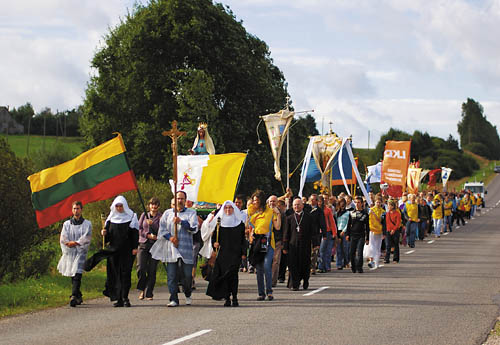
Tamkevičius emphasises that throughout this year the Marian Day prayers and processions have been a form of preparation for the 400th anniversary.
“A holiday comes and goes. It is very important that this 8 September is not just a one-day holiday,” he says.
“Throughout this year a bishop and I have been visiting each parish as the painting of the Mother of God circulates among the parishes. Our mission is to prepare people spiritually for 8 September, and to give them spiritual sustenance that they can maintain after the big celebration is over.”
“Offer up your sweat to Mary! Offer up your pain!” shouts Sr Pranciška into a microphone.
Her voice is broadcast by a portable loudspeaker carried on the back of a teenage boy to several hundred children from the Jesuit school in Kaunas and other local schools.
The young pilgrims carry banners of the Virgin Mary, wave flags and chant the Our Father and Hail Mary as they walk. Between prayers, Sr Pranciška trots alongside a tall young man with a guitar, who strums the guitar and sings hymns into the microphone.
“It’s hard to keep the rhythm right,” the guitarist says. “Sometimes I have to walk faster for a more rapid rhythm, and sometimes I have to walk slower for a more meditative song.”
Sr Pranciška comes from a family of non-practising Catholics. She was 16 in 1988 when Lithuania burst into its “era of rebirth”. At that time, when control over the Catholic Church was loosened, she experienced religion for the first time. She became a nun in 1997.
Today she is one of the organisers and leaders of the eight-kilometre procession into Šiluva. This June, the Marian Day theme is prayer for young people from Lithuania’s Catholic schools.
Sr Pranciška is typical of the new generation of enthusiastic young nuns and priests who are rebuilding the new Lithuanian Catholic Church, which embraces old traditions at the same time as grappling with contemporary social issues.
“I love processions,” says 12-year-old Justas brightly. “I belong to the hiking club at school, and I take every opportunity to walk. This is fun!”
Rožė is 67. She keeps up a brisk pace walking alongside a group of middle school children. A year ago she had a successful hip transplant, and today she is walking to thank Mary for her good health and her good fortune.
“I was riding the bus into Šiluva when I saw the procession going past,” she says. “I shouted to the driver: ‘Stop the bus!’ I got out and began to walk. I love a procession.”
Five years ago, she and a friend who had an injured foot carried a large wooden cross, praying the entire way, from Kaunas to Šiluva, for the occasion of 8 September. It took them several days. On the evening of their first day, they began looking for a place to stay. They asked farmers to take them in, just like Christ and the apostles would have done 2,000 years ago. Four farmers turned them away, but a fifth allowed them to sleep on the hay in his barn.
“The farmers who didn’t take us in shouted after us: ‘You’re crazy!’ But that didn’t stop us from walking,” Rožė says, and a wide smile spreads across her face.
“I even went on processions during Soviet times. I wasn’t afraid of anything. That’s how I was raised. My father wouldn’t let me join the Pioneers. He’d say: ‘Don’t you dare come home from school with a red tie!’ All his brothers were deported to Siberia.”
This September, Šiluva awaits in joyful anticipation the crowds of pilgrims and the faithful. The festivities promise to be an exciting mix of ancient and modern tradition, with one spiritual goal: faith and healing. The message of Šiluva is that healing is possible.
By Laima Vincė

Social media