


HE AMBASSADOR ALFONSAS EIDINTAS: IN SEARCH OF THE MOSCOW SPHINX (The Magazine for Corps Diplomatique, Vol. 14-15, p. 77-78)
Most of us remember the dramatic days in 1991 when thousands of Lithuanians formed a human shield around the national television station in Vilnius, which had been taken over by Soviet forces on 13 January. Fourteen innocent civilians were either shot by Soviet troops or run over by tanks. Hundreds were injured in the confrontation with the Kremlin's Red Army.
The whole world followed the dramatic events on television. The Soviet Union's misuse of military force only served to strengthen the Lithuanians' resolve to reclaim their national independence. In a referendum on 9 February 1991, 90% of the Lithuanian population voted for independence from the Soviet Union. Later the same year, the Soviet Army showed for the last time its military muscle against civilian targets in Lithuania. Lithuania regained its freedom as an independent nation, together with Estonia and Latvia, following an attempted coup against Gorbachev.
The Baltic States returned to Europe and self-determination. Thus, these hard-tried Nordic nations finally brought an end to the subjugation they had been under since the Red Army entered Lithuania in the summer of 1940. A large portion of Lithuania's elite where either forced to flee the country or liquidated by the Soviet occupiers. Perhaps as many as three hundred thousand were deported under atrocious conditions to the Gulag camps in Northern Russia or Siberia.
However, January 1991 was not the first time Lithuanians had bravely fought against Soviet power. Lithuania's armed anti-Soviet insurgence had last fully nine years from 1944 to 1953. This "forgotten" war was also an embarrassment to the Western powers (see article on page 76).
"In Search of the Moscow Sphinx"We fast-forward to 17 November 2006 and a press conference called by Lithuania's ambassador in Norway HE Dr Alfonsas Eidintas at his Embassy's chancery in Oslo. On the table lay a thick red book of almost six hundred pages. It was fresh from the printer's, but only a few of us could understand more than the main words of the title “Ieskok Maskvos Sfinkso". Even though Lithuanian is one of Europe's oldest languages it has had a very isolated development.
The author is not I unknown to us either: Alfonsas Eidintas. As one of Lithuania's foremost historians (see CV), Ambassador Eidintas already has a number of books to his name. As his first novel, however, it is not surprising that it is based on Lithuania's recent history. It describes the build up to the Soviet Union's occupation of the country in 1940. Eidintas does not use the historical events as a backcloth for the personal interactions in the book. It describes the high-level diplomatic game that unfolded with all its deceit in Moscow. Eidintas offers portraits of Stalin, Hitler, Molotov and Ribbentropp. The infamous agreement between foreign ministers Molotov and Ribbentropp that resulted in Lithuania's national tragedy is symbolized on the front cover of the book by a swastika and hammer & sickle juxtaposed.
We look forward to a translation. Currently, "In Search of the Moscow Sphinx" is the most incomprehensible book that the editor of The Magazine has in his office!
When the Soviet Union collapsed in 1991, there was a dramatic change in diplomacy in the satellite states in Central and Eastern Europe. Not only were the Soviet lackeys swept out of ; the government offices in the independent states, the entire diplomatic service had to be renewed. The communist parties' diplomats were generally compromised.
But from where could the independent states find new diplomatic leaders? There is only one answer: From among the countries' leading intellectual and academic powers. Ambassador Alfonsas Eidintas is a good example of an academic turned diplomat from these countries.
As editor of The Magazine since its start in 1993, 1 have had the great pleasure of meeting many of these eminent academics, and have learnt a great deal from them, not least from their traumatic experiences under communist rule. My encounters with them have strengthened my belief that a united Europe has an independent and: important role to play in the future of international politics. They also reminded me that European ideals of freedom can never be defended by diplomacy alone.
It is decisive actions that shape his- story, and such actions at historic crossroads can demand the utmost sacrifice from us all.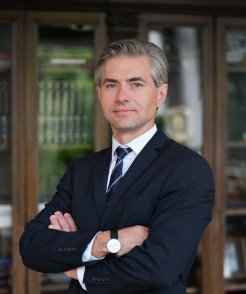
Social media


