GOOD FORTUNES AHEAD (Made in Lithuania, Vol 24, No 2, 2007, p. 12-16)
After Lithuania had joined the European Union the development of its economic, political and cultural relations with the European countries advanced further and faster. Lithuania does not only aim to become the leader in the Baltic region but also to actively develop multi faceted relations with every Member State of the European Union. France is not an exception. Editor Saulius Gudeliauskas talks to the Ambassador of the Republic of Lithuania to France Giedrius Čekuolis.
– Your Excellency the Ambassador, please tell us about Lithuanian-French political and economic relations. What events had an impact on their development?
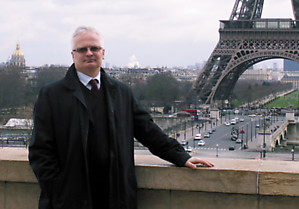 – On 29 August 1991, after Lithuania and France re-established their diplomatic relations, political, economic and cultural relations, which were quite intensive during the inter-war period (between 1919 and 1939) and disintegrated during the Soviet period, were restored between these two countries. Speaking about bilateral relations between Lithuania and France, it should be noted that France has never recognised Lithuania’s annexation by the Soviet Union in 1940. France was one of the few Western European countries, which did not return Lithuania’s 22476,5 kilograms of gold, which were deposited in French banks. France recognised Lithuania de jure on 20 May 1920.
Since the very beginning of the re-establishment of Lithuania’s independence, France has contributed actively to Lithuania’s re-integration into the democratic family of European countries by providing political and practical assistance to our country on its road to the European Union, NATO and other important international organisations. On 16 June 1994 the Agreement of accord, friendship and co-operation between the two states came into effect. Our countries signed a number of agreements regulating the state relations regarding encouraging investments and mutual protection, technical and financial assistance, the establishment of a securities exchange, interna-tional transportation of cargoes, double taxation on incomes and capital and avoidance of fiscal violations, transfer of illegally residing persons to their country of origin, abolishment of the visa regime, and the status of the building of the Embassy of the Republic of Lithuania in Paris. Four official visits by the President of the Republic of Lithuania Valdas Adamkus to France (in 1999, in 2001, in 2002 and in 2005) testify to active bilateral relations between the two countries. The last visit was important to the development of the bilateral relations between Lithuania and France. The Presidents of both countries agreed to maintain continual personal contact in co-ordinating the most important items on the EU agenda, and spoke about ways to draw European society deeper into the discussion about the future of the European Union. Within the context of bilateral relations it was declared that bilateral relations were in a good state of affairs.
In 2001, the President of France J.Chirac came to Lithuania on an official visit.
Currently there are four honorary consuls of the Republic of Lithuania in France who reside in Rhone-AlpesHaute Normandie and Basse Normandie, Champagne Ardennes and Provence, Alpes and Cote d‘Azur regions. They defend the rights of Lithuanian citizens and encourage the development of economic and cultural relations between Lithuania and France.
It should be noted that following the re-establishment of the independence of Lithuania, the post-war Lithuanian emigrants who understood the French mentality very well and spoke the French language fluently, contributed greatly to the development of bilateral commercial relations. The Government of France strengthened economic co-operation between the states by financing training and sabbaticals of Lithuanian civil servants, scientists, and business people at the best educational institutions in France (the National School of Administration (l‘ENA), the Sorbonne University, and other institutions of higher education). Six-month long courses for founders of Lithuanian small and medium-sized enterprises financed according to the TEMPUS programme were organised at the University of Lyons. Delegations headed by high ranking state officials, which included business people from Lithuania, played an important role in strengthening economic relations between the two countries.
– The issue of investments is critical to Lithuania. Why aren’t French investors in a hurry to invest in Lithuania?
– Attracting foreign investments to Lithuania is one of the main objectives of the Government of the Republic of Lithuania these days. If we want to keep the present growth of our national Gross Domestic Product in a long-term economic view, which is currently 6 per cent, we have to increase direct investments in Lithuania’s economy. According to the Department of Statistics of the Republic of Lithuania, French direct investments in Lithuania totalled EUR 76.7 million, that is, 1.4 per cent of total foreign direct investments in Lithuania, which was about EUR 5.5 billion. France was in the 15th place on the list of main investors, and the number of French investors in Lithuania totalled 64. These are not large figures for an economically developed EU state with a population of over 60 million. The greatest disadvantage in attracting investments to Lithuania is our small market. The French, as do other investors from other countries, first of all invest in order to become established in a specific region, and the larger the region, the faster the return on the investment. Perhaps that is why French investments made in the north-eastern direction usually end up in Poland. Lithuania still fails to make full use of its advantages as a transit country, which Belgium and Holland did successfully in their own time. Lithuania can be attractive to foreign investors only as a country for re-export. Favourable conditions should be created for those investors who would produce goods in Lithuania and create services for export. For this purpose industrial parks are being developed nowadays, assistance of the Structural Funds of the European Union should be taken whenever possible, and privileges in renting land for industrial purposes should be given.
The largest part of French direct investments in Lithuania is concentrated in the public utilities sector (65 per cent of foreign direct investments of France in Lithuania). Among the promising areas for French investments in Lithuania the following should be mentioned: manufacturing industry, the motor car parts sector, the manufacture of mechanical appliances sector (such companies as Renault, Peugeot, Citroen and others could invest here), as well as chemistry and pharmaceutical industries.
When strengthening economic relations with France attention should be drawn to the prospects of bilateral co-operation in the energy sector. Currently the energy company EDF (Eléctricité de France) is interested in the possibilities of investing in the electricity generation sector in Lithuania. Another French group – AREVA, which has considerable experience in nuclear energy, is one of Lithuania’s potential partners in building the new Ignalina Nuclear Plant reactor.
– Which Lithuanian enterprises try to penetrate the French market?
– Speaking about bilateral trade exchanges, it should be noted that bilateral trade indicators are constantly improving. One of the main factors influencing the increase in Lithuania’s import is the need of a growing economy for goods, therefore it is not surprising that France exports more and more to Lithuania. Nonetheless, regarding bilateral trade I would like to express my satisfaction that for several years in a row Lithuania has had a positive trade balance with France, and the growth rate of Lithuanian export to France is a source of pride for all of us.
Lithuanian enterprises mainly export to France the following: mechanical appliances, electrical goods, minerals, chemical industry products, plastics and articles thereof, as well as furniture and textile articles. The private companies Baltijos baldø grupë UAB, Sparta AB, Arijus UAB, and other Lithuanian companies are trying to become established in the French market. It should be noted that these days the large concern Achema has successfully established itself in the French market. The branch of the Achema group, Litfert s.a.r.l., whose trade volumes have been increasing with every successive year, has been operating in Rennes for a number of years now. Achema is the largest manufacturer of fertilisers in the Baltic States, and France is its main trade partner. French clients buy 24 per cent of the Company’s total production. Other large Lithuanian enterprises could also establish their branches in France. At the beginning a company should concentrate on implementing a strategy of product introduction to the market. In the long run this investment would have prospects because the French market is very large. The said divisions of enterprises could also cover the markets of the Mediterranean Sea region.
Co-operation between Lithuania and France, no matter what heights it has reached, is not a finite process, therefore further work, dialogues, and action on the parts of both states are needed in order to achieve these common goals: to create a united and free Europe, to ensure safety and stability in the world and in the region, to develop good relations with neighbouring and third party states, and to enhance economic and cultural co-operation.
– Lithuania is very aware of France and its culture and history. Many of us became acquainted with it in our childhood when we read books about the three Musketeers or watched films. And what about the French? Do they have enough information about Lithuania?
– Speaking about the French people’s attitude to our country, one should admit that residents of France are only beginning to discover the Baltic States and to take interest in their culture, history and politics. For a long time we were “exotic” countries to the French, who did not know much about our area. Interest in the Baltic states began once Lithuania had become a member of the European Union, the organisation in which France plays a very important role. On the other hand, the French, like other European nations, take great interest in sports – they do know about the capabilities of our basketball players. Matches between Lithuanian and French football teams in Vilnius and France are good advertisements for Lithuania. Unfortunately, the Lithuanians lost the first match 1:0. Speaking on a cultural level, it should be noted that verses of the diplomat Oskaras Milašius could be found in every French anthology of poetry. I am happy to mention that the number of French tourists in Lithuania increases markedly every year. Currently the Lithuanian Tourist Information Centre is being opened in France, which will contribute to the increase in tourists to Lithuania.

Social media