


FRIENDLY NEIGHBOURS (2007 Issue 9, p. 51-53)
We met with the H.E. Ambassador of Ukraine to Lithuania, Mr Borys Klimchuk at the Ukrainian Embassy in Vilnius where we discussed the many issues involving the joint historical, economical, cultural and political ties between our two countries. Ambassador Klimchuk was open, sincere and enthusiastic about his work here in Vilnius and happily shared his views on many subjects he deals with on a daily basis. Following is just a summary of our conversation:
Ukrainian-Lithuanian Relations: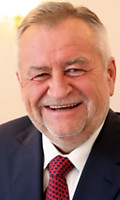
“The strategic course of Ukraine towards integration into the EU and NATO opened new possibilities and broadened the horizons of Ukrainian-Lithuanian relations, which already had a solid historical basis formed in the era of Kyivan Rus and the Grand Duchy of Lithuania.
Please, allow me a small historical detour. One of the main examples of successful co-operation between our countries was the meeting of monarchs of European countries that took place in 1429 in the southern capital of the Lithuanian Grand Duchy, Lutsk. The host of this meeting was Lithuanian Grand Duke Vytautas. This congress determined the basic principles of co-habitation of European countries and in some respect laid the foundations of a modern united Europe.
I was born in a village near Lutsk and it is mentioned in the second Lithuanian statue of 1518. President Adamkus visited Lutsk last year. Lutsk is closely connected with the history of Lithuania, being the southern capital of the Grand Duchy. We are very proud of our common history and it is important to underline that even though Ukraine was a part of the Lithuanian Duchy, it was never subjugated. Lithuanian Dukes never appointed their own governors, it was Ukrainians who were in charge locally. It was a co-operation of elites. And I tend to agree with historians who call it a ‘velvet occupation’.
As to modern times, when Viktor Yushchenko became President of Ukraine, contacts between Lithuania and Ukraine on the highest level became more frequent. The two leaders established a close personal relationship. The head of Ukraine visited Lithuania in May 2005. It was agreed that Lithuanian experts would participate in easing visa EU requirements for the Ukraine, as well as facilitating the integration of Ukraine into north-Atlantic and European structures. In May 2006, President Yushchenko participated in the ‘Vilnius Conference’, and President Valdas Adamkus has visited Ukraine 10 times in 2004-2007, showing his full support of Ukraine’s march towards democratic and economic reforms as well as supporting Ukraine’s foreign initiatives.
During a visit in November 2006, the two Presidents signed a joint declaration that stated that relations between our two countries is a dynamic and close partnership.
Dialogue on an inter-governmental level also became more dynamic, so during the official visit of Prime Minister Gediminas Kirkilas to Ukraine in 2007, a number of agreements of co-operation in the spheres of trade and investment were made. The heads of governments also agreed to assist each other in the energy sector, such as the transportation of Caspian oil and a mutual electricity supply.
We are also glad to witness the fruitful development of the relationship between our Foreign Ministries. In 2005 there were four official visits of Foreign Ministers. Our ministers agreed to collaborate in Ukraine’s aspiration to integrate into European and north-Atlantic structures, and a definite plan of actions was drawn where Lithuania helped Ukraine to take 10 steps towards EU integration by 2007. Lithuania shared its experience in social development, insurance, agriculture and law.
In 2005 a meeting of the ‘Ukraine-NATO’ commission took place in Vilnius, where dialogue between Ukraine and NATO was initiated, followed by informal consultations of Defence Ministers.
The current status and tone of the relationship between Ukraine and Lithuania proves that bilateral co-operation will be further developed and strengthened in accordance with the interests of our countries. This dialogue flourishes due to the efforts of the Council of Presidents of Ukraine and Lithuania, inter-governmental council of co-operation and inter-parliamentary assembly of the Supreme Rada of Ukraine and the Lithuanian Seimas. Such diverse co-operation that embraces all state levels is a unique phenomenon.
In the future Ukraine will receive practical help from Lithuania on the mechanism of joining the EU, such as strategic planning, integration on all levels, programming and control of the adaptation of EU legislation within national legal system, integrating customs regulations, guidelines for negotiating with the EU and others. Ukrainian officials will be undertaking internships in Lithuanian government institutions in order to learn how to work in an EU context.
Strategically it is important to develop bilateral co-operation on the energy level, especially energy supply and security. One such project has been already implemented. It is the ‘Viking’ railway rout that joined Odessa and Klaipėda, creating a transport corridor to carry freight from Ukraine, Southern Caucasus and the Caspian region to the Baltic States and Scandinavia.
Trade and Economic Relations:
Trade relations between our two countries has developed at a great speed. The Ukrainian department of statistics shows that commodity exchange between our countries in 2003 was US$374 million, and in 2006 - $575.7 million. The commodity exchange for the period of January-July 2007 was 36% larger than in the same period in 2006. Ukraine exported goods are worth US$192 million to Lithuania, while Lithuania exported US$183.6 million. Metals, timber, machinery and equipment, seed-oil, food and mineral products are the most popular exports to Lithuania. Lithuania export refined oil products, machinery, equipment, food and textiles.
In 2006 the Viking rail link moved 23,464 items of cargo, it is forecast to reach 40,000 in 2007. This is an impressive achievement compared to only 98 freight items transported in 2004.
One of the major recent aspects of economic co-operation between our countries is energy security and minimisation of dependence from external energy suppliers.
On a local level, 15 Ukrainian regions have signed economic co-operation treaties with 10 Lithuanian districts. This co-operation accelerated trade ties and attracted direct business investments. Direct Lithuanian investment in the Ukraine at the beginning of 2007 was US$63.7 million, while Ukraine became fourth among Lithuania’s top ten investment destinations. There are 178 companies in the Ukraine that work with Lithuanian investment. Lithuania mostly invests in mining and exploration, agriculture, forestry, construction, hotels and restaurants, transportation, communication and banking.
SEB Vilniaus bankas acquired a Ukrainian bank ‘Azhio’ for US$32 million, reorganised it and later sold it to the Swedish financial group SEB. Lithuanian ‘Utenos trikotažas’ bought a majority stake in the Ukrainian textile plant ‘Mrija’. Lithuanian investment and construction company ‘Hanner’ is currently working on four real estate projects in Kyiv, Odessa, and in the Crimea.
There are many other Lithuanian business projects in Ukraine, Stata, Norvelita, Baltijos brasta, Kraitenė, Penevėžio klijai, Narbutas ir Ko Neolitas to mention just a few.
One of the recent major Ukrainian investments in Lithuania was the acquisition of ‘Klaipėdos konditerija’ by the Ukrainian company ‘Roshen’ for US$2 million.
Cultural Ties:
Cultural exchange between our countries is quite dynamic. Our performers, artists and writers regularly visit Lithuania, and our embassy enthusiastically helps them with these projects. I hope the Lithuanian public enjoyed the songs and dances of the Volyn national ensemble. Among other distinguished Ukrainian performers I would like to mention the folk groups Kolos, Kantabile, Akkord, the Chiubinsky choir, the symphony quartet of Odessa’s philharmonic theatre, the children groups Polunychka, fashion theatre Debiut, performances of Volynianochka, Podilski solovji, and many others. These performances are not just in Vilnius, but also in Visaginas, Kaunas, Klaipėda, Šiauliai and other cities.
Exhibitions of national costumes and folk crafts from the ethnographic museum of Volyn were very successful. In Trakai museum an exhibition from private Ukrainian and Lithuanian collections was held, with rare artefacts like ancient books published in Ukrainian monasteries or icons dating back to the time of the Ukrainian Baroque. Photo exhibitions are organised on a regular basis in Vilnius, Visaginas and Klaipėda.
The Embassy decided to aid communication between Lithuanians and Ukrainians and for the first time issued two phrase books. We hope these books will help citizens of both countries understand each other better and establish closer and more effective ties during their visits. Another publication is a full and comprehensive guide for Ukrainians wishing to work or stay in Lithuania. The Ukrainian Embassy also sponsored the publication of a book that illustrates the historical connection between Lithuania and Ukraine; ‘European Congress in 1429 in Lutsk’ which highlights the era when our two countries peacefully co-existed in the Grand Duchy of Lithuania and is published in two languages. The History Institute of the Ukrainian Academy of Science is currently working on research analysing Ukraine’s position when it was a part of the Lithuanian Grand Duchy.
We are also proud of the contacts between Ukrainian and Lithuanian schools, in particular those of Vilnius and Klaipėda, as well as between Bila Tserkva and Kaunas. It is important to note close co-operation between the Universities of Šiauliai and Lviv, who regularly co-operate and created a set of friendly traditions for student exchange and mutual scientific work. Mykolas Romeris University hosted a group of Ukrainian students to study there.
Finally, we are proud to say that there are approximately 22,000 people of Ukrainian descent living in Lithuania. They have created 20 organisations with six major communities in Vilnius, Visaginas, Kaunas, Jonava, Klaipėda and Panevėžys. Ukrainian communities always celebrate the days of Taras Schevchenko, our most renowned Ukrainian poet, who lived in Vilnius in 1829-1831. Lithuanian-Ukrainians also organised a number of events dedicated to another famous Ukrainian poetess Lesya Ukrainka in Vilnius and Druskininkai. Independence Day is always celebrated by the communities and they try to organise their most exciting commemorations.
Elections:
Ukraine has just held democratic, clear and transparent elections. The people have expressed their opinion and made their choices by casting their ballots. Now these people want those whom they have elected, the so-called political elite, to do their job well. And it is the task of our President to help the elected political groups. Today we are not only talking about power division, coalitions and parliamentary majorities, we are also talking about the creation of a responsible opposition – which is probably even more important in the Ukraine these days. It is no secret that the Ukrainian opposition is very active and prone to make very dynamic decisions. The President needs to perform the very exacting work of gathering opposition forces and encouraging them to meet on common ground. This task is very difficult and may not always be clear to everyone. But I understand it well. It is complicated to unite competing political forces, especially when certain politicians in Ukraine understand power in a very direct sense, when the winner gets it all. But it is not what it should be like in a democratic country.
Our President thinks that it is high time Ukraine started creating clear rules for the political course of the country, where power in the country is not associated with a certain name, but with a system of beliefs and actions that build an effective civil society. This is especially clear to ordinary people, who I met in plenty during my last pre-election visit to Ukraine. Ukrainian people assess political alliances in accordance with their actions - whether they are rational or irrational, functional or dysfunctional, effective or not. We no longer vote for just names but for the strategy behind the personalities, and I am very glad that this political transition is happening.
When I came to Lithuania I noticed that Lithuanians may not always be politically active and I thought why. Today I see that those Lithuanians who do not participate in elections are not bad citizens. No! They are good citizens of their country. It is because Lithuanian people are more or less convinced that Lithuania has managed to construct an effective state apparatus. Allow me to compare it with a train moving along railway tracks. There are the tracks and the train is moving, and the only task of the driver is to make the train move slower or faster. People, in the meantime, know that the train will keep moving forward. Lithuanians know that the train won’t be derailed and I am really glad to see this happening in Lithuania. I call it stability. Of course, there is always room for improvement.
In Ukraine we yet have to build this train and lay those tracks, so that our train can carry on moving smoothly regardless of the names of the drivers. We are still to create a stable political system. As to the direction of the Ukrainian train, I am convinced that the destination is Europe. Many Ukrainians understand and appreciate European values and ideals and they want to move in that direction, if only for pragmatic reasons. My country needs social guarantees, democratic and financial stability. We understand that in Europe we will feel more protected and secure, where our civil rights would be well protected.
Ukraine’s independence is still very young. We are like 17 year-olds who still need to learn a lot. Our road may not be very straight yet, sometimes we wonder off or walk in zigzags, taking a few steps forward and a few steps back. But this is okay, this is our own way, it is the Ukrainian way.
I don’t believe in the separation of Ukraine into the Eastern and Western parts. This topic was never raised until 2000. Judging from the fact that it is a recent phenomenon, I think that it is artificial, most likely a result of political technologies of certain power blocks. And in 2002 this theme all of a sudden became central and managed to divide the country in a most appalling manner. I come from Western Ukraine, a very individual, very patriotic and very active region which values independence. I would like to underline that the economic activity in this region is very high, higher than in Kyiv. And even buying ability is higher. We are not poor and I am very proud of my land.
My own family is a good example of how we can integrate properly. I have two daughters and five grandchildren. My wife is from Kharkiv, which is eastern Ukraine. So, in my family east and west co-exist peacefully. The husband of one of my daughters is from Donetsk, the heart of Eastern Ukraine. He speaks Ukrainian perfectly and now works as a prosecutor in Lutsk, western Ukraine. I have lots of friends in the eastern and central Ukraine, more than those from Lviv.
I am an optimist and therefore convinced that Ukraine will choose the correct path that will bring about all the above mentioned guarantees and long-deserved stability.
Labour Migration:
Labour migration from Ukraine to Lithuania has increased, and it is quite natural. We expected this process and now are ready for it. This year we see that many Ukrainians, especially construction workers, bricklayers, plasterers, dyers, truck drivers and others come here to earn money. Also Ukrainians come to work as welders, especially in Klaipėda’s wharfs. I do not see any problems with this trend. Let people come and work: it is beneficial for both countries. I am convinced that some day the Ukrainians will come back home, just as Lithuanians are returning today.
Personal Impressions of Life and Work in Lithuania:
I have been working in Lithuania for three and a half years now. I feel comfortable here. Vilnius is a genuine European capital, picturesque and modern. I especially like the fact that Lithuania is an active country with a vibrant political life. Lithuanians do not feel inferior among other EU member states. They feel equal among equals, and know that they can influence the development processes in the EU. A lot of important events take place in Vilnius, like international summits, conferences, etc.
Ukraine can learn many things from Lithuania, especially for our practical preparation to joining the EU. There are many projects in the spheres of education, science, customs, taxation, agriculture, transportation have been under implementation. I am particularly happy that highly qualified Lithuanian specialists and consultants are now working in the Ukraine helping my country to get ready for European standards. I am glad that the contacts that the embassy makes here help Ukrainians overcome the so-called ‘fear of Europe’, which exists especially among our public servants. But every time Ukrainians come to visit Lithuania they spend several days here and then return to Ukraine completely changed, with a new vision and understanding of what it is like to be a part of a united Europe.
When I meet with Ukrainians who come to Lithuania I ask them: ‘So, how does it feel to be in NATO?’ They appear to be puzzled, as they haven’t seen any NATO soldiers patrolling the streets in accordance with the popular stereotype. When I ask how they feel being in an EU country. They say: ‘Cosy, comfortable, no surprises’. I also think that it feels like home here, people share a lot of similarities and there are no great barriers.
I welcome Lithuania’s attempts of fighting corruption. However, I think, that corruption can hardly be fought; what can be done is the creation of certain mechanisms that minimise it or prevent it from spreading. Lithuania has taken a number of steps in this direction with institutions formed to monitor the activities of state organisations and this is a wonderful example of how corruption can be curbed, which the Ukraine needs to carefully analyse and perhaps adopt. We are preparing a dossier that will help minimise corruption based on the principle of separation of private and public interests. This model is well developed in Lithuania and is like a gospel for a Lithuanian public servant. And we learn from your experiences, from the Special Investigation Service for example. We also want to create a national anti-corruption bureau of investigation.
On a personal level I don’t believe in conflicts, as they are never effective. I believe in learning lessons. I believe in communication, for it leads to solutions. I noticed that multiple contacts and meetings can help resolve even the most delicate and even sharp questions in any relationships. Another way of problem solving is to have enough courage to admit the truth. Honesty and acceptance bring understanding and aid in reaching compromises.
By Zarema Plaksij
Social media


