EXCEPTIONAL LADIES AND GENTLEMEN (Lithuania in the World, 2007, Vol.15, No. 3,)
Honorary consuls perform a vital role as dedicated public servants Every three years, Lithuania hosts a congress of distinguished foreigners to honour them for their service. These are its honorary consuls, tasked with representing it on their particular spot on the planet, whether it is above the Arctic Circle, or at the southern tip of Africa.
Their work is vital. In many cases, they are the only connections in places where the country has yet to establish a permanent embassy. Although every honorary consul has unique abilities and specific strengths, they all share one overriding trait, which is the most important feature for any honorary consul, their love for Lithuania.
Principles
An honorary consul is usually a foreigner who has been assigned to nurture and protect the country’s interests, developing commercial, economic, cultural, scientific and educational ties. They work under the auspices of the Lithuanian embassy and the government.
“We are grateful for the goodwill and initiatives of these honourable people who give their time, experience and energy to Lithuania,” says the foreign minister, Petras Vaitiekūnas. “The corps of the country’s honorary consuls, which has greatly expanded over the last fifteen years, is a strong lynchpin for our diplomatic service.”
Lithuania currently has 143 honorary consuls, 16 honorary consul-generals among them, in 67 countries around the world.
Although the United States, with its many Lithuanian communities, boasts 16 honorary consuls, the most of any country, the size of a country doesn’t necessarily dictate the number: Russia has one, while Denmark has six. Countries such as Sri Lanka, the Dominican Republic, Nepal, and many others, hold the distinction of having but one honorary consul, Lithuania’s only official representative.
All honorary consuls hoist the Lithuanian flag on their premises, observe national holidays and receive government officials. However, they are not paid for their services. So they must be people of means, ready and able to contribute necessary time, effort and money.
Matchmaking
Romanas Podagėlis, ambassador at large with the Foreign Ministry, has much experience and responsibility dealing with honorary consuls.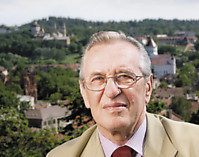
He explained: “We need honorary consuls in countries where we have interests: political, economic, cultural and educational.
“How do we find them? In a way, it is a mutual discovery. Many were already involved in projects or activities that helped Lithuanians. They are often surprised when we ask them if they’d consider being an honorary consul.
“It is not a decision to be taken lightly. In many countries, the honorary consul is the only representative we have, so they have to be skilled enough to cover all aspects of international relations. The key is that before they become honorary consuls, their work should be noticed by someone, and this someone tells someone else, and eventually it gets to me.”
Getting noticed
Take Ulf Halvor Hallan, honorary consul in Nordland and Troms, who maintains the consulate in the town of Bodo, just above the Arctic Circle. He had never thought about being an honorary consul. However, right after Lithuania’s independence, he helped Lithuanians come to his neck of the Norwegian woods, and continued to help. Some time later, he was noticed.
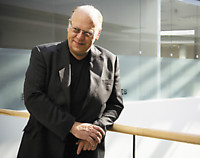 Hallan explained: “I was working with the mayor on the Nordland Music Festival, one of the largest music festivals in Norway. By chance, that year, there were changes in the programme, and we invited the Lithuanian National Symphony Orchestra, chartered a plane, and I immediately took on the responsibility as their host, and made some friends along the way.
“I soon visited Lithuania for the first time, and I felt as if I was coming home. I’ve travelled a lot, to fifty-six countries, but I’ve always wanted to know one country a bit more. I began to work more and more on Lithuania’s behalf, along with introducing Norwegians to the possibilities of mutual cooperation.
“Eventually, I got a call from the Lithuanian embassy in Oslo, and, to my surprise, they offered me the position of honorary consul. I thought about it, and accepted.”
François Xavier Nieberding, honorary consul in Antwerp, credits his father with introducing him to Lithuania.
“It all started with one fateful meeting in 1993, when my father, who owned several private business schools in Europe, introduced me to the very nice and charismatic Archbishop Bačkis of Vilnius. He had come to Antwerp with a request: was there any possibility of sending some Lithuanian students over to Belgium for a summer course in marketing, computer science, finance, and so on? 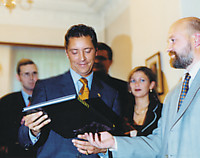
“My father agreed, and the first students arrived, and continued arriving for several years, and my father did not charge them the school fee. During that time, I was working for my father, and had the opportunity to meet some of those students.
“They talked a lot about their homeland, and that is how my interest began to grow. The honorary consul in Monaco learned of this, and that’s how I became an honorary consul.”
Bill Toner, the honorary consul in Scotland, at first became acquainted with Lithuania when he became managing director for Narbutas & Ko, a Lithuanian furniture company, and through this, he became a regular visitor to the embassy in London, and they noticed him. The embassy soon began seeking his advice on furthering commercial interests in Britain, and this led to his nomination as honorary consul for Scotland, which became official in November 2005.
Then there is Bernd Moser, honorary consul in Erfurt, who represents the German states of Thuringen and Sachsen-Anhalt. As a manager with TUV, one of the leading testing, evaluation and certification organisations in the world, he met Lithuania when TUV expanded here.
His work did not go unnoticed. It was the German parliament that asked him to be an honorary consul.
“I accepted the position. But I also had a personal mission. I want to see better cooperation between Germany and Lithuania.”
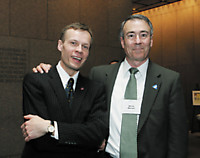 Dennis Garrison, honorary consul in San Francisco, discovered Lithuania from his work in the Kaimas (Countryside) Fund, courtesy of the US-Baltic Foundation, an organisation formed in 1990 to strengthen democracy and free markets in the three Baltic States. He became involved in this project, that has helped over 2,500 young people in Lithuania.
“After visiting Lithuania several times and becoming involved with the Kaimas Fund, I was asked, and accepted the position of honorary consul, because this way I could do more things to help people, especially children in rural areas.”
Fast forward
Some were drawn to Lithuania through its impact on world history. During the Middle Ages and the Renaissance, Lithuania was vast. At one time it was one of the largest states in Europe, and its legacy is still strong in these parts of the world. Jerzy Bankowski, honorary consul in Toruń in Poland, is one such example.
“I have always been interested in Lithuania. I come from the east of Poland, so there are long standing Polish-Lithuanian friendships in my family. As a businessman and a member of the Rotary Club, I established contacts with Lithuanian companies, and my activities went far beyond the scope of business.
“I started many activities in which friends from Lithuania participated; therefore, it was suggested I deal with Lithuanian affairs not only unofficially, but also as an honorary consul. Being guided by my fondness for this wonderful country and nation, I proudly accepted the function.”
Western Ukraine also has a joint historical heritage with Lithuania. Nowadays, the honorary consul, Vitaliy Antonov, works in the historic city of Lvov, and takes care of the Lithuanian diaspora there. In 1999, he was appointed honorary consul. But in a way, he had already been one.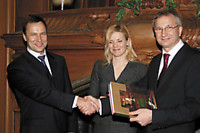
“At first, my interests were only connected with my business. I am president of the Universal Investment Group, and we were selling oil products in Western Ukraine, and we were the first to do business with Lithuania in all of western Ukraine. When our work became known in the local community, everyone asked me to help them forge ties between our region and Lithuania, which I did.
“In the meantime, my own business became interested in other kinds of cooperation between our countries, and this led me to act as a kind of ‘unofficial consul’. Being on friendly terms with the Intergovernmental Cooperation Council, they proposed that I legalise my work by becoming an honorary consul in the Lvov region. At that time, I was the only honorary consul of Lithuania in the whole of Ukraine.” There are now four.
Lilia Fortunato Tatò 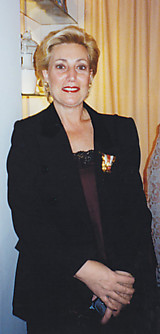 lives in Bari, in Puglia in southern Italy, on the Adriatic Sea. Before she became an honorary consul in 2002, she was virtually the only one there who knew anything about Lithuania.
“It was one of my first jobs,” she explained, “to inform the local authorities and government representatives about Lithuania, and about how we could connect in our beautiful city.”
Although Bari and Lithuania are seemingly not connected, it is worth mentioning that there is, indeed, a historical connection, and through this, Lilia met Lithuania.
Almost 500 years ago, the Italian princess Bona Sforza became the queen of Poland and grand duchess of Lithuania. Her life and death read like a Shakespearian tragedy. Young, beautiful, and purebred Renaissance royalty, she was betrothed to the much older Sigismund the Old, the king of Poland and grand duke of Lithuania. Schooled in the cutthroat world of Italian politics, Bona acted as such, acquiring immense wealth and securing her power ruthlessly, at the same time as alienating her husband and her subjects.
When the old king died, the tale grows even more intriguing. The new king, her son Sigismund Augustus, fell in love with the Lithuanian Barbora Radvilaitė, considered one of the most beautiful women in Europe at the time. However, she was not fit to marry the king, according to the rules of royalty, but they married anyway, causing a great storm. Five months afterwards, Barbora died from poisoning, and the number one suspect was Bona Sforza.
Sigismund forced her to return to Bari, although as its duchess. Soon afterwards, she herself was poisoned. Her story was an intriguing study for Lilia, and helped her discover modern Lithuania.
A full-time part-time job
Being an honorary consul is mostly hard work. They tirelessly make connections, they receive many kinds of guests, and handle a lot of bureaucracy. They also have to make a living: it’s all part of the job.
François Xavier Nieberding did not have much time to learn the ropes before being thrust into his duties.
As he recalled, “One of the challenges I faced came four months after I was appointed. Algirdas Brazauskas, who at that time was president, was making an official visit to Antwerp. With him were several ministers and mayors, and the Lithuanian ambassador to Belgium asked me to organise the visit.
“I can assure you that this was a great challenge. Protocol, security and meetings: all went well. It was a successful day in Antwerp.”
Among all his successes in helping Belgians make business connections, Nieberding has also organised concerts with artists, children’s choirs and other musicians. He notes that he invites both Belgians and Lithuanians living in Belgium, in order to create some opportunities to meet each other. He is also preparing for Vilnius 2009.
“Last week, the Lithuanian ambassador in Brussels came to Antwerp on an official visit. We also met the alderman responsible for culture. We spoke with him concerning Vilnius 2009 as Cultural Capital of Europe, and the commemoration of a thousand years of the name of Lithuania. We agreed that I will contact him to see what kind of activities we [the cities of Vilnius and Antwerp] can organise together.”
The United Kingdom relies on Bill Toner in its dealings with Lithuania. When President Valdas Adamkus visited Britain last year, Toner was the UK’s official representative. As Scotland has attained a greater degree of autonomy, he attends all consular meetings for the other embassies in Scotland, along with all the Scottish Parliament events concerning Lithuania.
He meets and arranges visits for Lithuanian government officials visiting Scotland, and will have the great honour of representing Lithuania at the opening of the new Scottish Parliament. However, he is most proud of his work in education.
“I have worked with west of Scotland colleges to aid cooperation with Vilnius University and other Lithuanian schools of higher education. For instance, about 40 Lithuanian students and education directors have attended Cumbernauld College in Glasgow.”
In Norway, Ulf Hallan spends much time working with the local community in Bodo to make business connections, as well as hosting Lithuanian guests, who have found Bodo a welcoming place.
“Since we’re north of the Arctic Circle, it’s fascinating for Lithuanians to come,” he explained.
He has also had much success introducing Norwegians to Lithuania. So much so that he has his own apartment in Vilnius.
“I bring groups here to make contact and meet people. Some are as small as ten, others as large as seventy. I’ve also had to prepare the airmen and their support team from a Norwegian Air Force fighter squadron, who will be coming to do their six-month tour at the Nato air force base in Šiauliai.”
Bernd Moser 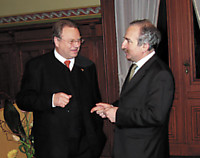 is strictly business.
“I was involved in the organisation of a business forum in Erfurt in 2007, which received a delegation of Lithuanian parliamentarians. I also arranged for the Lithuanian minister for the economy to meet his Sachsen-Anhalt counterpart and discuss the promotion of wind energy.
“I am also active in another function. Last year, I became a member of the board of the German-Lithuanian Forum. There I work mostly together with the Lithuanian Development Agency in Germany, to establish contacts with partners in Lithuania, and also to provide information about different aspects of the country itself.”
However, even he does not neglect the arts.
“I was particularly glad that I had an opportunity to arrange a photography exhibition by Lithuanian artists in Erfurt in November last year, in collaboration with the Germany-Lithuania Society. The theme was ‘Lithuania Today’, and it featured the everyday lives of Lithuanian citizens.”
Jerzy Bankowski works to promote culture, especially in making connections with Lithuanians. He explained: “Toruń is a city where many prestigious cultural events take place. Artists from Lithuania take part in several of them. Among others are the Lithuanian National Symphony Orchestra, which participates in the Festival of Music and Art of Baltic States.
“The theatre festival will host actors from Lithuania. The event is accompanied by a number of exhibitions, among others an exhibition of photography. Many Lithuanian painters have chosen Poland as the place where they create and present their works of art.
Lilia Fortunato Tatò also loves the arts. Since Bari is a city full of famous monuments, castles, cathedrals, circular stone houses and other archaeological landmarks, she has worked to build up cultural relations with Lithuania.
“We have held concerts featuring the work of Čiurlionis, the most famous Lithuanian composer, painting exhibitions, and theatre. We have also translated Lithuanian books into Italian.”
Another of her ideas is to “twin” the castle in Bari with the castle in Trakai. On the other hand, she has not neglected the local business community. In 2005, she organised the first entrepreneurial visit to Vilnius, which proved very successful.
“We already have connections in food, one of Puglia’s most important industries. We deal in meat, cheese and wine, and also wood.”
Dennis Garrison has been encouraging Lithuanian Americans in northern California to participate in cultural events.
“The cultural ties between Lithuania and the United States are very strong. The San Francisco Lithuanian-American community hosts concerts by Lithuanian entertainers each year.”
He has also been active in creating economic ties. “This last April, a civic group from Šiauliai visited northern California to learn about agricultural programmes at the University of California at Davis. Some of the visitors, who belong to Rotary International, visited hospitals and sought funding for medical equipment from local Rotary Clubs. Later, the city of San Francisco received a team of Lithuanian doctors.”
Garrison has had the opportunity to meet the president.
“In February, we received a delegation from the Lithuanian International Chamber of Commerce on a visit to San Francisco. During that time, President Adamkus came to make two presentations to the World Affairs Council of San Francisco. We held a reception in honour of Lithuania’s Independence Day. Over three hundred people attended, including the mayor of San Francisco, who presented Adamkus with a key to the city.”
The person of last resort
In some countries, Lithuania has many consular officers. This is important, because it has more extensive relations in these places. One essential distinction is that in bigger countries, honorary consuls represent a region, quite often their home town, and if there’s a sudden catastrophe, earthquake or tsunami, they are the fastest link with Lithuanians who may be in trouble.
Alas, Lithuanian citizens also get in trouble in less spectacular ways. They may simply need a bite to eat, a place to stay for the night and a ticket home.
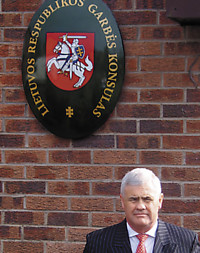 Bill Toner gets a number of requests from Lithuanians for visas and passports when they cannot get in touch with the London embassy by phone. He also deals with people who find themselves out of money, and those who had a one-way ticket from Lithuania, only to find themselves in trouble.
“It’s one of the many duties of an honorary consul, but I haven’t had to deal with anything really bad,” he explained.
Nieberding recalled helping a young girl.
“She had come to Belgium with her boyfriend. They had a fight. He kicked her out of his car, and left her on the street with only her luggage and no money. I got a phone call from the local police, asking me to drop by to see what I could do for this distraught girl. I arranged and paid for a hotel room, food and a bus ticket, so she could get back home. She was so happy, and thankful.”
Bernd Moser found himself having to deal with a “hostage situation”. He explained: “It so happened that a Dutch enterprise had sold some equipment to Ukraine, and hired Lithuanian transporters to deliver it. When the Lithuanians reached the border, a conflict arose between the Dutch and the Ukrainians about the price of the equipment. So for days, while the two sides argued, the Lithuanians were stuck at the Ukrainian customs point, unable to leave it.
“When I got word of this, they had already been stuck for many days, so I drove there to help them. The Dutch and the Ukrainians continued to argue, but I was able to convince the customs officers to let the Lithuanians deliver the equipment, and then they went back home.”
They must love Lithuania
“Ideally,” explained Podagėlis, “honorary consuls should be all-rounders with universal ideals. They must show initiative, and in return, we must too. If we demonstrate an initiative from one side, it’s good; but if it’s from both sides, such as organising common projects together with the embassy and with the consuls, we get even better results. I should note that to be an honorary consul isn’t just about getting noticed. These are people who have their own lives, families and businesses to attend to. They are respectable, moral people, and are, and should be appreciated for accepting the position of honorary consul.”
Vitaliy Antonov views his work as honorary consul this way: “Every person, in some way, wants to do something good for the community, and to take an active part in its life. The appointment as honorary consul gives me this opportunity.”
Ulf Hallan is honoured to be an honorary consul.
“What grabs my heart are the people. I find them open, honest, highly moral, very friendly, good to be with, and they’ve become close friends. I always take care to make sure that when I invite people from Norway, they meet Lithuanians. They need to meet people to know the country.”
Jerzy Bankowski has visited Lithuania several times, and each visit is special.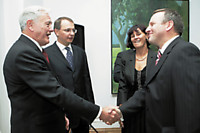
“The country has always surprised me, not only with the speed of its economic growth, but also with its care of traditions and history. I’ve always been charmed by the unpolluted nature, beautiful lakes and forests. I feel as if Lithuania is my second home, and the cordiality of its inhabitants captivates me deeply. I have devoted friends there.”
For Dennis Garrison, rural Lithuania forms his bond.
“This is an exciting time in the country’s history, as the people decide how they want their government to function, what ethical standards business and government will be expected to meet, and what the economy must become to provide prosperity to its people. The privileges of freedom must also be balanced with the responsibilities of freedom, such as compassion towards the elderly and children, who do not have as much in terms of material wealth and opportunities.”
Bernd Moser explained that his success has come from having a good team and a lot of help. “In order to make a real contribution as honorary consul, I need the support of my colleagues, friends, business partners and family, and I thank them sincerely for their support.”
François Xavier Nieberding had this to say: “Lithuania is a great country, in every sense. It is an honour to promote it here in Flanders.”
He added: “I’m planning a business mission, with three or four Belgian businessmen, at the end of June. Every time I do it, it’s nice to see how these people become positive at the end of a visit. So you see, I am not the only one who thinks that Lithuania is a great country!”
Aleksas Apynys

Social media