


EUROPEAN SOLIDARITY IS THE BEST INVESTMENT INTO THE FUTURE (Baltic Rim Economies, Bimonthly Review 5/2007)
Twenty years ago the idea of restoring the independence of the three Baltic States - Lithuania, Latvia and Estonia - was still considered a risky political project. However, with the support and solidarity of the Western democracies, we not only rebuilt our statehood, but also established competitive and fast-growing free market economies. Our road to success was built on democratic values, economic pragmatism, the culture of social and political dialogue, and a firm perspective of European and transatlantic integration.
Today the three Baltic States represent a successful political and economic ‘trademark’. And the cooperation between the Nordic countries and the Baltic States, which also includes Germany, Poland and Russia, has changed geopolitics of the Baltic Sea region.
Our geographic location on the frontier of the European Union is a big advantage; but it also poses new challenges. One of them is to bring the European Union and Russia closer to each other. The more Russia will become integrated with the European values and economic cooperation, the more will we exploit the potential of the Baltic Sea region.
Unfortunately, the EU border infrastructure in our region today hardly corresponds to the growing needs of businessmen and investors. We need to address this challenge together. Through cooperation and integration we can transform our region into one of the most progressive and competitive regions in Europe.
Ambitious projects of Rail Baltica and Via Baltica are already underway. However, the energy security issues still need further progress. The Baltic States continue to exist as ‘an energy island’ having access to mainly one energy supplier – Russia.
Lithuania has taken first steps towards increasing of our energy independence. We focus on two strategic projects: development of a new nuclear power plant and connection of our energy grids with those in the EU.
We are grateful to our Northern neighbours, first of all, Finland and Sweden, for their continuous assistance to the security of the old Ignalina Nuclear Power Plant, which is due to be closed in 2009. But we also look forward to learning from the Nordic experience and expertise, especially in the environmental field, as we proceed with the construction of a new nuclear site.
During the years of the EU membership Lithuania established close economic business cooperation and investments links with the Nordic countries. More than a quarter of Lithuanian exports today go to the Nordic markets. Sweden, Denmark and Finland are among the largest foreign investors in Lithuania. Therefore, it is natural that common EU energy infrastructure is essential to guaranteeing stable economic and social development of the region. I am certain that our success, as well as the successful realization of energy projects, will only strengthen the economic potential of the whole Baltic Sea region and stimulate its future growth.
It is worth remembering that the present-day European Union also takes roots in energy. 50 years ago the European Coal and Steal Community and EURATOM offered a unique way of overcoming disputes among the European nations, which later was established in the European acquis.
In 21st century coal and steel is replaced by oil and gas. However, supranational structure to govern the supply and demand for those resources is not yet established. We have a common EU trade policy, but we do not speak in one voice, when we have to deal with energy issue. Competition among the Member States regarding energy recourses has no clear rules.
So why the EU supports, politically and financially, the development of the EU transport infrastructure in the new Member States, but the development of energy infrastructure is left to the discretion of individual countries?
I believe that suppliers also suffer from this situation as they lack incentives to invest more in new fields and technologies. Monopolistic presence in the region prevents from creative thinking.
As a result, the name “Responsible Energy for Responsible Partners” chosen for Vilnius Energy Security Conference, which is held on 10-11 October, is not accidental. We trust that this forum, to which representatives are coming from the countries of Northern and Southern, Eastern and Western Europe, Central Asia, the Caspian Sea and the Black Sea regions and from the USA, strengthens transatlantic energy dialogue and helps to create a constant high-level consultation mechanism, and an open cooperation among the countries, which have energy resources at their disposition, transit countries and consumers.
While the dependency of the European Union on the external countries is constantly increasing, it is high time to tackle the EU energy issues in solidarity not just inside the EU, but also to speak in the solid EU voice with its external partners. The EU energy partners not only talk loudly about their policy interests, but also implement their energy policy actively. In the meantime, the EU countries still function mostly on the bilateral basis and speak, I would say, tentatively with Georgia, Azerbaijan and Central Asian countries. But do we have an efficient strategy of relations with these countries, and, even more so, a strategy coordinated with the USA, our most important partner on the American continent?
The European Union has to take a rational opportunity to avoid the situation, when even in Europe democratic countries compete between themselves and fall prey to their own egotism and failure to agree. Moreover, can Europe shut eyes to the fact that the oil dollars and oil euros increase not the welfare of the common people, but the wish to use power politics in the dialogue with partners, and manage business affairs in this way?
The European Union does not threaten anyone to become an energy policy dictator. I think that Europe does not need this, because it is not within our interests to impose our will on other countries of the world. The strength of the EU is our firm foundation of values, solidarity and strong transatlantic relation, as well as the open dialogue with all of our partners. We should learn to use this potential to guarantee secure and prosperous future of European people, while the countries, which are rich in energy resources, should invest their income into reforms promoting social progress.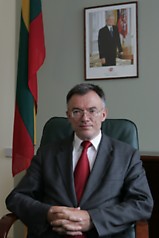
Petras Vaitiekūnas
Minister of Foreign Affairs
Lithuania
Social media


