


Budrys: Lithuania’s example shows that a country’s influence is determined not by its size, but by its ability to build strong alliances and act on principle in the international arena
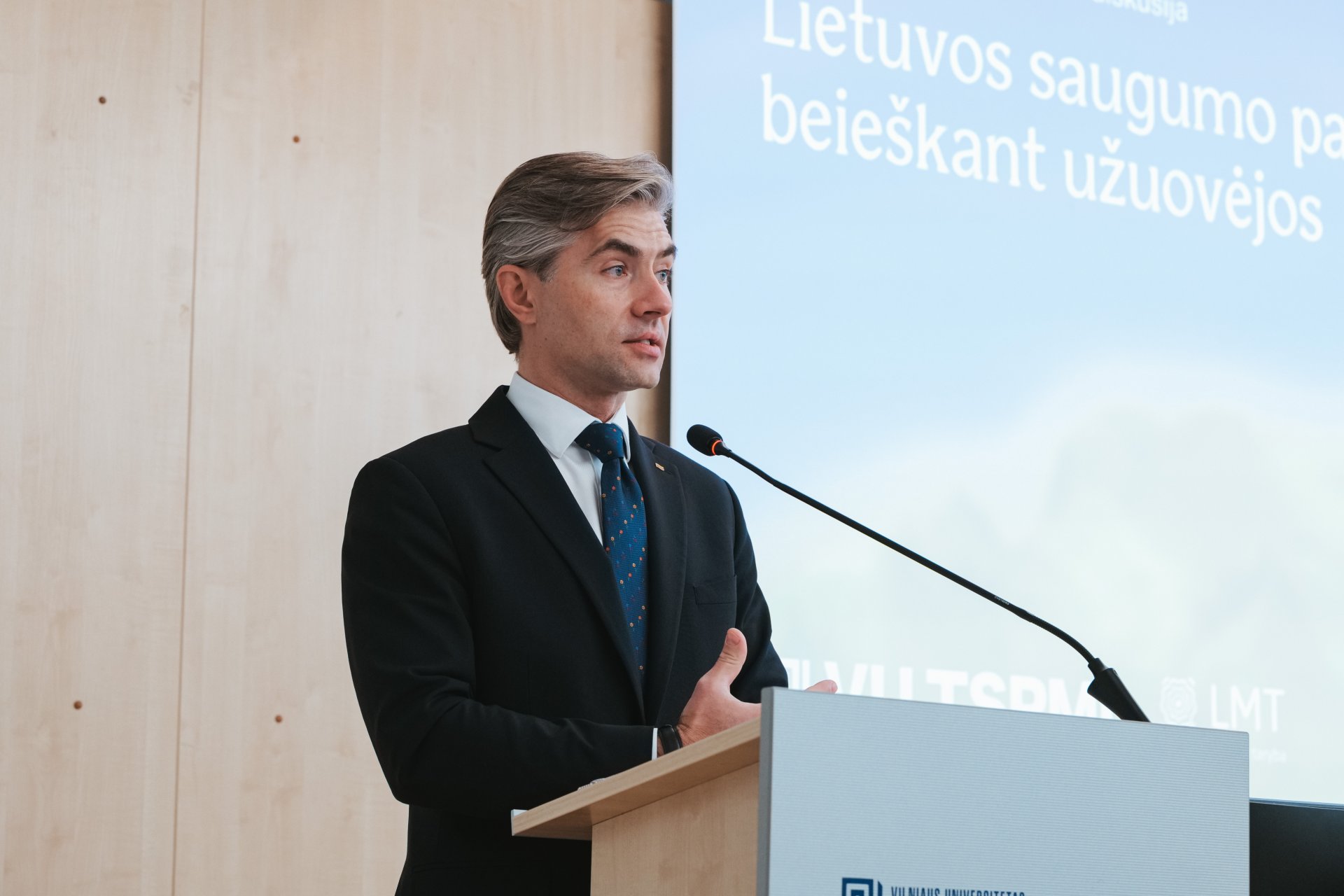
On 15 October, Minister of Foreign Affairs Kęstutis Budrys delivered a keynote address and took part in a round-table discussion entitled Small States and Security Partnerships. Organised by the Institute of International Relations and Political Science at Vilnius University, the discussion explored the role of small states in the international arena and their ability to pursue their security interests.
Lithuania’s Foreign Minister emphasised that Lithuania successfully combines two key approaches available to small states in the field of foreign policy. The first is based on building strong alliances and strengthening security guarantees through the consistent development of partnerships with the United States, Germany and other NATO Allies. The second is based on active engagement in international organisations and the ability not merely to adapt to the international agenda, but also to shape it.
“Lithuania’s experience shows that a country’s influence is determined not by its size, but by its ability to build strong alliances and act on principle in the international arena. Drawing on our strong partnerships with the United States, Germany and other Allies, as well as our active engagement in the United Nations, the Council of Europe, the EU and NATO, today we are not only strengthening our own security but also contributing to decisions that shape the future of Europe and the world, from energy and sanctions policy towards Russia and Belarus to the regulation of artificial intelligence and the protection of human rights,” Budrys said.
As an example of the results of such leadership, the Foreign Minister pointed to the EU’s adoption this week of its most comprehensive package of sanctions to date targeting Russia’s military-industrial complex, aimed at hampering the Kremlin’s war machine.
However, the Minister stressed that the international environment is becoming increasingly complex. The stability of international rules is diminishing, geopolitical uncertainty is growing, and traditional institutions are facing the need for reform.
According to Budrys, this uncertainty in the international system calls not for alternatives, but for additional ways of operating: building regional coalitions, investing in strategically important technologies and strengthening networks of diplomatic relations at all levels of governance.
According to the Foreign Minister, long-term security rests not only on external guarantees but also on a country’s own ability to remain strong, resilient and valuable to its partners. Investment in defence, the economy, technology and societal resilience is therefore an integral part of a modern small-state strategy.
“Small states are not condemned to simply accept circumstances as they are. They can shape their own future security and prosperity if they consistently strengthen their alliances, expand their networks of influence and invest decisively in their own capabilities. Today, what matters most is not the size of a country, but its strategic thinking, perseverance and ability to act creatively,” Budrys said.
Social media


