


AT THE EMBASSY IN THE U.S., LITHUANIAN FOREIGN VICE-MINISTER HIGHLIGHTS THE IMPORTANCE OF LIVE MEMORY OF TOTALITARIAN CRIMES IN THE WORLD
Genuine memory of crimes committed by totalitarian regimes and the restoration of justice must be of concern to both the U.S.A. and the entire international community of democratic countries, said Lithuanian Vice-Minister of Foreign Affairs Evaldas Ignatavičius during the discussion on crimes of totalitarian regimes in Europe at the Lithuanian Embassy in Washington D.C., on 17 November.
“Silence about the geography of totalitarian terror with its perpetrators and victims demonstrates that there are white spots in the European historical memory,” said E.Ignatavičius.Professor Timothy Snyder of Yale University took part in the event and presented his book “Bloodlands: Europe Between Hitler and Stalin”. The author emphasized that the Eastern Europe, which in the 20th century found itself at the very epicentre of the Nazi and Soviet totalitarian regimes, was one of the most dangerous places to live, irrespective of the ethnic background of people.
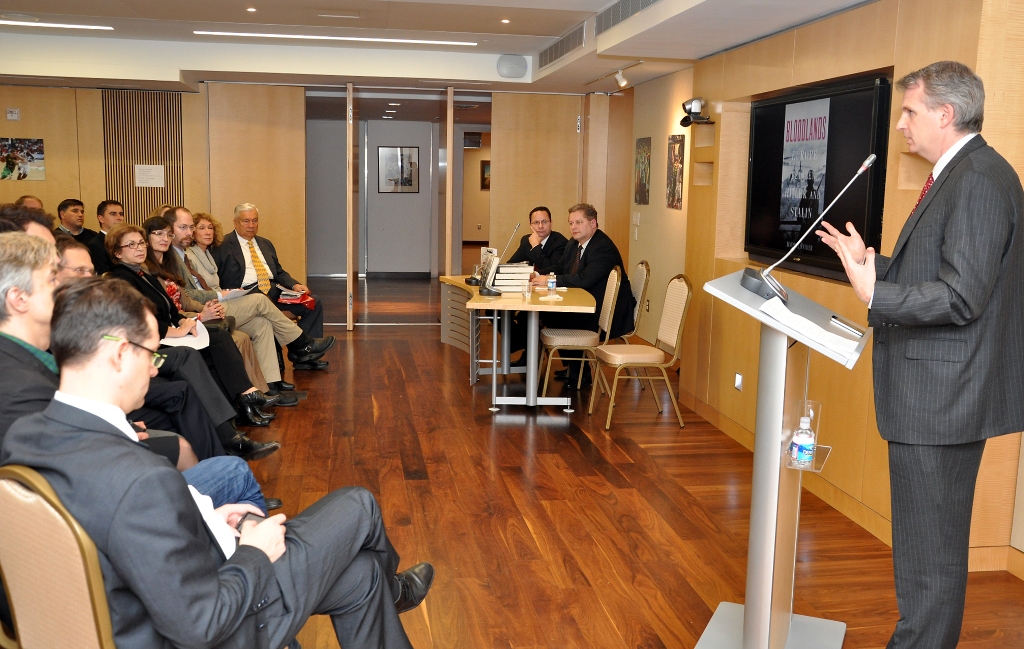 The book by T.Snyder tells three closely interwoven stories: Stalin’s terror, Hitler’s Holocaust and the starvation of non-Jewish people and war prisoners in the “bloodlands”. From 1933 to 1945, about 14 million local people were murdered in the territory from Central Poland to Western Russia, including Ukraine, Belarus and the Baltic States.
The discussion was attended by representatives from the U.S. Congress and administration, Polish and Hungarian Ambassadors in Washington, D.C., members of the local Lithuanian community.
T.Snyder studied history at Oxford and, currently, is a Professor at Yale University. His research areas are: Eastern Europe and history of the Holocaust. Winner of the 2003 George Louis Beer Prize of the American Historical Association, the author has many other awards for his work.
The book “Bloodlands: Europe Between Hitler and Stalin” by T.Snyder has been published also in the Lithuanian language. The Ministry of Foreign Affairs of Lithuania has supported the translation of this book.
Social media


