AN IMPERIAL VISIT (Lithuania in the World, 2007, Vol.15, No. 3, p.4-5)
Vilnius receives the Emperor and the Empress of Japan On 26 May hundreds of onlookers holding Lithuanian and Japanese flags flocked to Daukantas Square in front of the President’s Office. That day, Japan’s 73-year-old Emperor Akihito, accompanied by his wife and consort, Empress Michiko, became the first Japanese sovereign to set foot on Lithuanian soil, during a short stay in Vilnius. (Emperor Akihito succeeded in 1989, and is Japan’s 125th emperor.)
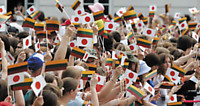
The brief sojourn in the Lithuanian capital was part of the couple’s official visit to Sweden, the three Baltic States, and Great Britain. It was a visit that was long on historical reflection and meetings with ordinary people, and short on fanfare.
At a luncheon hosted by the Lithuanian president, Valdas Adamkus, the emperor praised the grit and obstinacy with which the Lithuanians had faced occupation under their former Soviet masters.
“We go back in our memories to the hardships of the Second World War, and later history, which was full of trials, and we are deeply impressed by the courage and dignity with which your people met all the troubles,” he said.
Adamkus said he was impressed by their interest in Lithuania’s history, and by their unassuming disposition, hailing the event as one “light on pomp and grandiosity”.
“We spoke of human affairs, daily life, and about people’s concerns,” he said. “I was truly surprised that the imperial family knew our past, especially the last fifty years.”
According to the president, the visit meant “greater international recognition” for Lithuania. “We welcome the emperor with great joy, and I think this is the beginning of closer cooperation between our two countries and peoples.”
The empress told journalists before leaving Japan that she had become interested in Baltic affairs two decades ago, when she started to read about the region.
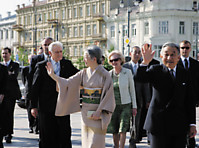 They also said they had fond memories of a 1992 exhibition in Japan of works by M.K. Èiurlionis, a Lithuanian painter and composer who is held in high esteem by the Japanese, and the emperor impressed the news conference when he gave the media a short lesson on the last century of Lithuanian history.
The Japanese constitution prevents Emperor Akihito from getting involved in politics. Other than attending the president’s luncheon, he eschewed the usual round of speeches and meetings with state officials that often typify visits by foreign heads of state. Instead, the couple opted for an earthier approach, taking in a folk music festival, meeting with locals, and chatting with artisans involved in traditional crafts.
Empress Michiko charmed Lithuanians by wearing a corsage reflecting Lithuania’s flag, in yellow, green and red.
While in the capital, the imperial couple laid a wreath in front of the monument to the famous Japanese diplomat Chiune Sugihara (1900–1986) who, as acting consul to Lithuania in 1940, flouted his own government’s official policy by issuing over 2,000 visas to Jews seeking to flee the country before the Nazi invasion. Because some families escaped on a single visa, historians estimate that he may have saved some 6,000 lives. He is widely known as “Japan’s Schindler”. By some estimates, some 40,000 people are living today thanks to his defiant gesture in defence of humanity.
The couple, who typically undertake one visit abroad annually, said they regretted their itinerary did not include a stop in Kaunas, Lithuania’s second city, where there are Sugihara and Èiurlionis museums.
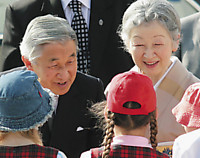 Throngs of photographers and cameramen from Japan shadowed their every move, bringing publicity to the small Baltic country and relative newcomer to the European Union, located on the bloc’s eastern fringe.
The visit was capped with an announcement by Japanese officials that a fully fledged ambassador is to be posted to Lithuania in early 2008. Presently, the ambassador resides in Copenhagen, though Japan has maintained a diplomatic mission in Vilnius for a decade. Lithuania and Japan reestablished diplomatic relations after the break-up of the USSR in 1991.
As part of a longstanding practice of spreading its massive wealth by sponsoring arts groups beyond its borders, since 1997, Japan has been a major benefactor of Lithuanian culture. Donations to museums and Classical music ensembles over more than a decade top well over 10 million litas.
It has bought top-quality instruments for veteran Classical musicians and conservatory students, and audio-visual kit for museums, and it has contributed to library renovation programmes.
Darius James Ross

Social media