A SIMPLE APPROACH: DELVE DEEPLY, BUT KEEP IT SIMPLE, IS THE PHILOSOPHY OF THE FOREIGN MINISTER (Lithuania in the World, Vol. 15 No.1, 2007, p. 12-15)
When you sit down with Petras Vaitiekūnas, the minister of foreign affairs, you know that you are not in the presence of a glib politician. A 52-year-old father of three, during his career he has held some of the country’s top (and toughest) diplomatic and foreign policy advisor assignments.His appointment as minister came last year, following a standard round of horse-trading, when the present four-way, centre-left ruling coalition took power.
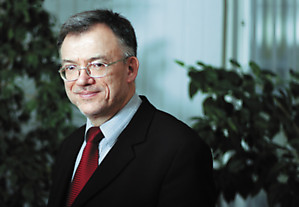 Vaitiekūnas fits the bill partly because he does not belong to a political party, though it is likely that his spotless record did more to tip the scales in his favour. (In Lithuania, cabinet ministers do not necessarily need to be elected MPs).
He is a tall man who likes sombre, well-cut suits. Since becoming minister, he has eschewed the bow ties that accompanied his five years as ambassador to Latvia (1999 to 2004), which matched his good manners and alert gaze. He is not given to rhetorical flourishes, answering questions with a sincere but measured frankness.
As a young intellectual growing up in the Soviet Union, he studied physics, a common path taken by those who wanted to pursue serious academic studies without compromising their principles, earning a doctorate in 1983.
“The natural sciences then managed to preserve the essence of academic study, and were the least tinged by ideology,” he says. “Other fields were drenched in communist ideology. There were numerous poets and playwrights among the ranks of physicists and mathematicians.”
On the break-up of the Soviet Union, he was a signatory to the declaration which saw Lithuania reclaim its independence, and embarked on a new career as a foreign policy analyst and aide, notably in the office of President Algirdas Brazauskas in the mid-1990s, and perhaps somewhat heroically in that of President Rolandas Paksas during the 2004 crisis that saw the head of state removed by impeachment.
Vaitiekūnas was brought in at the height of the affair as a neutral and safe pair of hands to keep the state afloat while the ill-fated chief’s political career sank amid a flurry of corruption allegations.
He was made ambassador to Belarus in 2005, but his stint was cut short after a year when Vilnius’ squabbling politicians reached a peace deal, and called on him to assume his present role.
Asked which role he prefers, that of ambassador or that of minister, though he does not downplay his commitment to his new job, he says with a physicist’s candour that he is the type of person who likes to delve deeply into one field of endeavour, rather than take a bird’s-eye view of many.
Serious reading
When he is not working, he unwinds by reading books by Kurt Vonnegut and contemporary post-Soviet and postmodern authors, like Viktor Pelevin and Viktor Sorokin (both the latter are engineers by trade, while Vonnegut started out as a chemist), and he keeps abreast of developments in physics and astronomy by reading Stephen Hawking.
So, light reading only?
“Yes,” he says with a smile. It is not altogether clear whether he got the joke.
“By the way,” he adds, “the contemporary re-thinking of cosmogony [the theory of the origin of the universe] is a revolution comparable in importance to that of Newton. It’s fascinating to observe it.”
He starts speaking about gravitational forces, equations, string theory and the theory of everything, but promptly wraps up his discourse once he reads from my befuddled expression that I am, in cosmogonic terms, an utter illiterate.
Does he get bitten by the travel bug?
“My greatest desire is not to go anywhere. During the holidays I’m happy to just amble about Vilnius.”
This is an understandable response, given that foreign ministers typically have travel schedules more gruelling than those of UEFA football players, and seem to be perpetually on the road.
Fine dining? The minister is not a fan. Simplicity is his motto. He says he provokes howls of protest when he takes the helm in the kitchen: it’s beetroot, potatoes and pickled cabbage when it’s his turn.
His favourite dish of all is fresh bread with olive oil, and a glass of South American white wine.
“It’s fundamental food. It’s food that’s as close to nature as you can get. It’s biblical,” he waxes. “I like things that are simple and that can’t be reduced or embellished.”
Open-door approach
His pet peeve, he says, is arrogance. And one of his main aims as minister is to do battle with the remnants of a lingering bureaucratic hauteur in some quarters of the government and the diplomatic service. His watchwords are approachability and the proverbial open door.
“Some civil servants need to become more grounded, and to move from the macro to the micro level. The writing of macro reports is important, but we can’t overlook other things, such as helping out small businesses that face obstacles setting up in a foreign market. That’s the concrete and time-consuming stuff, while country reports, in my view, shouldn’t exceed two pages.”
His views bring to mind Albert Einstein’s oft-quoted dictum: “Everything should be made as simple as possible, but not simpler.”
His model of a diplomatic service, he says, is Iceland, a land with a population ten times smaller than Lithuania’s, which emphasises the small details, and gives priority to helping its citizens who come knocking.
Vaitiekūnas also believes that what he calls Lithuania’s “fragmentation”, due to a massive recent wave of emigration, is something his ministry will increasingly have to deal with.
“In this new global world, Lithuania is becoming increasingly fragmented. But it’s an open question if the same fragmentation will hold true spiritually.”
He is referring to the many mini-Lithuanias in the USA, Ireland and the UK, among other countries.
One of his plans for next year is to see the simultaneous lighting up of Christmas trees in all countries around the world that have Lithuanian diplomatic missions.
“This will happen regardless of whether it is afternoon morning or night, and all Lithuanians living in those countries will be invited.”
Time, space and light.
It made me think of an old school joke: “If it’s green and wriggles, it’s biology. If it stinks, it’s chemistry. If it doesn’t work, it’s physics.”
Let’s hope it works.
Global world
What have been Lithuania’s chief foreign policy achievements in the past year?
The main one has been our success, together with our partners, in drawing attention to the question of energy security, an issue that has now become something that is inseparable from Lithuanian diplomacy. There are fewer and fewer doubts that EU countries must address this issue with a single voice.
It is understood that our economy, now that we are part of the EU’s internal market, must be hooked on to the EU energy grid. At a summit in March 2006, we managed to convince the EU heads of state that Lithuania and its Baltic neighbours are, from an energy point of view, like islands which are physically cut off from the EU.
A key step in this direction was the start of talks between Lithuania, Estonia, Latvia and Poland to build a new atomic power plant [to replace the Soviet-era Ignalina plant which is slated for closure by EU mandate].
Another victory was the decision by the European Parliament to create an institute for gender equality in Vilnius, which is due to begin work in 2007. This reflects Lithuania’s progress on the gender equality and equal rights front. Clearly, many women in the political, business, academic and cultural communities have benefited, and today they are making this known outside the country.
After the big round of expansion in 2004, only Lithuania and Poland saw the creation of EU institutions on their soil. The gender equality institute will employ over 30 people. It will be charged with gathering, analysing, and distributing information about gender equality issues to other EU countries and the community at large.
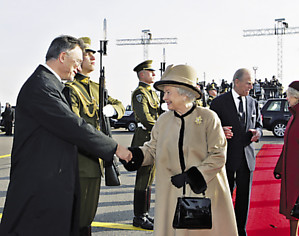 And one of the most memorable state visits in 2006 was that by Queen Elizabeth II. This first-ever visit by a British monarch to Lithuania proved to be an exceptional opportunity for us to consolidate the many centuries of friendship and cooperation between our two countries, which today are based on modern and dynamic interests we hold in common.
Given the recent shift in the political landscape of the United States, will Lithuania keep its forces in Iraq?
We acknowledge that the situation in Iraq demonstrates the need to rethink the actions of the alliance in that country. Being a part of the international coalition in Iraq, we are interested in Iraq’s as well as the Allies’ success.
Together with the rest of the coalition, we are pleased to hear about the improvement in the security situation in southern Iraq. Such conditions permit multinational forces to transfer security responsibilities to the Iraqis. This situation also opens up an opportunity to use our forces in other places, where robust operational engagement is even more needed.
Before making a final decision about the further participation of Lithuanian troops in Iraq, we will assess all the factors and consult with our partners from the coalition.
And Afghanistan?
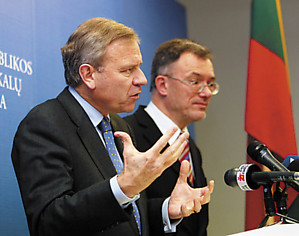 The operation in Afghanistan is Nato’s number one priority. Lithuania has 229 soldiers serving in missions abroad: 136 of them are in Afghanistan.
At the recent Nato summit meeting in Riga, Lithuania declared its intention to increase significantly its financing of civilian projects in Afghanistan in 2007: reconstruction and training programmes are a key priority.
Afghanistan will remain one of Nato’s key priorities next year as well. It is obvious that Nato by itself cannot resolve all of the problems there; nor can it guarantee sustainable expansion. Some progress has been made in coordinating the activities of the international community in Afghanistan, but our efforts need to be redoubled, working with key international organisations such as the UN and the EU.
Where does Lithuania stand on Turkey joining the EU? When do you see this happening, if at all?
I think that the continuing talks with Ankara and the ongoing process of reforms are more important than setting a date. I am buoyed up by the fact that Turkey’s leaders, despite some rough patches in talks with the EU, will keep going with their reforms, which are of benefit to the Turkish people. I want to stress that these are being carried out fairly successfully, and their continuation is the only path to success.
President Valdas Adamkus spoke about this at a recent forum in Istanbul. He compared Turkey’s present situation with Lithuania’s in 1997, when we were disappointed that we were not invited by the European Commission to join the group of countries on the fast track into the EU.
We had enough wisdom not to assume the stance of a jilted country: we increased the pace of reform, and managed to catch up. I hope our partners in Turkey will do the same. That is my sincere wish.
What do you make of the recent gas price row between Russia and Belarus?
The talks between Belarus and Russia, which lasted until the eleventh hour, showed, once again, that energy supplies, or the lack of them, remain one potential form of political pressure. I think this lesson will encourage the EU to deliberate seriously questions related to energy security.
Will Lithuania maintain the status quo in its relations with Belarus?
Our relations with Belarus are based on a principle of pragmatic cooperation between neighbour states. Attention is paid to border controls, along with economic ties, transport, environmental protection, and encouraging ties in areas such as culture and our common historical heritage. There is a working relationship between our ministries and other state officials, as well as between people in both countries’ business communities.
Our relations with Belarus did not fall off the radar after we joined the EU, and we are participating actively with the EU in forming the European neighbourhood policy.
We have always stressed that the international community, and especially Europe, must not only maintain but also strengthen its support for democratic processes and civil society in Belarus. People in Belarus who are public-spirited, especially the country’s existing intellectual elite, have to feel that they are both understood and supported by the EU.
What does encouraging democratic expansion eastwards mean? How would you describe ties with Russia and Ukraine?
Lithuania uses various means: we are continually developing neighbourly ties, we support the EU’s and Nato’s open-door policies, and we have been encouraging democratic reforms in Ukraine, Russia, Moldova and the countries of the southern Caucasus.
Ties with Russia, our biggest neighbour, are based on democratic values and mutually beneficial cooperation. Russia is our primary export partner, followed by Latvia and Germany; and it is one of our biggest investors.
We believe our relations with Russia are good, but it must be admitted that political dialogue is proceeding with difficulty in some areas, due to Russia’s position on certain questions, for instance on the way both countries interpret the historical events of 1940.
I would say our ties with Ukraine are especially close and dynamic, and are becoming increasingly more so. In the last few years, they have been reinforced by our two countries’ profession of Euro-Atlantic values, and we rejoice that over the past fifteen years our relationship has evolved to the point where it is now a strategic one.
Aside from the two-way institutions that have been established at the national level, ten cooperation agreements have been signed, which involve six Lithuanian regions and nine Ukrainian districts.
As long as Ukraine remains on a path of systematic reform, Lithuania will remain one of Ukraine’s most active supporters in its quest to integrate into Euro-Atlantic structures. We have bolstered this support with training programmes for Ukrainian civil servants, including projects in border and veterinary control management and state revenue administration.
Lithuania has been sharing its experience in the field of public information on Nato issues. We hope that Prime Minister Viktor Yanukovich will keep his word and continue along the path of Euro-Atlantic integration. The fact that 70 per cent of Ukraine’s youth support this direction is proof that the stereotypical view of Nato is diminishing, while the country’s future leaders see it as a member of the Euro-Atlantic community.
What are the key foreign policy goals in the short term and beyond?
For 2007, we have outlined three principal tasks: to consolidate our membership in the EU and Nato, and to play an active role within these organisations; to continue encouraging stability and the expansion of democracy to the East; and to optimise the work of our diplomatic corps.
Darius James Ross

Social media