A COUNTRY ON THE MOVE (Made in Lithuania, Vol 25. No 3, 2007, p. 12-15)
The sixth Trans-Atlantic Forum of the State Legislative Leaders Foundation, titled ‘The Republic of Lithuania – a new Member State of the European Union within the Neighbourhood Context’, was held in Vilnius.
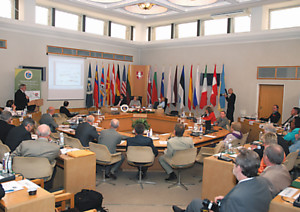 It was an opportunity for delegates and participants to consider the different turning points and phases of Lithuania’s geopolitical and social situation, the current political system of our country, and Lithuania’s roles in the European Union and in the context of interrelations between the European Union and Russia.
Professor Alfredas Bumbliauskas, from the Department of History in Vilnius University, presented the most significant dates and facts in Lithuania’s political history to business and politics representatives from the USA and from European countries. He emphasised that Lithuania, a country, which unites a variety of nations, confessions and civilisations, was the fastest country to march into European civilisation. Civil society, modern culture and principles of farming, a base that formed during the times of the Republic of Lithuania and enabled Lithuania to survive the disasters and the Soviet order from the middle of the 20th century, have become the ideological basis for the re-establishment of independence in 1990.
Professor Dr. Algis Krupavičius, from Kaunas University of Technology, presented his report about Lithuania’s road to democracy and the structure of the current political system. Having reviewed the change in the political regimes, he accentuated the fact the three Baltic States were one of the first countries to start the political changes that were to take place in Eastern and Central Europe. The important thing was that Lithuania regained its independence and created a democracy by means of political compromises. Currently, there are organisations in the country with up to 7000 supporters.
Following the detailed reports by the historian and the political scientist and the discussions by the participants in the Forum, the Chairwoman of the State Legislative Leaders Foundation, Lithuania’s Minister of Agriculture Prof. D.Litt. Kazimiera Prunskienė characterised the road of Lithuania’s re-integration into the European Community, its achievements and the role in participating in the enlargement of the European Union and policy reforms. In the more than 17 years of the re-established independence, from the former Soviet republic Lithuania has become a member of the European Union and followed Trans-Atlantic integration to become a member of NATO. “Though Lithuania could not take part in the process of European unification for almost 50 years, the people of Lithuania have always cherished European democratic values and have never lost hope of returning to the European family”, said the Minister of Agriculture Prof. Kazimiera Prunskienė, emphasising that Lithuania was reforming itself and making progress in various areas in the life of the nation and the state. However, the Chairwoman of the State Legislative Leaders Foundation did not conceal the problems that the country had faced and admitted that it was not in all cases and in all areas that Lithuania managed to find the best solutions, to come to an agreement, and to ensure the reforms would continue to move forward. “I think that today’s challenges, which both Lithuania and the whole European Union face, could be best met by acting harmoniously in the European Union, after putting in order our institutional structure and uniting our efforts to solve our long-term priority goals. We must understand integration not only in the institutional sense but also as a reduction of qualitative differences between the countries in economic, social and quality of life areas. These issues will continue to be relevant for many decades to come”, stated Prof. D.Litt. Kazimiera Prunskienė. By 2013, an advanced and competitive national economy, which is market-oriented from the technical, economic and managerial point of view, will have been created, and “from the field to the table” food economy will have been integrated as the base of its raw materials. The average size of a farm should reach 20 ha, and the number of commercial farms at full employment should be around 20 thousand. The share of people working in agriculture, hunting, forestry and fishing sectors will decrease to as little to 10 per cent. As many as 108 thousand hectares of land will be consolidated and land reclamation systems will be upgraded and renovated.
Bioenergy will be developed at a much greater pace, areas set up for plants for energy usage will be increased, which will allow at least 10-15 per cent of mineral fuels to be replaced with bio-fuels by 2015.
Farmers will engage in farming on the principles of sustainable agriculture, the environment will be protected, infrastructure will be developed, and alternative businesses will create a safe and people-friendly environment for work and recreation in the village.
The demographic situation in the village will improve, younger people will engage in farming – 20 per cent of all farmers will be people under 40 years of age. Difference in income between urban and rural population will decrease to 15 per cent. The sense of community will strengthen, which will allow strategic decisions to be adopted and implemented in place. With the quality of life improved in the village, the latter will become more attractive to live and work in. Deurbanisation may even take place – people will start moving from towns to the country where they will not only spend holidays in summer and have a rest but also engage in farming, set up their businesses, and, above all, will have large and industrious families.
Ensuring modernisation and competitiveness of the agrarian sector was also discussed at the Forum. Many participants in the Forum from abroad wanted to know how we managed to solve our problems in that sector and what the sector’s prospects were. “About one third of the country’s population live in the village and the village in itself is traditionally significant from many points of view because it is multifunctional. Basically this refers to the production of agricultural raw materials, the protection of the landscape, the fulfilment of its function regarding environmental protection, and the preservation of national cultural heritage for future generations”, said the Minister of Agriculture Prof. Kazimiera Prunskienė. The agricultural sector, together with the food industry, accounts for more than 8 per cent of the Gross Domestic Product, and following its convergence into an ever-changing sector of rural businesses, this figure is now closer to 10 per cent of the Gross Domestic Product.
“Membership of the European Union had a very positive effect from many aspects – modernisation, competitiveness, and income. During the past two years farmers’ incomes have increased by almost 30 per cent. We support the continuity of the common agricultural policy of the European Union. Support contributes greatly to strengthening this sector. Exceptional features during the current financial period as a result following the new European model of agriculture and food economy are as follows: multifunctionality and integrity of rural territories; traditional agricultural areas are supplemented with services; competitive agricultural production is developed; attempts are made to manufacture a higher added value product, to implement the quality policy, and to devote more attention to meeting the needs of the user.
The Minister of Economy Dr. Vytas Navickas discussed Lithuania’s economy and its prospects with the Forum’s participants. In his report the Minister presented an attractive picture of Lithuania’s macroeconomics underlying that the growth rates of the Gross Domestic Product (GDP) were not only sufficiently rapid but, according to all parameters, were also in the lead among the 27 Member States of the European Union. International experts also noticed the progress of Lithuania’s economy had made. For example, among the 27 Member States of the European Union the World Bank has evaluated Lithuania’s conditions for business as very high. “Investors from many countries choose Lithuania. And some of the largest investors are Poland, the Scandinavian countries, and Russia”, said the Minister of Economy of the Republic of Lithuania Dr. Vytas Navickas. The list of export countries is rather diversified, that is, there is no country, which is overwhelmingly reliant on Lithuania’s export. Meanwhile, Russia takes the first place in the list of imports. Russia supplies our country with energy resources.
The Forum addressed another very sensitive issue – the role of Lithuania within the context of interrelations between the European Union and Russia. “Lithuania, as a responsible member of the European Union, is concerned with the future of the European Union and further perspectives of its relations with the neighbours. We understand the importance of the European Union’s relations with Russia because if we ensure good relationship with this country and draw it into adopting global collective decisions, the probability that the world in the 21st century will be based on universal democratic values will only increase”, said the Minister of Foreign Affairs Dr. Petras Vaitiekūnas who presented a report on this theme. He emphasised that the basis for security in Europe were strong Trans-Atlantic links on the one hand and on the other hand – co-operation between NATO and Russia and the European Union and Russia, which would benefit both parties. According to the Minister, it is obvious that presently Europe has to find an answer to the question “what will be the basis for its relations with Russia?”, which is the European Union’s important partner in many areas. “The openness of the European Union and Russia should strengthen co-operation even more in those areas where results, which are beneficial to both parties can be achieved. Development of economy, trade, and investments are the best examples of that”, said the Foreign Minister Dr. Petras Vaitiekūnas. According to Vaitiekūnas, Lithuania can take pride even now in the acknowledged role of an expert in the European Union for its active engagement and initiatives in formulating the eastern policy agenda of the European Union.

Social media